
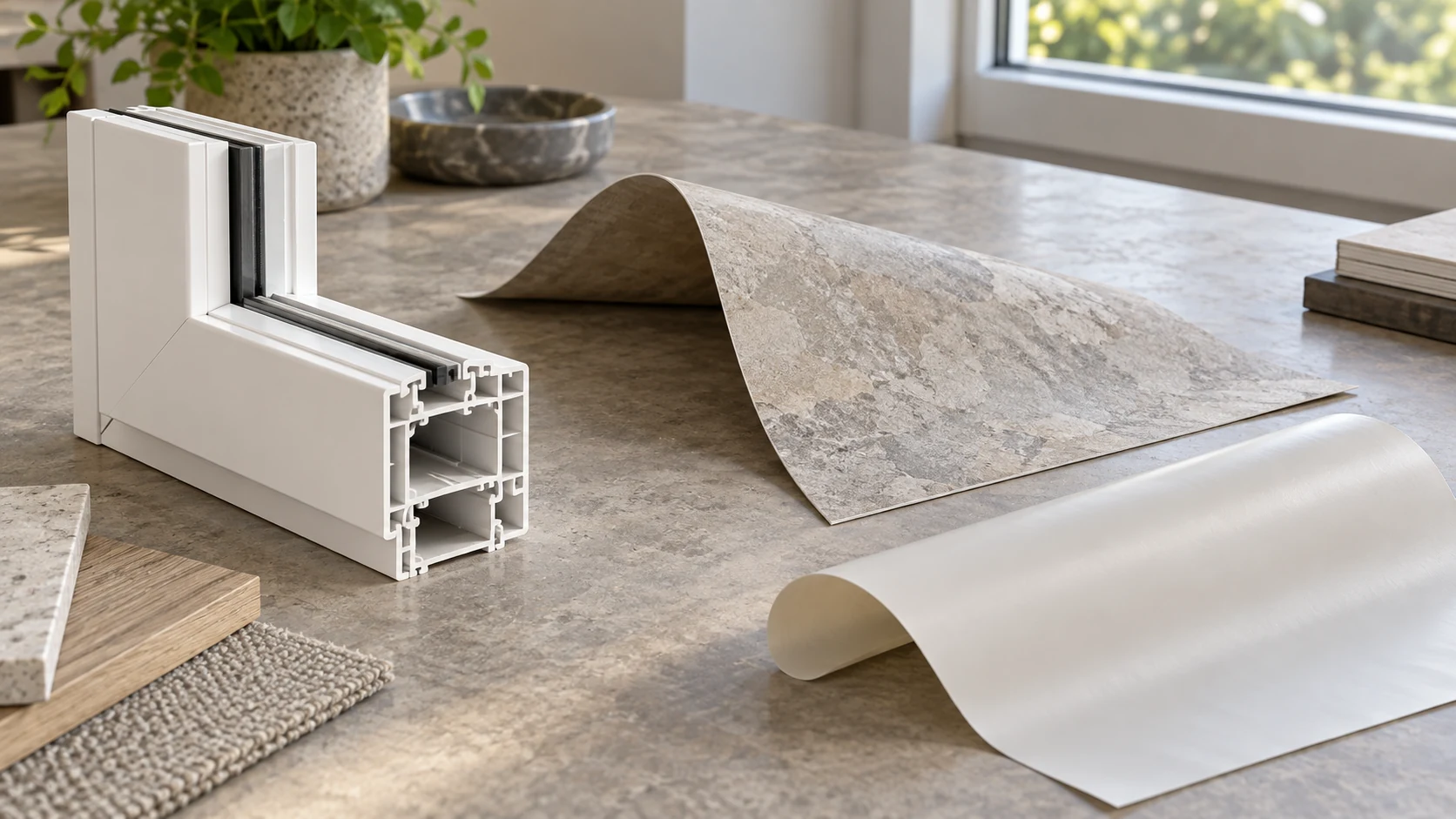
For fences, windows, flooring and wall coverings, PVC vs vinyl usually compares two names for the same plastic: polyvinyl chloride. Vinyl is the everyday name for PVC, and whether it is stiff or soft comes from the formulation: unplasticized PVC is rigid at room temperature, while plasticizers make it flexible. In chemistry, vinyl has a broader meaning, so the material description on a particular product still matters.
Are PVC and Vinyl the Same Thing?
Yes, in building products vinyl almost always means PVC, including vinyl windows and fencing. PVC is the technical abbreviation; calling it vinyl doesn’t create a second, stronger resin.
The Vinyl Institute’s production explanation gives vinyl as the common name for polyvinyl chloride. The European Council of Vinyl Manufacturers calls PVC vinyl too, noting that in Europe the word vinyl is often reserved for flexible uses. So everyday usage and the product’s real formulation tell you more than a dictionary split between two shopping labels.
| Label or term | What it means | Rigid or flexible? | Typical context |
|---|---|---|---|
| PVC | Polyvinyl chloride, a particular polymer | Either, according to formulation | Pipes, profiles, films and many building products |
| Vinyl in building products | Common commercial name for PVC | Either | Windows, siding, fencing, flooring and wall coverings |
| uPVC | Unplasticized PVC | Rigid | Pipes and window profiles |
| Plasticized PVC | PVC formulated with plasticizers | Flexible | Flexible films, cable coverings and upholstery |
| Vinyl in chemistry | A chemical group and related naming terminology | The term alone gives no finished-product stiffness | Monomers and polymer names |
The labels work at different levels. A pipe’s material name tells you its resin family, while a finished window also has glass, fittings and a profile design. A wall covering can pair a plastic face with a different backing.
For a furniture surface, the PET-versus-PVC film comparison compares two genuinely different materials. Comparing PVC with its own nickname would hide the difference you actually want to see.
For PVC film as a furniture face, see how it fits among the materials in the decorative laminate overview.
What Does “Vinyl” Mean in Chemistry?
The vinyl group is CH₂=CH–, also called ethenyl, so the chemical meaning is much broader than the shopping label. The name comes from ethene; calling it an ethane group mixes up two different compounds.
The IUPAC Gold Book’s vinylic-group entry, in its current 2025 online edition, defines that group, and the 2013 IUPAC Blue Book, section P-57.1.6.3, gives vinyl as the retained name for ethenyl. Those are naming rules for chemists, not descriptions of a fence or a window.
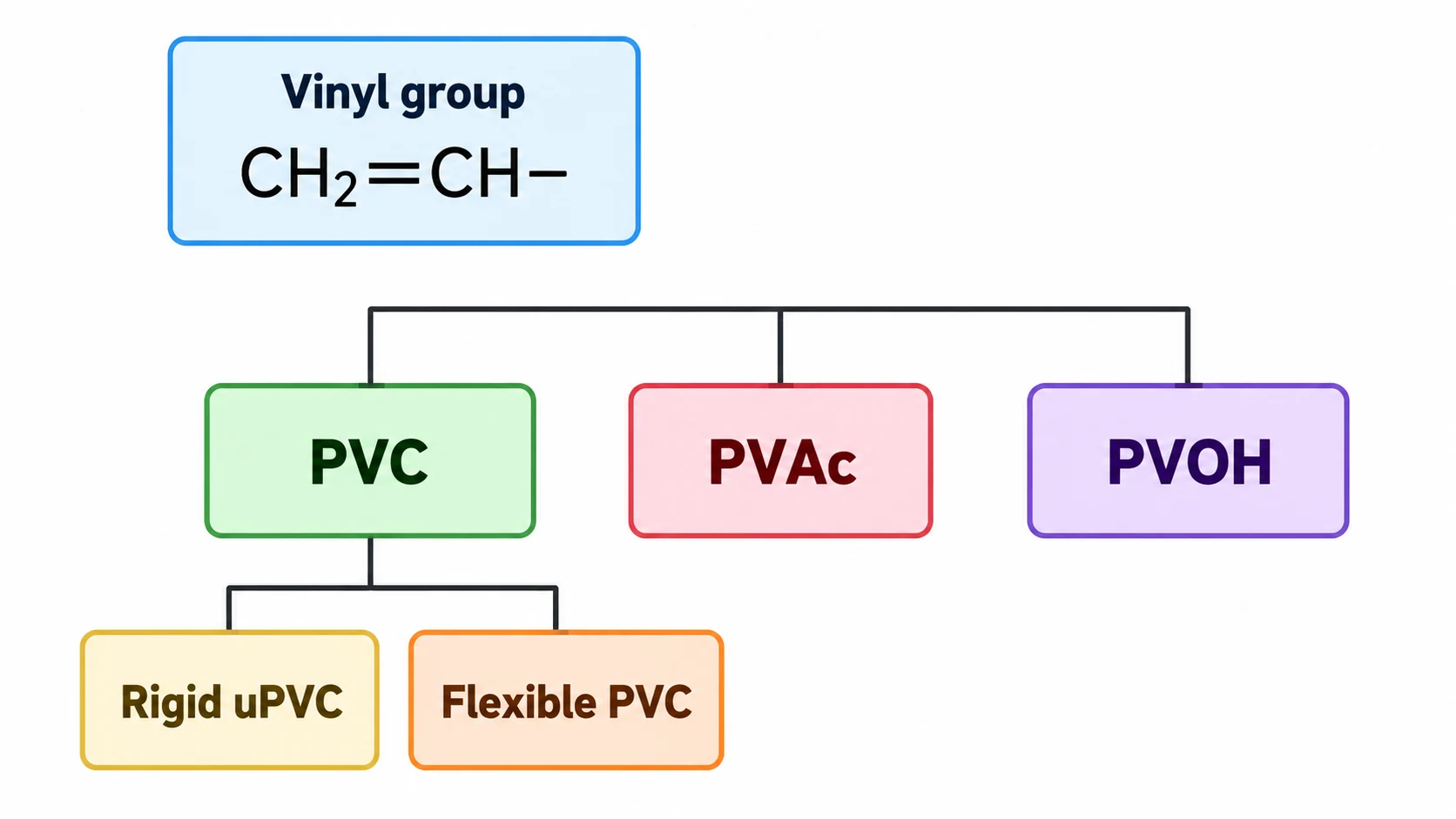
Several polymers carry vinyl in their names. Polyvinyl acetate is the basis of white glue, and polyvinyl alcohol goes into water-soluble films, as the 2023 Echemi explanation and the 2024 BestVinyl discussion both note. A shared name doesn’t make their properties interchangeable with PVC.
That broad chemistry is why “PVC is one of the vinyl polymers” is true while “every vinyl product is PVC” is not. It gives no basis, though, for saying a vinyl fence is a better material than a PVC fence. For that purchase, the resin, construction and documented performance of the actual product are what count.
Why Is Some PVC Rigid and Some Flexible?
Because of plasticizers: PVC is naturally rigid at room temperature, and plasticizers make the same polymer soft and bendable. A flexible PVC film and a rigid PVC profile share a resin family but feel completely different in your hand.
The UK Environment Agency’s March 2024 review separates unplasticized and plasticized PVC, and the ECVM plasticizer explanation describes how additives change flexibility and related properties. Plasticizers change the formulation; they don’t turn PVC into a separate substance called vinyl.
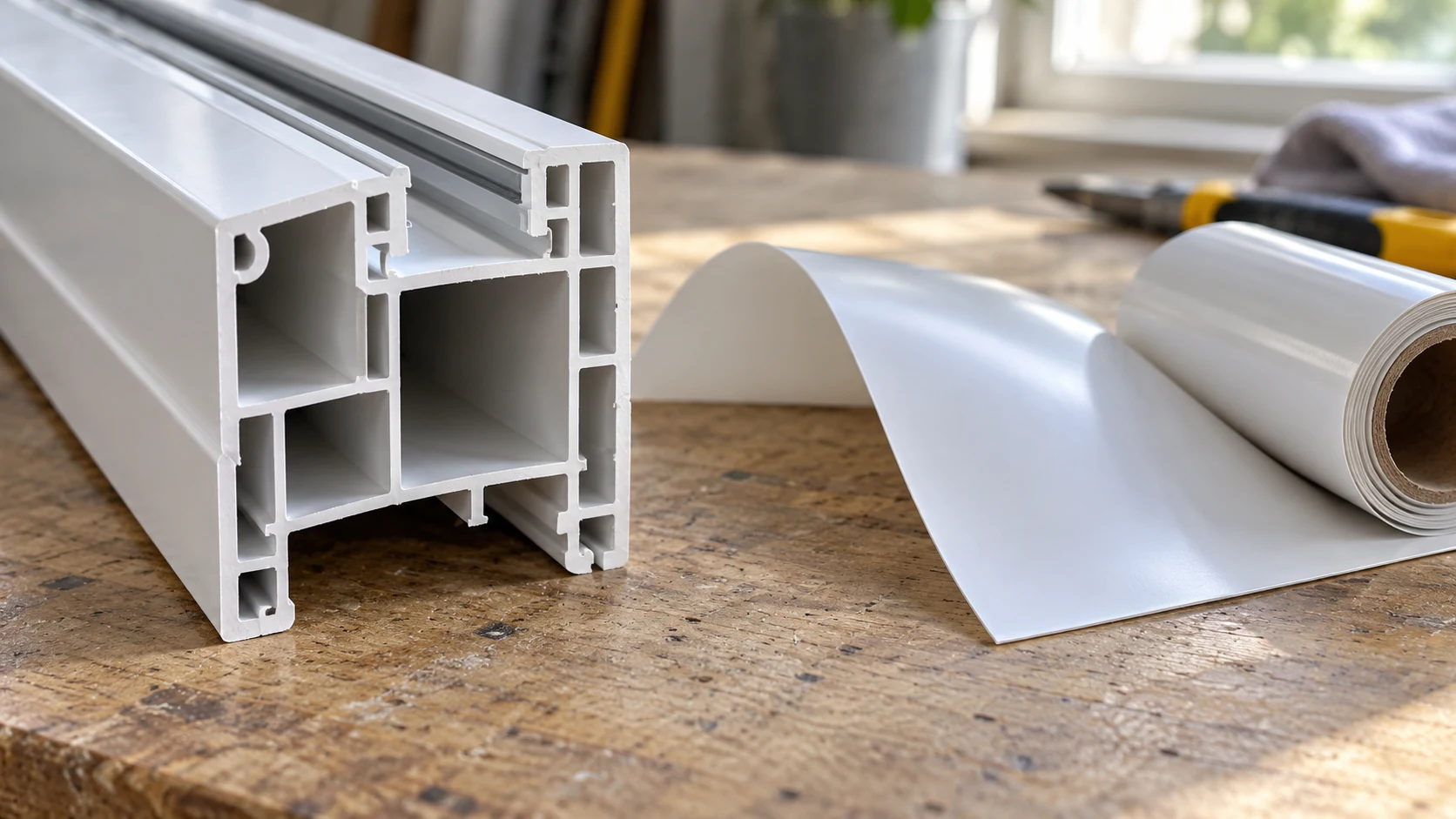
Plasticizer status is only part of the recipe. Resin is combined with additives and modifiers chosen for the job, including stabilizers, pigments and impact or UV modifiers, as the production page linked above describes. So rigid PVC still contains additives; “unplasticized” describes one ingredient, not a pure resin.
Decorative films show the range. The Composite Panel Association’s 2026 Design Portfolio, printed pages 40–41, says flexible two-dimensional laminates are commonly made with plasticized vinyl, and lists polyester, polypropylene and paper-based materials in the same family. Three-dimensional laminates use materials such as PVC or PETG, formed around shaped parts.
For a shaped cabinet front, the thermofoil-versus-laminate comparison explains the finishing route. The face material and forming method answer that question better than the word vinyl does.
What Is uPVC, and Is It Different From Vinyl?
uPVC is unplasticized PVC, the rigid form used in window profiles and pipes, and a window sold as vinyl is usually made from it.
The Vinyl Institute’s April 2025 PVC explanation spells out the abbreviation as unplasticized PVC. Claims on that page about drinking water belong to pipes, so keep them out of a window comparison.
In its window explanation, NewSouth states that vinyl windows are made from PVC and sells them as uPVC vinyl windows. Seeing both words on one product is normal.
Real differences between two windows come from their profiles, glazing and other components; the same page lists glazing and spacer features alongside the material. Those belong to a particular window system, not to whichever name the resin is given.
Interior panels work the same way. A wall-panel material overview helps you identify the surface and the board behind it separately, because the name on the face tells you nothing about the layers underneath.
How Should You Compare “Vinyl” and “PVC” Products?
By the product’s formulation, construction and intended exposure, because the two names usually mean the same base material. Compare like with like, and don’t borrow a benefit from a different PVC product.
Fences
For fencing, compare the profile construction, described formulation, installation requirements and warranty. BestVinyl explains that the fencing trade uses vinyl and PVC interchangeably. A lifespan or wind-speed claim needs the product, construction and test conditions behind it; the label gives you no rating.
Windows
For windows, compare complete systems, including glazing and profile features. The uPVC profile is only part of the window. When a seller uses both words for the same window, a PVC-versus-vinyl label comparison tells you nothing.
Flooring, wall coverings and craft film
For films and coverings, read the stated material and application; not every flexible sheet has the same make-up. Decorative laminate families include PVC, PET, polypropylene and paper. Plasticizer information can be more specific than the word vinyl: the plasticizer page lists options including DINP, DOTP and DINCH, so a statement about one plasticizer says nothing about the rest of the formulation.

| Product decision | Useful information | Why the label alone is incomplete |
|---|---|---|
| Outdoor fence or window | Product construction, exposure requirements and warranty terms | The common resin name does not set a service life |
| Flexible wall covering or upholstery | Face material, additives where declared, backing and care instructions | Flexibility covers several formulations and constructions |
| Furniture decorative film | Material, flat or formed application, surface treatment | Two-dimensional and three-dimensional laminates use different routes |
| A product intended for wet areas | Approved application and installation details | A water-resistant face still belongs to a larger assembly |
For a bathroom or other wet interior, the PVC wall-panel pros and cons cover the finished panel system; a window’s or pipe’s behavior won’t answer that.
What Are the Disadvantages of PVC?
Additives that can be released under some conditions, softening when heated, and harmful products when it burns. Which of these matters depends on the product and where it is used.
The UK Environment Agency review describes additives that are not bound to the polymer and can be released under certain conditions. It is an environmental review of PVC additives in general. Its definition of a thermoplastic, a material that softens when hot and sets on cooling, explains why heat can change PVC’s shape; it gives no single service temperature for all PVC products.
Sun exposure is product-specific too. The ranked articles mention fading and brittleness, while UV modifiers are among the additives used for outdoor products such as siding. For an outdoor fence or window, ask what the formulation and warranty cover; the word vinyl doesn’t prevent weathering.
Burning is the third issue. An archived EPA page on barrel burning says hydrochloric acid is produced when products containing PVC are burned, and its archived guidance on open burning explains how burning chlorine-containing waste can form dioxins. Those are disposal and fire issues, not emissions from a window in normal use. Never burn PVC offcuts in a fire pit or wood stove.
Kitchen cabinet materials face a different set of exposures: cleaning, heat near appliances and moisture at edges. Match the documented surface and construction to those, instead of ranking two names for one plastic.
Where Does a Non-PVC Decorative Film Fit?
Puremorfilm makes decorative film with a silicone functional face, and our wall film contains no PVC. The currently established production backing is PET, so the silicone face and its support layer should be identified separately.
The film uses a No DOP formulation. That statement covers DOP specifically. Our silicone surface is inherently flame-retardant, with higher grades up to UL 94 V-0 available on request for the film.
In the manufacturer’s laboratory tests, coffee, red wine and soy sauce showed no obvious surface change after 24 hours at 25°C followed by wiping. We mainly supply rolls, with film-faced boards also available, using PUR flat lamination for panels.
Our decorative wall film offers a new paint-free finish with a silicone functional surface, distinct from PVC, melamine, PP and PETG decorative faces. For furniture decorative film, start with the actual face, supporting film and application method.
Which Should You Choose: PVC or Vinyl?
Neither: choose between actual products, since vinyl is usually just PVC’s common name. Identify the material first, then compare construction and intended use.
| Label on the product | Likely meaning | Next comparison |
|---|---|---|
| Vinyl fence, window or siding | A PVC-based building product | Construction, exposure and warranty |
| Vinyl flooring, wall covering or upholstery | Commonly a flexible PVC construction | Face, backing, declared composition and care |
| uPVC | Unplasticized PVC | The completed profile or assembly |
| Another polymer named in the material specification | That stated material | Its intended application and documented properties |
| Silicone-faced decorative film | A different functional face on a supporting film | Surface properties and flat-panel application |
Two products with different labels can both be PVC, while two products both called vinyl can need different care and installation. For a furniture or wall finish, bring the intended application, area and preferred color or texture when you contact us.
Frequently Asked Questions
Is PVC considered plastic or vinyl?
Yes, both: PVC is a plastic, and in building products it is commonly called vinyl.
Which is stronger, vinyl or PVC?
Neither name is stronger, because both usually mean PVC. Rigid uPVC is stiffer than flexible plasticized PVC, and the finished product’s construction decides its strength.
What is the downside of vinyl windows?
Warping or fading in extreme heat, according to NewSouth’s window FAQ. Check the specific window’s exposure requirements.
Are vinyl windows made from PVC?
Yes, usually from unplasticized PVC profiles. The window also includes glazing and other components.
Are PVC windows good?
Yes, they are a low-maintenance option when the glazing and features suit the installation. Compare the specific window system and warranty; the resin name gives no energy rating.