
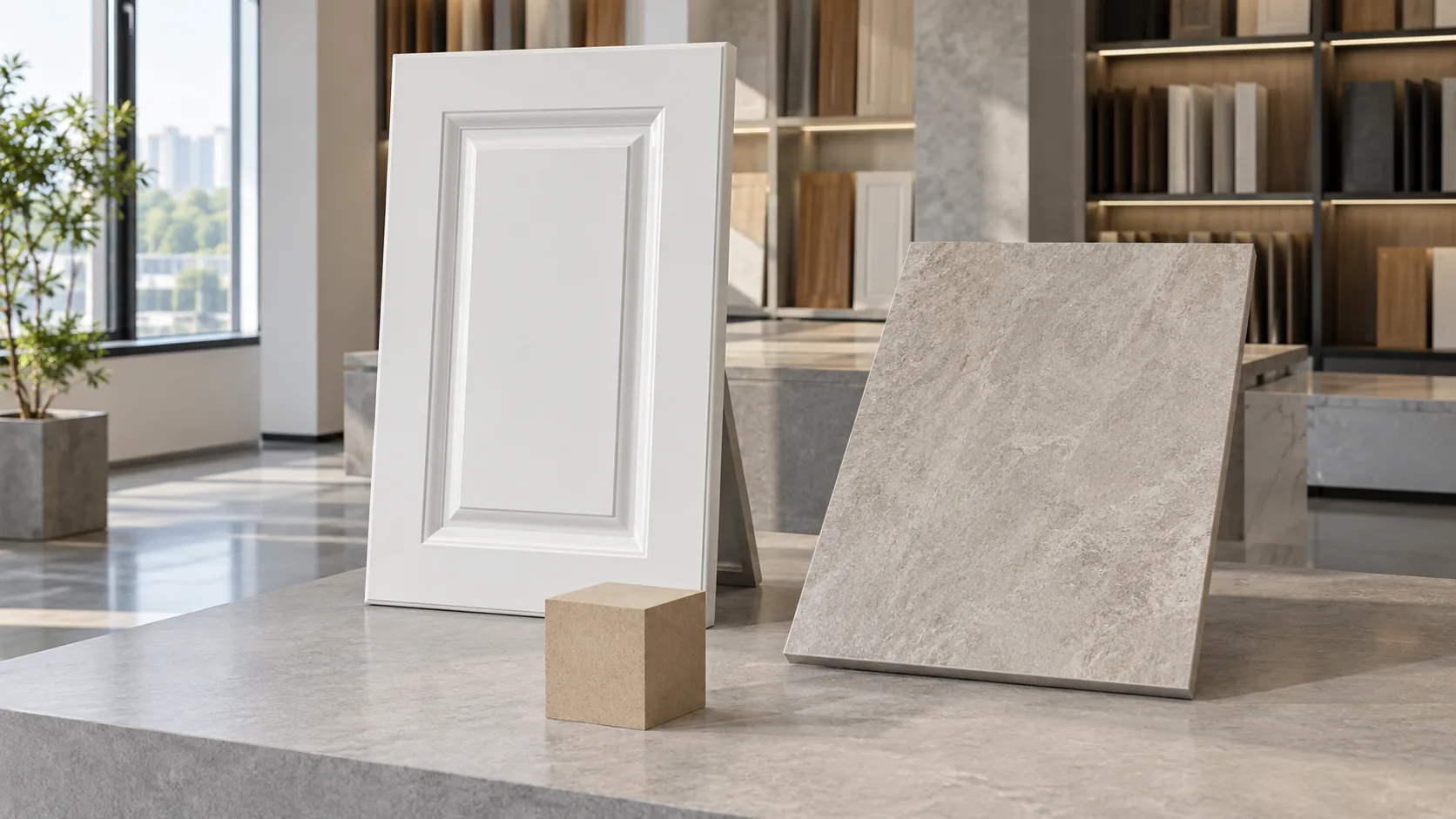
Thermofoil and laminate cabinets can look alike, but they behave differently. Thermofoil is a vinyl (usually PVC) film heated and vacuum-formed over a shaped MDF door, so it gives a seamless painted look on Shaker and routed profiles at a low price; its weak point is heat, which can make the film bubble or peel near ovens, toasters and dishwashers. Laminate, either HPL or melamine/TFL, is a harder resin surface on flat doors with banded edges; it handles heat and scrubbing better but cannot wrap detailed profiles.
In production terms, thermofoil is the better match for routed cabinet doors because a forming-grade film covers the contours and front edges. For flat cabinet doors, choose HPL when you need a separately selected wear-grade face, or melamine/TFL for ready-faced board that avoids a separate lamination step. Match every option to appliance heat and edge exposure.
What do thermofoil, HPL and TFL contain?
Thermofoil is a plastic film formed over a core. HPL is a resin-paper sheet made separately and glued on. TFL is decorative paper fused straight onto a board. All three are faces; the MDF or particleboard behind them is a separate choice.
| Dimension | Thermofoil / 3DL front | HPL-faced front | Melamine / TFL front |
|---|---|---|---|
| Face and core | Thermoformable film, traditionally PVC, formed onto a prepared MDF component | A separate resin-paper sheet bonded to a selected core | Resin-impregnated décor paper fused directly to a board; MFC specifically uses chipboard |
| Routed or recessed door | The direct route when the film and adhesive are approved for the profile | Ordinary sheet lamination does not follow a deeply routed face | Ready-faced sheet does not wrap a newly routed recess |
| Flat slab door | Possible with a suitable film and finished edge/back construction | Suitable; add face/back bonding and trimming | Suitable and already faced; proceed to cutting, drilling and edging |
| Front-edge appearance | A formed wrap can cover front and intended edges without separate edging there; the back still needs detailing | Separate edge treatment, or a suitable postforming grade for a controlled curve | Cut edges need separate edging; the original face does not seal them |
| Heavy rubbing on a flat front | Choose a film coating with relevant scuff results | Start with the required horizontal or high-wear grade | Choose a declared wear grade; a general TFL label supplies no wear class |
| Heat and water at appliances | Heat-sensitive film/bond construction needs the maker’s placement limits; an intact front does not protect open core | A heat-resistant face still leaves bond, edges and core to assess | A cured face still leaves cut edges and core to assess; MFC is not a waterproof door |
| Cost and remaining work | Include core preparation, forming and complete back/edge work | Include core, face/back sheets, adhesive, bonding and trimming | Fewer face-bonding operations at the cabinet shop when ready-faced board is suitable |
The Composite Panel Association’s 3DL description includes PVC and PETG films formed in a vacuum or membrane press. Traditional cabinet thermofoil commonly means PVC film; the wider 3DL category does not make all flat furniture films thermoformable.
HPL is a resin-treated paper sheet made on its own, while TFL is fused directly to the core (TFL description). “Laminate” on a quote can mean either, so ask which.
In UK quotations, MFC means melamine-faced chipboard, not MDF. An official UK board specification guide describes the pre-faced chipboard construction and its separately edged cuts. Choose MFC for a flat, edged front when that board grade fits; choose a validated foil-wrapped MDF route for a routed recess or wrapped front edge. Those terms describe different faces, cores and processes.
Our melamine and laminate comparison covers the TFL/HPL split. The laminated MDF guide explains why the decor and the board need separate names on a finished panel.
For the other face materials used on furniture panels, see the decorative laminate overview.
Thermofoil vs laminate vs melamine cabinets: quick comparison
Thermofoil, HPL laminate and melamine are the three common factory faces for kitchen cabinets. Thermofoil gives a seamless painted look on shaped doors but is the most heat-sensitive; HPL is the toughest flat surface and costs the most; melamine is the lowest-cost flat option and the usual choice for cabinet boxes.
| What you care about | Thermofoil (foil-wrapped MDF) | HPL laminate | Melamine (TFL / MFC) |
|---|---|---|---|
| Door styles | Shaker, routed and curved-edge doors in one seamless wrap | Flat slab; postforming grades can wrap one rounded edge | Flat slab with separate edge banding |
| Heat | Most sensitive: can bubble or peel near ovens, toasters and dishwasher steam | Good | Fair; edges and banding are the weak point |
| Scratches and wear | Softer vinyl face | Best of the three | Good for everyday use |
| Chips and knocks | Resists edge chipping, can dent | Good | Corners and edges chip more easily |
| Repair | Peeling film usually means a new door | Small chips can be filled | Small chips can be filled; damaged doors replaced |
| Relative price | Low to mid for shaped doors | Highest | Lowest |
| Best use | Painted-look doors away from strong heat | Hard-working doors and worktops | Cabinet boxes, shelves, budget flat doors |
Which faces suit routed profiles and flat doors?
Thermofoil for a routed or raised-profile door; HPL or TFL for a flat slab. A postforming HPL grade can handle a rounded edge, but a deeply routed door face needs a forming process.
Films in the 3DL category guidance run 10–16 mil, or 0.254–0.4064 mm. That is a typical range, and it shows how much thinner a formable film is than a laminate sheet.
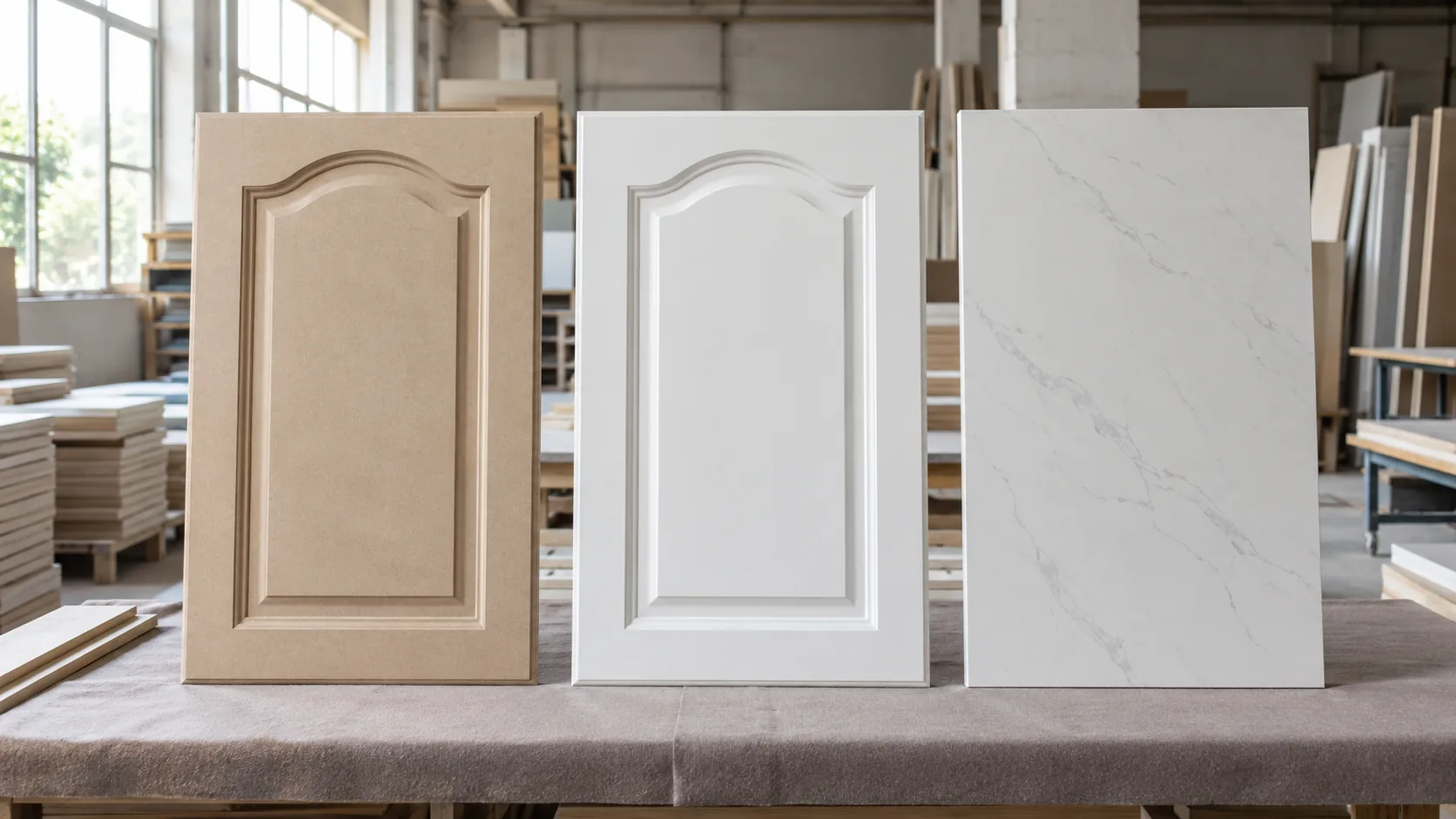
General-purpose HPL is typically 0.71–1.22 mm thick (HPL guidance). That figure covers the sheet alone; the finished door is thicker. Compact laminate and other special grades are built differently.
Routed recesses, outside corners and edge returns all shape how the film forms. The door also has a back and areas the wrap doesn’t reach. Look at those before assuming the film seals the whole door.
Flat panels need their own edge finish after cutting. The MDF cutting guide covers getting the core to size; the face and edges come after.
Compare texture, gloss and the finished edge on actual samples in the same decor direction. For a paint-like look, place a solid-color sample beside the painted finish you want. Look along the face in the room’s light, then inspect the wrapped edge or separate edging.
How should heat, water and daily wear affect the choice?
At an oven or dishwasher, choose the complete door only after its clearance and shielding requirements fit the layout. At a sink, protect edges and joints from water entry. For daily rubbing, select the declared HPL/TFL wear grade or the film coating’s documented scuff performance.
One US cabinet maker’s 2021 cabinet-series product guide, printed page 14, warns that extended exposure above 160°F (about 71.1°C) can permanently damage its thermofoil, and recommends heat deflectors. That figure is for that product line under long exposure; don’t treat it as a universal limit or a repair setting.
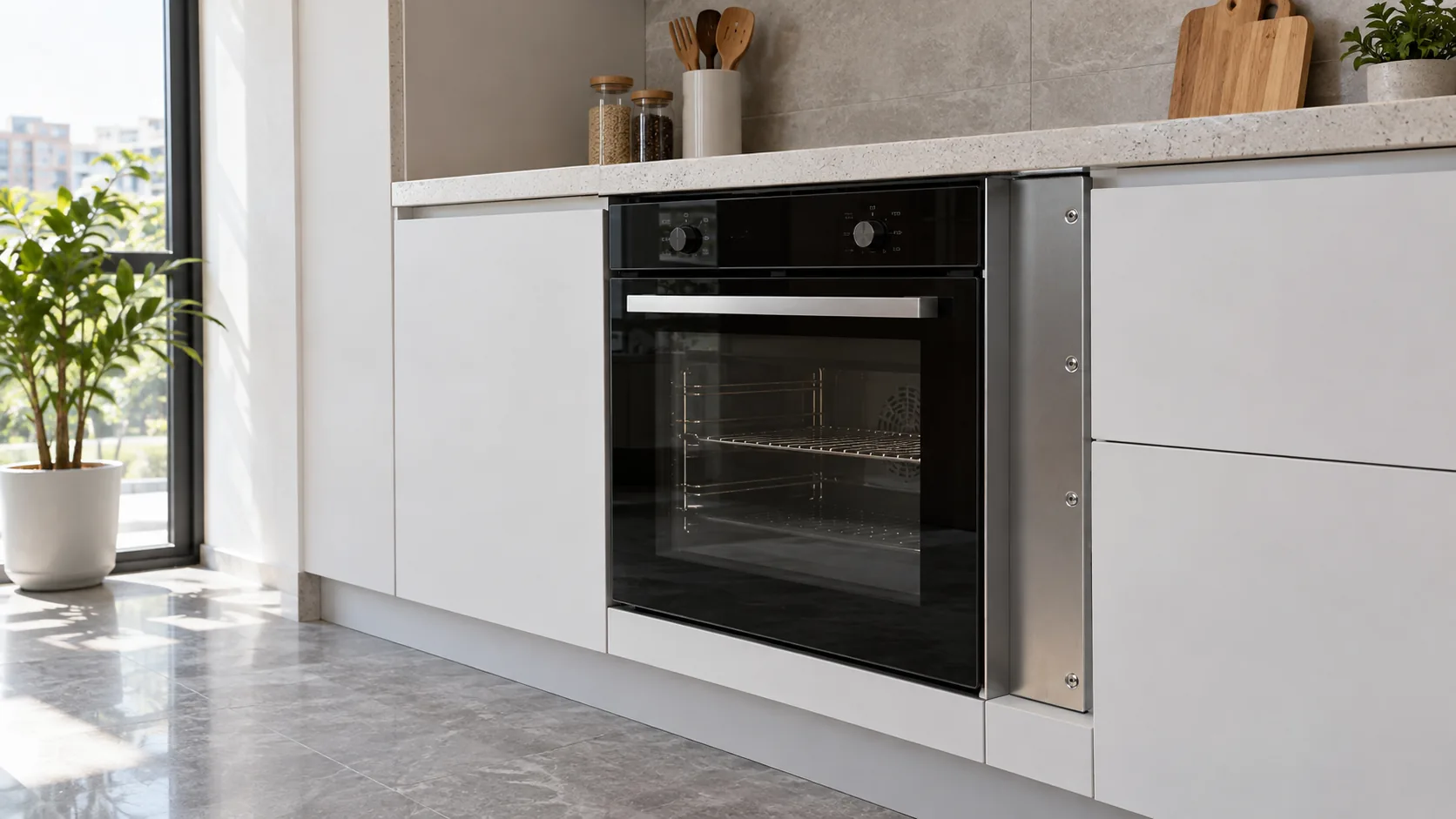
An oven vent, a dishwasher’s steam release and a toaster on the counter each heat a different spot. Look at the real layout. Moving a steam outlet or stopping hot air from getting trapped fixes the cause; a new front in the same spot would just peel again.
At a sink, the bottom edge, pipe cutouts and joints let water into a wood-based core. The front can look perfect while a cut edge swells. The MDF moisture guide explains core grades and direct wetting.
For heavy rubbing on flat fronts, look at high-wear HPL or a TFL panel with a declared wear class. For routed fronts, check the scuff results of the film’s own coating. Scuff and chemical resistance in 3DL depend on the 3DL coating, and special high-wear grades exist in the HPL grade guidance, so you are choosing between grades, not between two categories.
CPA 5-25 Table 1 puts TFL Class 3 at WP >150 in its modified wear test, an endpoint for wear-through. Scratch and impact use separate methods, so compare reports that used the same one.
When is repair practical, and when is replacement preferable?
Repair a small loose spot only when the film is intact and the core is dry, firm and still square. Replace or reface when the wrap has shrunk or torn, the lifting is widespread or the core has swollen.
Look at the failure first. Loose film over a sound edge, film cracked at a profile and a softened core are three different faults. Note where it is, how far the lifting runs and whether the core or a hinge seat has changed shape.
Rebonding needs a repair system matched to the film and the existing bond. The heat warning above gives you no glue temperature or pressing time. A hair dryer and household glue on an unknown door can leave the real cause in place and mark the finish.
An intact, sound PVC/vinyl or glossy laminate front can be repainted with a primer made for that surface and a compatible topcoat. One US bonding-primer data sheet, SXA-110 US111225, lists PVC/vinyl and covers glossy-surface prep. It asks for a clean, dry, sound base, deglossing on glossy laminate, and an adhesion test on doubtful plastics. At 77°F/25°C and 50% RH, it allows 3–4 hours before a quality latex or oil topcoat and 24 hours before a two-component topcoat.
On a film you can’t identify, test adhesion before you paint over it. Paint on loose film just hides the failure underneath. That primer also excludes polyethylene and polypropylene, so its PVC listing doesn’t cover every film.
Our peeling thermofoil guide covers the repair-or-replace decision; the MDF finishing guide covers painting bare MDF.
How should maintenance differ between cabinet surfaces?
Use the mild, nonabrasive routine meant for that surface, and keep stronger stain removers to the finishes they are approved for. For everyday grime on thermofoil, a soft damp cloth with mild dish soap, then rinse off the residue and dry.
The October 2022 cabinet care guide gives separate instructions for thermofoil, acrylic/gloss and melamine. Thermofoil gets mild dish soap and a nonabrasive cloth or sponge. Acrylic should never be wiped dry, and melamine has its own list of chemicals to avoid.
Edges and handles are where the difference shows. A solvent that is fine on one bare face can attack another finish or soften an edge seam. Match any cleaning permission to the actual face, not to everything called laminate.
If you hand a kitchen over to a client, list the finish each instruction covers and when to stop. Peeling, swelling or a gloss change after cleaning means stop and assess. Our laminate cabinet cleaning guide gives the routine and how to tell damage from dirt.
Keep the care sheet with the finish record. If a replacement door has a different face or gloss, update the instructions so nobody uses the old cleaner on the new door.
How do you compare door costs and supply scope?
Compare finished-door quotes on the same drawing, look, conditions and included work. Forming film, bonding a sheet and machining ready-faced board each put a different amount of labor into the price.
| Route | Operations to include in the quotation | Scope to make visible |
|---|---|---|
| Formed film front | Core preparation, forming/bonding, back and edge completion | Profile geometry and delivered front construction |
| HPL-faced front | Core, front/back sheets, adhesive, bonding and trimming | Bonded panel versus completed drilled door |
| TFL front | Faced panel, cutting, drilling and edge treatment | Supplied sheet versus finished component |
| Repair or refacing | Removal, substrate work, new face, hardware and installation | Retained cabinet parts and replaced parts |

Include cutting yield, handling, rejects and installation where they apply, then divide the batch cost by the accepted quantity. A price gap then points to a real material or step.
| Item | What to specify | Why it matters |
|---|---|---|
| Surface | Film, HPL or TFL identity, grade, decor and gloss | Identifies the offered finish |
| Component | Current geometry, thickness, routed details and holes | Defines the finished front |
| Assembly | Core, bond, back, edges and hardware | Describes the complete construction |
| Service | Appliance placement, moisture and cleaning conditions | Establishes the intended exposure |
| Evidence | Relevant test method, reported result and system covered | Connects a claim to an actual tested object |
| Supply | Included processing, installation and replacement provisions | Allows comparable commercial scope |
The standard’s scope covers interior TFL panels and excludes flooring. A report under it covers that TFL panel only.
For lifespan, read the warranty, care conditions and service claim together with where the doors will go. The care guide ties its warranty to climate, storage and installation conditions. A door beside a self-cleaning oven and one in a laundry room will age differently under the same warranty term.
Thermofoil vs melamine doors (foil-wrapped MDF vs MFC): which is better?
In the UK the same choice is usually described as foil-wrapped (vinyl-wrapped) MDF doors versus MFC, melamine-faced chipboard. The trade-off is the same: foil-wrapped MDF gives shaped, painted-look doors with no edge seams; MFC gives cheaper, tougher-faced flat doors with banded edges.
Choose thermofoil if you want a painted-look Shaker or routed door at a modest price and the doors are away from strong heat. Choose melamine if you want flat slab doors, a woodgrain or textured look, and a face that copes better with heat and cleaning. Both sit on an MDF or particleboard core, so moisture at cut edges and hinge holes matters for either.
Next to an oven or a self-cleaning range, use a heat shield or choose a heat-tolerant laminate door for the panels closest to the appliance. If thermofoil doors are already peeling, see what causes thermofoil peeling and how to fix it.
Where does silicone decorative film fit?
Our silicone decorative film is an option for flat slab fronts and panels; a routed MDF front that needs vacuum forming requires a different film route.
Puremorfilm manufactures silicone decorative film in China with a silicone functional face on PET support. Rolls have no self-adhesive backing and are laminated flat to board with PUR adhesive. We also supply silicone laminated panels quoted per project. Use the material for furniture fronts, cabinet doors and wall panels on vertical or low-wear faces, excluding floors, all countertops, cooktops, shower floors and other walked-on areas.
For thermal movement, SGS report SZIN2608002405PL01 recorded length change of 0.06% and width change of 0.10% after the submitted film sample spent 600 minutes at 100°C and recovered at room temperature for 14 hours. This is a film-sample dimensional-stability result; it sets no oven clearance, maximum service temperature or rating for the adhesive and complete door.
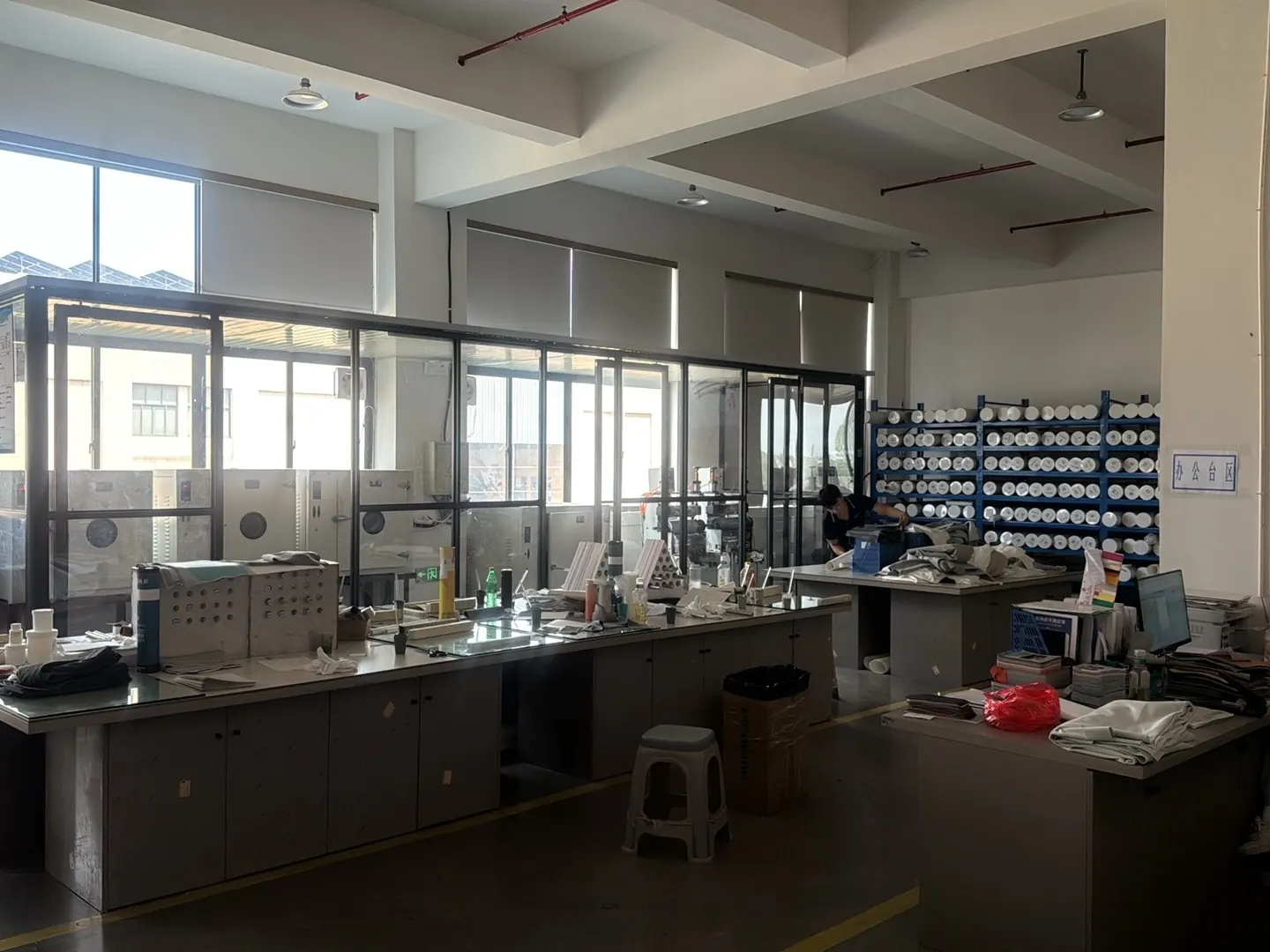
Furniture and wall film rolls start at 500 m per pattern. Panels are 1220 × 2440 mm with a minimum of 200 sheets per pattern, quoted per project. A sample evaluation should use your actual board, PUR bond, back and edge construction.
Learn more about silicone decorative film and its flat-panel supply options. Bring your part drawing and service conditions to a sample discussion.
Which route should you choose for the finished door?
Choose a validated thermofoil route for a routed front; choose HPL or melamine/TFL for a flat front when its grade and edge construction fit the use. For UK quotes, MFC is the chipboard-core TFL option. All routes still need the actual maker’s appliance-clearance and care instructions.
- For repeat door sizes, compare the delivered scope with what your own line can finish.
- Separate setup and fitting from the per-door price on a small replacement order.
- For a different flat furniture face, weigh the extra bonding step and supply form against your current line.
For a flat silicone-faced slab front, contact Puremorfilm with the drawing, core and appliance layout. We can discuss film rolls for PUR flat lamination or laminated panels quoted per project; a routed front that needs forming remains a different route.
Frequently Asked Questions
Can thermofoil cover routed MDF doors in a production batch?
Yes. A validated 3D film and adhesive system can cover the approved routed geometry in a vacuum or membrane press. The tightest recess, outside corner and back-edge detail must be included in the production approval.
Is MFC the same as foil-wrapped MDF?
No. MFC means melamine-faced chipboard: a melamine-paper face on a chipboard core. Foil-wrapped MDF uses a thermoplastic film on MDF and can cover suitable routed profiles; MFC is a flat-panel route with separately finished cut edges.
What are the downsides of thermofoil cabinets?
Heat-related lifting, damage at an edge or water entering the core can force refacing or replacement. The applicable heat limit comes from the actual door maker; a warning for one product line is not a universal PVC limit.
How long do thermofoil cabinets last?
There is no guaranteed lifespan for all thermofoil cabinets. Appliance heat, steam, moisture at open edges, installation and care affect the bond and core. Read the actual warranty and its exclusions, then inspect any lifting film or core swelling.
Can you replace just the thermofoil doors?
Yes. If the cabinet boxes are sound, replacement doors can be made to fit the existing openings. Record each door size, hinge pattern and overlay, and compare the replacement finish as a complete door construction.
How can you tell if cabinets are thermofoil or laminate?
Look at the door edges and the back. Thermofoil wraps the front face and edges in one continuous film with no seam on the front edge, and the back is often a different, plain finish. Laminate doors have a flat face with a visible edge band on the sides. Peeling or bubbling near appliances is a strong sign of thermofoil.