

Choose bathroom vanity cabinet materials by the part: the box, door face and top are often different materials. In a daily-use bathroom, start with moisture grade, finished edges and surface care; in a guest bath, appearance can lead. Resolve persistent wetting before choosing a construction for that exposure.
Which bathroom vanity cabinet material should you choose?
Choose solid wood for genuine grain and a construction that allows moisture movement; choose finished board-based furniture for a smooth painted or faced appearance. For particleboard, MDF and plywood, the declared grade and completed edges matter. A PVC-body model adds another construction option, with its own finish and care.
For a guest bathroom used mainly for handwashing, choose the appearance and care routine you prefer, then identify the box behind the painted or wood-grain front.
With daily use, compare the complete cabinet around the basin, including door bottoms, sides, the storage base and connections to the top.
For persistent wetting, prioritize a complete construction with stated limits for the intended exposure.
| Item | What it actually is | What to specify | What to watch |
|---|---|---|---|
| Solid wood | Wood retaining its natural grain | Species and frame or panel construction | Movement with moisture and grain direction |
| Plywood | A faced panel with a specified core construction | Core construction and plywood bond-line Type | Finished edges, openings and intended use |
| MDF | A wood-fiber core beneath its finish | Named moisture-resistant grade | Sealing of faces and exposed edges |
| Particleboard / MFC | Wood-particle core; MFC has a melamine face | The board grade beneath the face | Humid-use category and completed cut edges |
| PVC cabinet body | Plastic construction with a model-specific finish | The actual cabinet and component specification | Paint, hardware, top and care instructions |
Solid wood exchanges moisture with the room and moves differently along and across its grain. Coatings slow that exchange without stopping it, as explained in the 2021 USDA Wood Handbook. The MDF and solid-wood comparison covers the underlying furniture trade-offs.
How do the cabinet box, door face and countertop differ?
The box holds the storage space and supports the cabinet’s contents; the door face supplies the visible finish; the countertop and basin handle a different set of contacts. A vanity can combine these materials successfully. Its product description should identify each component clearly enough for you to choose and care for it.
A label such as “oak vanity” may describe the visible finish. Real wood veneer is a thin wood surface over another construction, while solid wood retains wood through the part. The wood veneer and solid-wood guide explains that difference before you pay for a particular look.
Even “hardwood plywood” needs a closer description. The 2024 hardwood and decorative plywood standard includes veneer, lumber, particleboard, MDF and combination cores. Species, core and final construction affect the supplied panel’s properties.
An actual mixed-material example is NAGA’s Armonia-900 specification: PVC cabinet construction, a two-pack painted finish and a separate ceramic top. The painting is a surface choice; the ceramic top is another component.
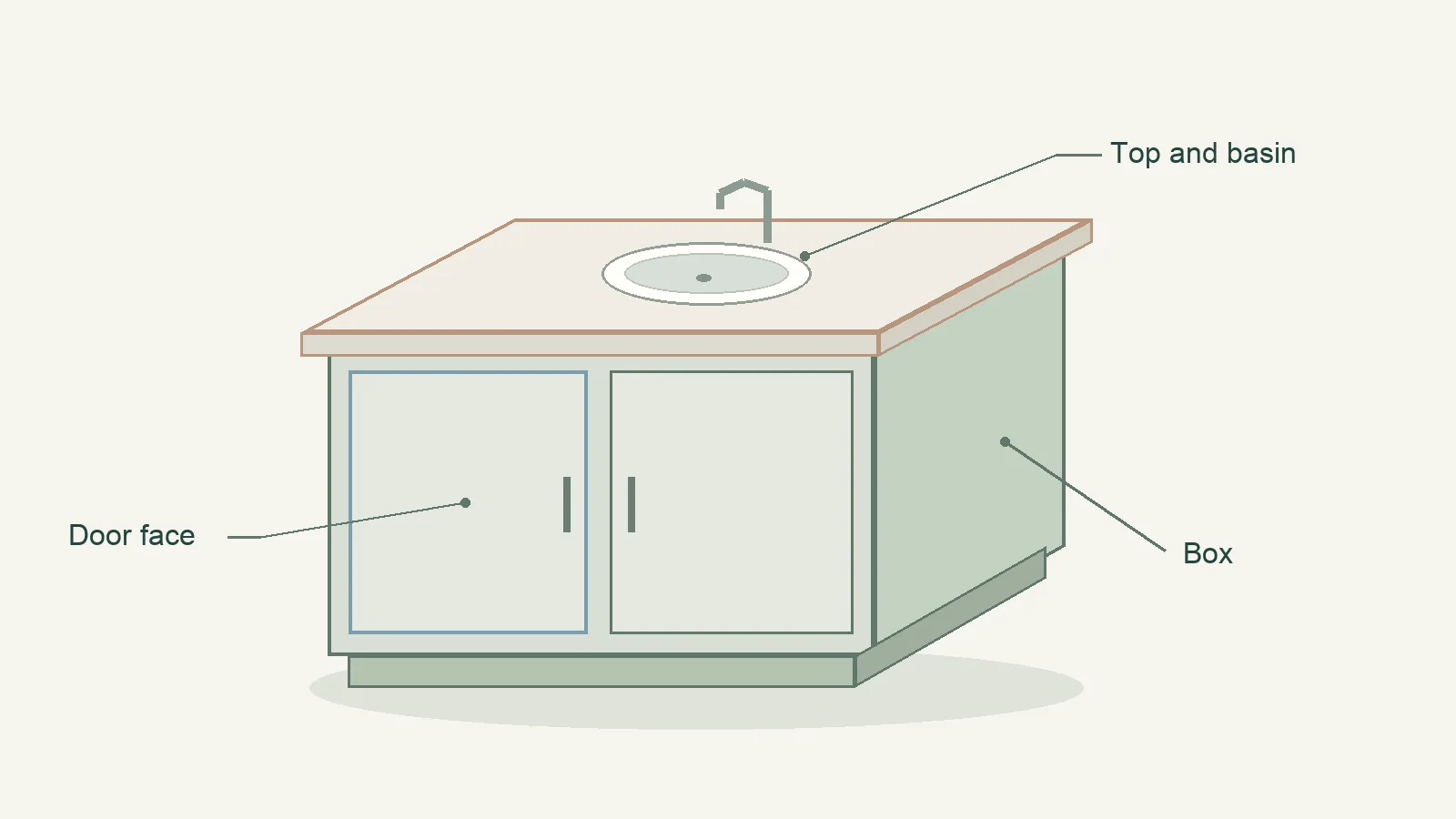
What do moisture-resistant grade labels actually prove?
Moisture labels describe a particular board or glue bond. P3 and P5 distinguish humid-use particleboard categories; plywood Type I and Type II distinguish bond lines. For a bathroom vanity, match the label to the component, then assess its finished faces, edges and openings against the intended exposure.
Kronospan lists both P3 particleboard and P5 particleboard among its bathroom-furniture applications. Their load-bearing categories differ. The category describes the board; the cabinet design determines which one is needed.
| Label | Object it describes | What it does not prove |
|---|---|---|
| EN 312 P3 | Non-load-bearing particleboard for humid conditions | A restriction against all furniture use, or a waterproof cabinet |
| EN 312 P5 | Load-bearing particleboard for humid conditions | That every vanity requires P5 or that any load is acceptable |
| HP-1 Type I | Exterior bond line, termed “fully waterproof” in Table 9b | Waterproof edges, coating, openings or a complete vanity |
| HP-1 Type II | Interior, water-resistant bond line | Continuous wet-service suitability of the finished cabinet |
| MEDITE MR | A named humid-interior MDF product | Waterproofing or a performance grade supplied by green dye |
Keep the plywood bond-line Type with the offered core and finish when comparing cabinet specifications.
MEDITE MR requires full sealing and coating in humid interiors; its green dye identifies the product. The MDF moisture guide covers that limitation. For the underlying fiber-versus-particle construction, see MDF and particle board.
Where can water reach edges and plumbing openings?
Water can reach the cabinet at the door bottom, back, exposed edges, pipe openings and box bottom, even when the visible face looks intact. Inspect those locations in the finished component. Site-cut holes need the selected board and finish’s required treatment after cutting, before the cabinet is closed in.
Look inside the basin cabinet with the doors open. Follow the waste and supply connections down toward the bottom panel. Check what lies beneath them and whether the back opening has exposed core. A front sample will show little of this route.
The European Panel Federation’s bathroom guidance calls for moisture-resisting finishing on exposed surfaces and edges. The laminated MDF guide covers face/core construction; MDF and plywood explains core choices.
Liquid water can change wood moisture quickly. Treat a dripping connection as a water problem to repair, then examine the exposed cabinet construction.
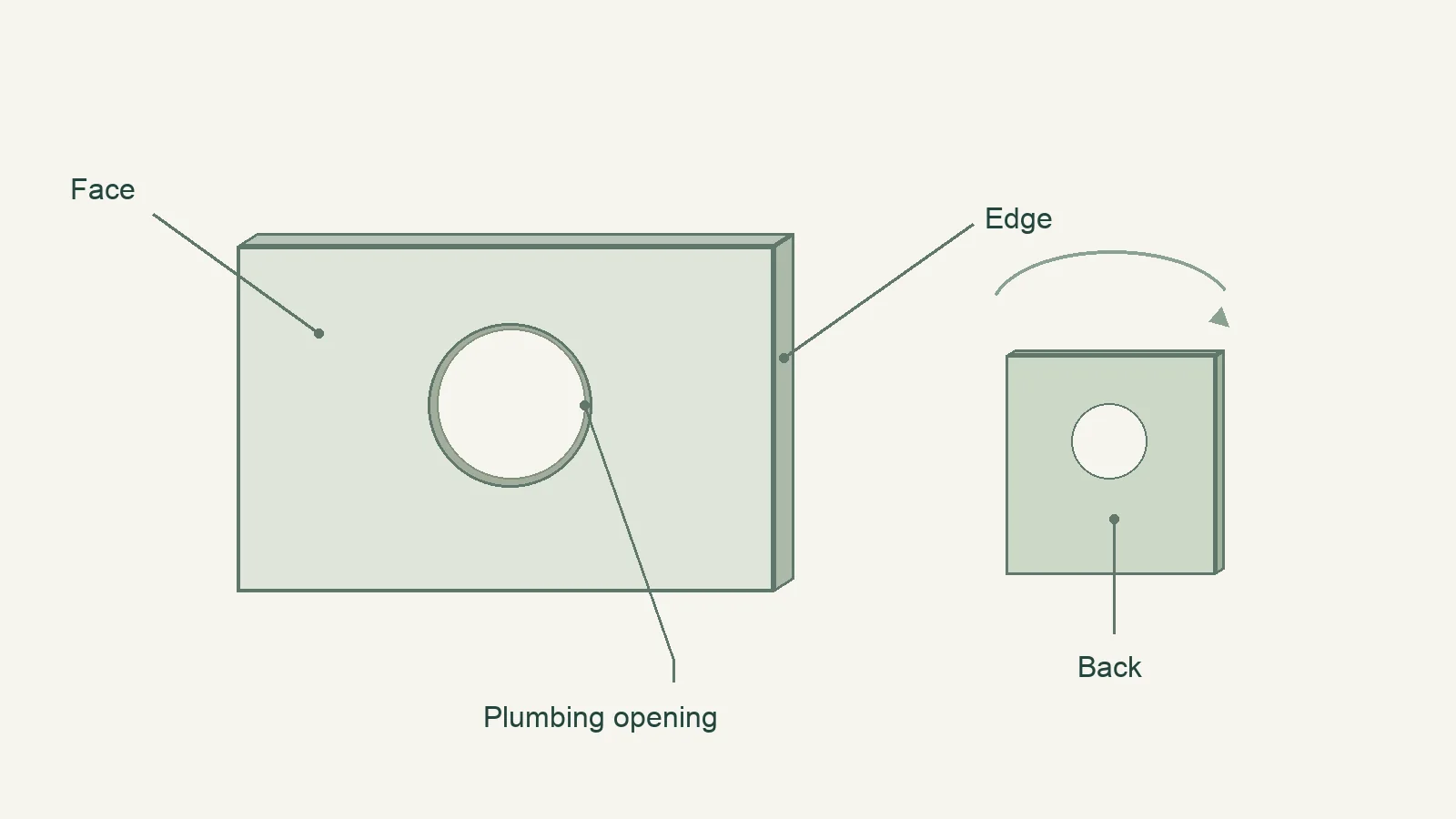
Will one cleaning routine suit every vanity surface?
No. The furniture finish, basin, top, mirror and hardware can permit different cleaners and cloths. A cleaner allowed on the basin may damage an adjacent painted door. Choose a vanity whose component care instructions fit your routine, and record where each cleaner can be used before cleaning across neighboring surfaces.
Tiger’s furniture guidance allows a soft damp cloth and mild cleaner for its furniture, excluding abrasives, chlorine and ammonia. Its wash-basin and mirror instructions are separate.
Harvey George’s care guide excludes solvent cleaners and abrasives from painted furniture. It treats stone and composite tops separately, with a suitable gentle cleaner and prompt removal of hair-dye or nail-product spills. Those are component-specific instructions.
We recommend completing this cleaning-permission card for the actual vanity. Write the planned product into the relevant row; a general description such as “bathroom cleaner” leaves its permitted use unclear.
| Component | Exposed face | Daily residue | Planned cloth and cleaner | Does the maker allow it? | Drying | Missing info |
|---|---|---|---|---|---|---|
| Doors and drawer fronts | Supplied paint, veneer or other finish | Water, soap or toothpaste splashes | Name the cloth and cleaner | Match the furniture care sheet | Record the required drying | Exact face and cleaner compatibility |
| Basin | Supplied ceramic or other basin material | Soap and water marks | Name the basin cleaner | Match the basin’s instructions | Include surrounding joints | Cleaner contact with adjacent furniture |
| Countertop | Supplied stone, composite or other top | Water, cosmetics or occasional spills | Name the top cleaner | Match the top’s care sheet | Record spill removal and drying | Treatment of the basin-to-top joint |
| Mirror and hardware | Mirror edges and supplied metal finish | Condensation and handled-surface residue | Identify each cleaning method | Check each finish separately | Include mirror edges | Overspray, runoff and coated hardware |
A PVC body also comes with finished surfaces to maintain. The Armonia model’s care sheet still calls for a soft damp cloth, avoiding abrasives and wiping spills promptly.
For a shared bathroom, think through the actual sequence: cleaning the basin, wiping the top, then touching the drawer front. If a cloth carries the basin cleaner onto the furniture, permission for the first surface has not answered the question for the second. Keep those steps separate where the care sheets require it.
Which parts can you inspect and replace after damage?
Door and drawer fronts are usually accessible for inspection; the box bottom and rear plumbing openings may become difficult to reach after fitting. Replacement depends on how each part is attached. For a bathroom vanity, prioritize visible water routes, access to the trap and a clear removal route for the damaged component.
Inspect the supplied pieces before fitting. Tiger instructs buyers to examine every part and avoid mounting damaged items. The model supplier’s warranty document separates cabinets, tops and hardware, and addresses damage found before installation. Record whether the work would concern the cabinet, top or hardware.
We recommend using the following card with the cabinet open. The removal and access entries should describe the actual model’s construction.
| Part | Who finishes it and when? | Water route | Visible after installation? | Replaceable on its own? | Open items |
|---|---|---|---|---|---|
| Door or drawer front | Factory finish; later alterations identified | Splashes and runoff at the lower edge | Usually visible front and back when opened | Record the hardware and removal route | Matching replacement face availability |
| Box bottom | Factory finish; site work identified | Water below supply or waste connections | Top face accessible; underside may be concealed | Fixed construction may require wider disassembly | Access to its edges and underside |
| Back panel at plumbing | Factory opening or site-cut opening | Pipe entry and concealed joints | Often partly hidden by pipes or drawers | Record how the panel and pipes restrict removal | Finished cut edges and service access |
| Top and basin | Supplied separately or as an assembly | Basin perimeter, joints and spilled water | Top visible; connections beneath may be hidden | Record whether top and basin separate | Sealing and access during removal |
| Hardware | Supplied finish and later fitting identified | Wet hands, condensation or runoff | Hinges visible; some runners concealed | Record the matching fitting and access | Clearance to remove drawers or fittings |
A front that detaches from its hinges and a bottom fixed into the cabinet need different replacement plans. For the fixed bottom, establish whether a damaged panel can be reached while the top, basin and plumbing remain in place. A new door alone would leave that bottom untouched.
Before buying, open the drawers and see what obscures the waste connection. Between otherwise suitable vanities, a layout that leaves the connection inspectable is easier to assess after a spill. The completed card should make the route visible before the unit is installed against the wall.
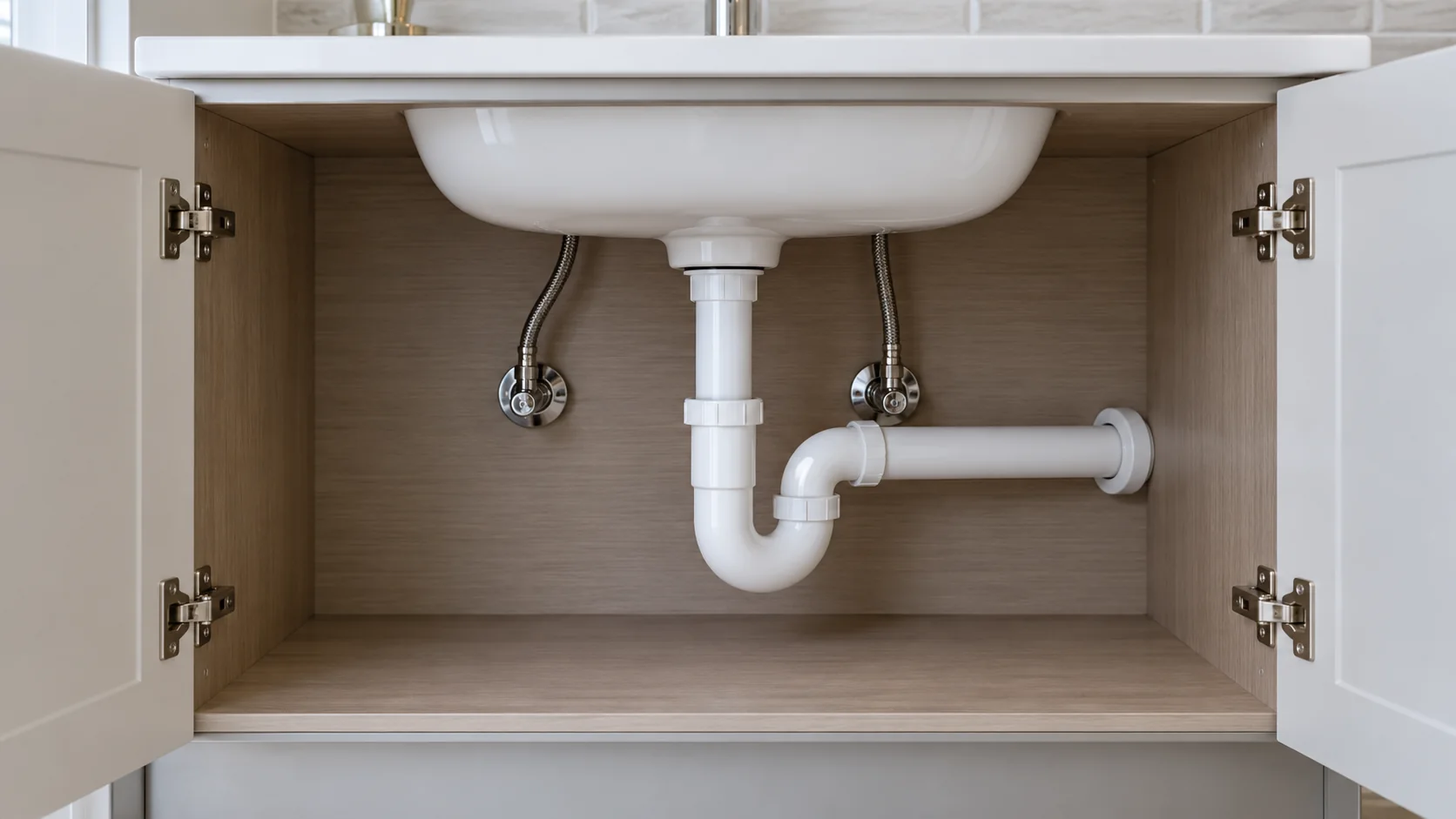
Where does a silicone face fit on vanity doors?
Puremorfilm makes decorative film with a silicone functional surface for flat furniture panels and cabinet-door faces. Our paint-free material with a silicone functional face, distinct from PVC, melamine, PP and PETG decorative faces, offers another finish for the exposed door surface; see our furniture decorative film.
The PVC-free film uses a No DOP formulation. The silicone surface is inherently flame-retardant, with higher grades up to UL 94 V-0 available on request. In the manufacturer’s laboratory tests, coffee, red wine and soy sauce left at 25°C for 24 hours wiped off with no obvious change.
We mainly supply rolls for PUR flat lamination, without back adhesive as standard; back adhesive is available on request. Film MOQ is 500 linear metres. Laminated panels are available on request in 1220 × 2440 mm, MOQ 200 panels. Samples are free.
The selected cabinet construction governs the core, hardware, edges, openings, basin and top; a PVC body remains PVC. With its leather-like feel and some elasticity, the film is unsuitable for floors, stovetop counters, shower floors and walked-on areas.

What should you approve before ordering the vanity?
Approve bathroom vanity cabinet materials as finished components with a workable cleaning routine and access to the plumbing. Start with the room’s use, settle the supplied construction, then complete the cleaning and replacement cards. Compare complete vanities on the same scope so a different top or fitting does not disguise the decision.
- First, list the components and their exposure. Identify the box, fronts, top, basin, mirror and hardware, including where water is likely to run or collect.
- Second, confirm the construction. Keep the board grade or plastic-body specification with the finished edges and planned plumbing openings. View those details alongside the face sample.
- Third, complete both cards. Decide which cleaner is permitted on each surface and how hidden connections or a fixed bottom can be inspected and reached.
- Fourth, compare the same purchase. Keep size, top and basin, hardware and installation work consistent between quotations, with any exclusions visible.
Give appearance priority in a guest bath and daily care and access more weight in a busy bathroom; resolve recurring wetting before settling the cabinet choice.
For a door-face film inquiry, contact us with the bathroom use, target face effect, part drawings or sizes, and quantity so we can discuss the supply or a free sample.
Frequently Asked Questions
Is MDF okay for a bathroom vanity?
Yes, if the named moisture-resistant grade suits humid interiors and the finished faces and edges receive the required sealing. Persistent wetting still needs to be resolved before that board is used.
Is plywood always better than MDF?
No. The actual core construction, bond-line Type and finished component decide suitability. A plywood name by itself gives less information than the specified cabinet build and its intended exposure.
Does a melamine surface make a cabinet waterproof?
No. The face covers a surface, while the core grade, exposed edges, drilled holes and joints still need an appropriate finished construction for the bathroom.
Does an oak finish mean solid oak?
No, not necessarily. An oak finish can be real wood veneer or a wood-grain decorative face over another core. The box and door descriptions should identify what lies underneath.
How can I tell what material a vanity is made of when shopping online?
A useful online specification names the box, door and top materials, gives the relevant board grade, and supplies care instructions for each finish. A photograph alone usually hides the core.