

A better cabinet comes from matching each part’s core to its exposure and connections, not from the board name. For PVC foam board vs MDF cabinets, compare a named foam-PVC construction grade for water-exposed parts when its heat limits, support and fixings suit the design. Choose a dry MDF grade for protected fronts, or a properly finished moisture-resistant grade for humid interiors. The sink base, door and loaded shelf can use different constructions.
Should you choose PVC foam board or MDF for cabinets?
Choose the core for the part: a documented foam-PVC construction grade can enter the shortlist near water, while suitable dry or moisture-resistant MDF can serve its stated interior conditions. For shelves, hinges and heat-adjacent parts, let the actual component design decide. Keep structural and temperature evidence alongside the water result.
| Comparison | PVC foam board | MDF |
|---|---|---|
| What it is | A cellular PVC sheet used as a core or component | Wood fibers bonded into a panel |
| Grade to name | A construction grade such as PALIGHT Gauge | MEDITE PREMIER for dry interiors or MEDITE MR for humid interiors |
| Moisture result on record | ASTM D570 mass uptake | EN 317 thickness swelling |
| Temperature boundary | Document-specific family and sheet limits, reviewed below | No general MDF heat limit in the cited datasheets |
| Connection evidence | Actual-grade fixing and assembly evidence still needed | Named-grade EN 320 face and edge values, reviewed below |
| Finish to settle | Exposed surface, adhesive compatibility and finished joints | Coating or facing, back, sealed machining and edges |
For a dry front, start with the grade and finish that suit its shape and appearance. At a sink base, include pipe openings and a possible leak path in the decision. For a long loaded shelf, retain the intended span and support in the comparison. Beside an oven or dishwasher, assess the board’s temperature boundary with the appliance installation details.
A material change can make sense in one part without being useful everywhere. Keeping a dry door construction while redesigning a water-exposed base component is a more precise decision than specifying one board throughout the kitchen.
How do PVC foam board, MDF and decorative film differ?
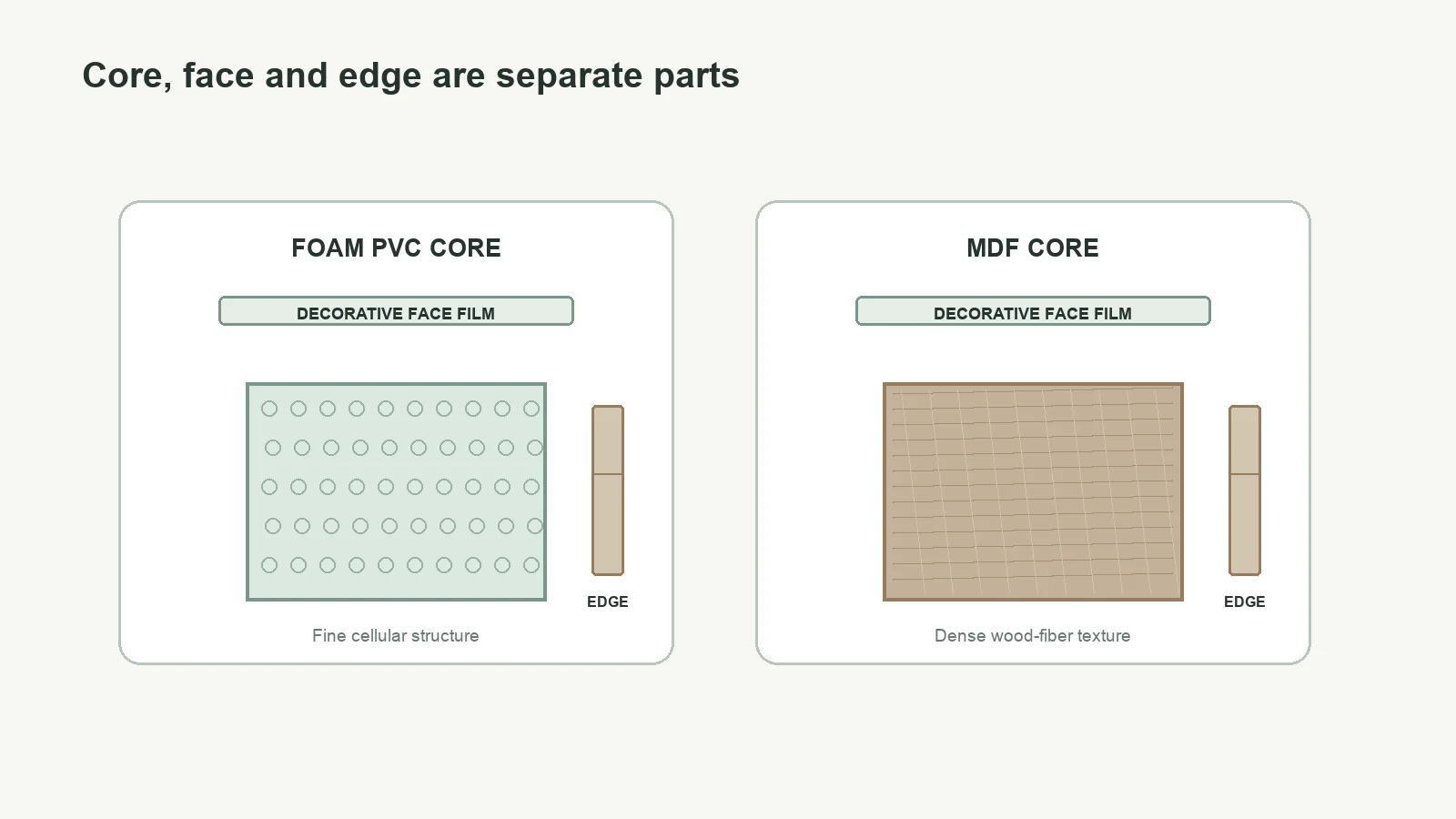
PVC foam board and MDF can form the body of a cabinet part; decorative film forms its visible facing. A foam sheet has a cellular structure, a hollow panel has separate internal cavities, and a thin film needs support beneath it. Identify the core, face and back separately before comparing offers.
Palram’s interior-design applications include foamed PVC sheet for furniture and cabinetry. Its product range separates construction boards from printing and display grades. A familiar product-family name therefore needs a specific grade beside it on the drawing or quotation.
MDF is another core route, with grades intended for different interior conditions. A door can have an MDF core and a PVC decorative face; calling that a “PVC cabinet” leaves the wood-based core unidentified. The decorative-film comparison explains that separate surface choice.
Likewise, a ribbed hollow wall panel and a foamed construction sheet have different sections. The wall-panel material guide helps distinguish the wall products that may appear in the same search results.
The carcass and front can use different cores. Include the back and panel balance when reviewing a faced door, because the visible side is only part of that construction.
Which core fits each kitchen cabinet part?
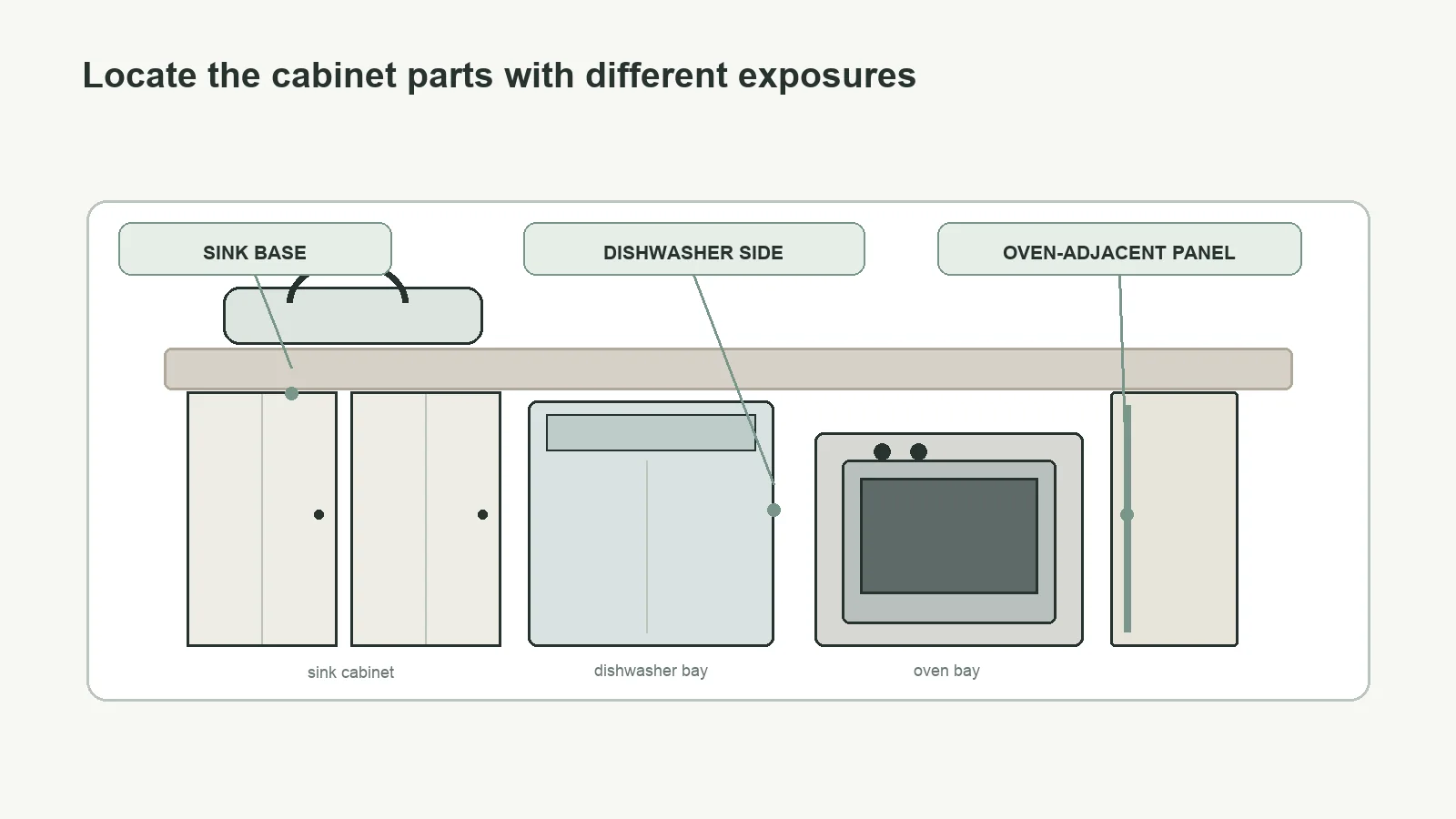
Use a part-by-part exposure map: keep a suitable dry construction for a protected front, evaluate a named foam-PVC grade or properly finished humid-interior MDF at the sink, and revalidate loaded or heat-adjacent parts separately. Mark the real water path, heat source and support before deciding which existing details can remain.
| Part | Actual exposure | Candidate grade | What maker data shows | What it leaves to establish | Keep, change or revalidate |
|---|---|---|---|---|---|
| Dry door or front | Room humidity, handling and cleaning | Suitable dry MDF or documented foam construction grade | Intended application and finishing route | Complete door, hinges and finished appearance | Keep an established suitable design; validate a changed core |
| Sink base and pipe cut-outs | Leaks, splashes and exposed machining | Documented foam grade or correctly finished MR MDF | Named moisture behavior and use conditions | Joints, openings and completed assembly | Change vulnerable details and repair the leak |
| Heat-adjacent side | Appliance heat and restricted ventilation | A grade supported for that position | Its documented temperature boundary | Actual panel exposure and appliance clearances | Revalidate the position independently |
| Long loaded shelf | Contents, unsupported span and supports | Grade with relevant component evidence | Available stiffness or connection data | Finished shelf deflection and support performance | Revalidate span, direction and supports |
For the named MR MDF finishing system, all surfaces must be sealed, primed and painted before installation. Carry that requirement through the pipe openings and other machining in the proposed part. Our MDF water-resistance guide explains why humid-interior use and direct wetting need separate treatment.
Repair a leak before replacing its damaged surround. Then decide which openings and joints will remain accessible if maintenance is needed again. For the face, back and edge arrangement of a wood-based candidate, see laminated MDF construction.
What changes when you replace an MDF core with PVC foam?
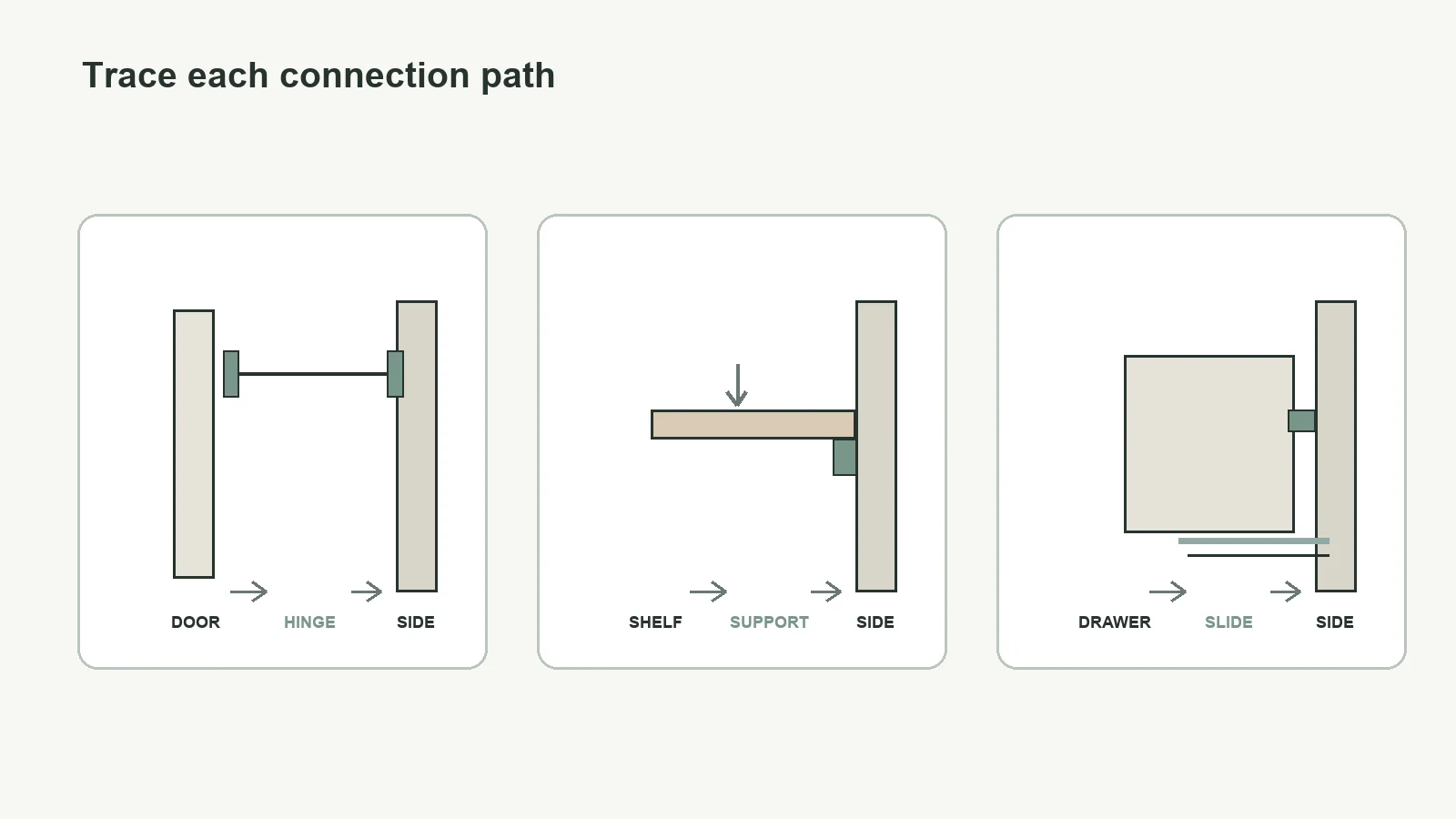
Replacing the core changes the path from a load through its fixings into the cabinet. Trace the shelf supports, hinge screws, drawer slides and box bracing on the actual drawing. Keep the grade, thickness, extrusion direction, connector location and unsupported span with each path, then approve the completed component that carries it.
| Connection path | What to specify | Why it affects the substitution | Completed check |
|---|---|---|---|
| Shelf → support → side | Grade, thickness, direction, span and support locations | Both shelf bending and the support connection carry contents | Shelf with its intended supports and load |
| Door → hinge → side or face frame | Door size, hinge arrangement and face or edge fixing location | The hinge connects different parts, each with its own fixing | Complete door and attachment |
| Drawer → slide → side | Side construction, slide position and connector location | The moving drawer transfers load through the side fixing | Installed drawer, slide and side |
| Box → back or bracing → wall fixing | Back, joints, bracing and mounting arrangement | The assembled box transfers loads beyond the visible panel | Completed box and mounting design |
The named MDF tables distinguish face and edge screw withdrawal and report different values for the moisture-resistant and dry grades. Both the grade and the connector position belong on the drawing. The figures in the next section give a specific example of those differences.
For the PVC candidate, the fabrication guide notes greater flexural strength along extrusion than across it. Mark that direction on a proposed shelf. It also ties adhesive selection to the materials joined and the application, so retain the actual face, bond and core in the sample.
KCMA A161.1-2022 evaluates shelf and bottom loading, joints, mounting, hinge loading and door cycling separately. Its door-cycling test uses 25,000 cycles. The cycling condition describes a test sequence, not years of service or certification for either proposed cabinet.
The cabinet-material selection guide develops the whole-part approval principle; the card above identifies the connections affected by this particular substitution.
How should you compare water and heat claims?
Compare water results by what was measured, and temperature figures by their stated document and sheet scope. Mass absorption, thickness swelling, a service range and a softening warning answer different questions. Use the proposed grade and thickness for the cabinet part, then assess its finished joints, surface and expected exposure as an assembly.
The named MR MDF table gives EN 320 face/edge screw values of 1200/900 N in its greater-than-12-to-19 mm column. The matching dry-grade table gives 1000/600 N. A fixing into the broad face and one into the narrow edge therefore need separate attention. The cited PALIGHT documents give no equivalent connection result, so these values support no material-family screw-holding winner or safe door load.
For water, that MR column gives EN 317 thickness swelling below 8%. The PALIGHT family leaflet, revision 08.2026 gives ASTM D570 mass absorption below 1%, at 23°C. Both figures describe 24-hour exposures, but one measures change in thickness and the other water gained by mass. A ratio between the percentages would compare different physical quantities.
The same leaflet gives a family service range of −10 to 50°C. The fabrication guide, revision 08.2026 lists −10 to 55°C in its separate 3 mm and 10 mm columns. It also warns of permanent softening when ambient or surface temperature exceeds 60°C. The warning identifies damage risk; use the service data for the supplied grade to establish its operating boundary.
For an 18 mm cabinet part, obtain its matching grade and thickness information instead of designing from the thin-sheet columns. A side beside an appliance also needs the appliance’s installation conditions and the actual expected panel temperature.
Finished-surface evidence remains another part of the decision. The cabinet standard includes detergent-and-water exposure at edges and an interior-shelf water test separately from raw-core properties. A sound core, a suitable finish and well-resolved joints all belong in a sink-base proposal.
How should you compare PVC foam and MDF cabinet quotes?
Compare quotations for the same completed parts and installation scope, including any redesign required by a core change. List the grade, thickness, face, back, machining, hardware and support details before comparing totals. A lower sheet price becomes useful only after the proposal includes the work needed to deliver a suitable cabinet.
A public budgeting example shows how specific that scope can be. Homewyse’s May 2026 calculator, using ZIP 47474 and a quantity of one cabinet, shows about $486–$736 installed. It specifies a solid-wood face frame and door frame, a veneer-plywood box with shelves and bottom, a plywood drawer box and basic installation. This is neither a PVC nor an MDF quotation and establishes no price difference between them.
That example excludes unlisted systems, framing and plumbing work, remediation, taxes and permits, and general-contractor supervision. State removal and disposal explicitly in your own scope as well.
| Quote item | What both proposals should identify | What changes the comparison |
|---|---|---|
| Grade and thickness | Exact board specification for every part | A material name hiding a different construction |
| Face and back | Finish and backing arrangement | Additional facing or balancing work |
| Edges and cut-outs | All finished sides and openings | Extra sealing or finishing operations |
| Machining | Shape, holes and recesses | Revised tooling or part details |
| Hardware | Hinges, slides, supports and fixings | New connections after a core change |
| Redesign or retesting | Work needed to approve the changed component | Costs beyond buying the sheet |
| Transport | Packing, handling and delivery scope | Different inclusions between suppliers |
| Installation | Fitting, adjustments and preparation | Site work added to the material offer |
| Removal and exclusions | Disposal and work omitted | Charges appearing after acceptance |
Use the part schedule from the exposure map to keep both offers aligned. Compare a finished door with a finished door, and a complete box with the same complete box. Keep a film purchase separate from a quotation that includes facing the panels and assembling the cabinet.
Where does a silicone furniture film fit?
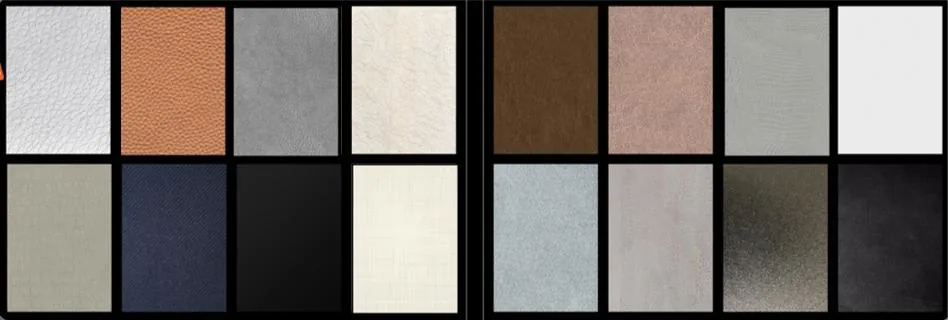
Puremorfilm makes decorative film with a silicone functional surface for flat furniture panels and cabinet-door faces. Core compatibility and the completed cabinet construction need separate validation. The furniture film is PVC-free. A PVC-foam core still contains PVC, even when its visible facing contains none.
Our paint-free furniture film has a silicone functional face, distinct from PVC, melamine, PP and PETG decorative faces. The silicone surface is inherently flame-retardant, with higher grades up to UL 94 V-0 available on request.
In the manufacturer’s laboratory tests, coffee, red wine and soy sauce left at 25°C for 24 hours wiped off with no obvious change. We use a No DOP formulation.
We mainly supply rolls for PUR flat lamination, with a film MOQ of 500 linear metres. Laminated panels are available on request at 1220 × 2440 mm, with a separate MOQ of 200 panels. Samples are free. Standard film has no back adhesive; back adhesive is available on request.
Because of its leather-like feel and some elasticity, it is not for floors, stovetop counters, shower floors or other walked-on areas.
What should you approve before ordering cabinet parts?
Approve each part’s exposure, grade and connections before ordering. Keep a suitable existing construction where it meets the job, and validate the finished component wherever the core changes. Then compare quotations for equivalent work. The exposure map and connection paths let you make that decision separately for the door, box and shelf.
- Mark each part and its exposure. Identify water routes, appliance positions and loaded spans on the cabinet drawing.
- Fix the core and connections. Name the grade, thickness, direction where relevant, supports and hardware positions. Carry the same information into the quotation.
- Approve the completed sample part. Include its real face, back, edges, cut-outs and fixings, with evidence covering its intended conditions.
- Compare the same scope. Resolve machining, structural changes, fitting and exclusions before choosing the offer.
For a free decorative-film sample or a film-order discussion, contact us with the use, target face effect, part drawings or sizes, and quantity.
Frequently Asked Questions
Is PVC board good for kitchen cabinets?
Yes, for parts where a named cabinet-suitable foam board and its completed design meet the water, temperature and connection requirements. Identify whether the proposal is a structural foam sheet, a hollow panel or a wood-based board with a PVC face.
What are the disadvantages of PVC kitchen cabinets?
The main drawbacks of a foam-core cabinet are its grade-specific temperature limits and thermal movement, which the fixing design and face bond must accommodate. Some products called PVC cabinets use only a thin PVC facing, so establish the core before applying any foam-board comparison.
What type of board is best for kitchen cabinets?
A suitable dry MDF grade can serve a protected front, a correctly finished MR grade can suit humid interiors, and a documented foam construction grade can be evaluated for particular water-exposed parts. Loaded and heat-adjacent parts need their own completed-design evidence.
Is PVC foam board strong enough for kitchen cabinet doors?
Yes, if the supplied grade, door size, hinges and assembly meet the loads required for that door. Review the completed door and its attachment; a loose sheet’s water result answers a different question.
Which material is easier to process for large-scale production?
Both can be processed with standard woodworking tools; the practical choice is the route whose tooling, conditioning and completed sample meet the job. The makers’ processing guidance supports that comparison, without establishing a throughput winner for every order.