
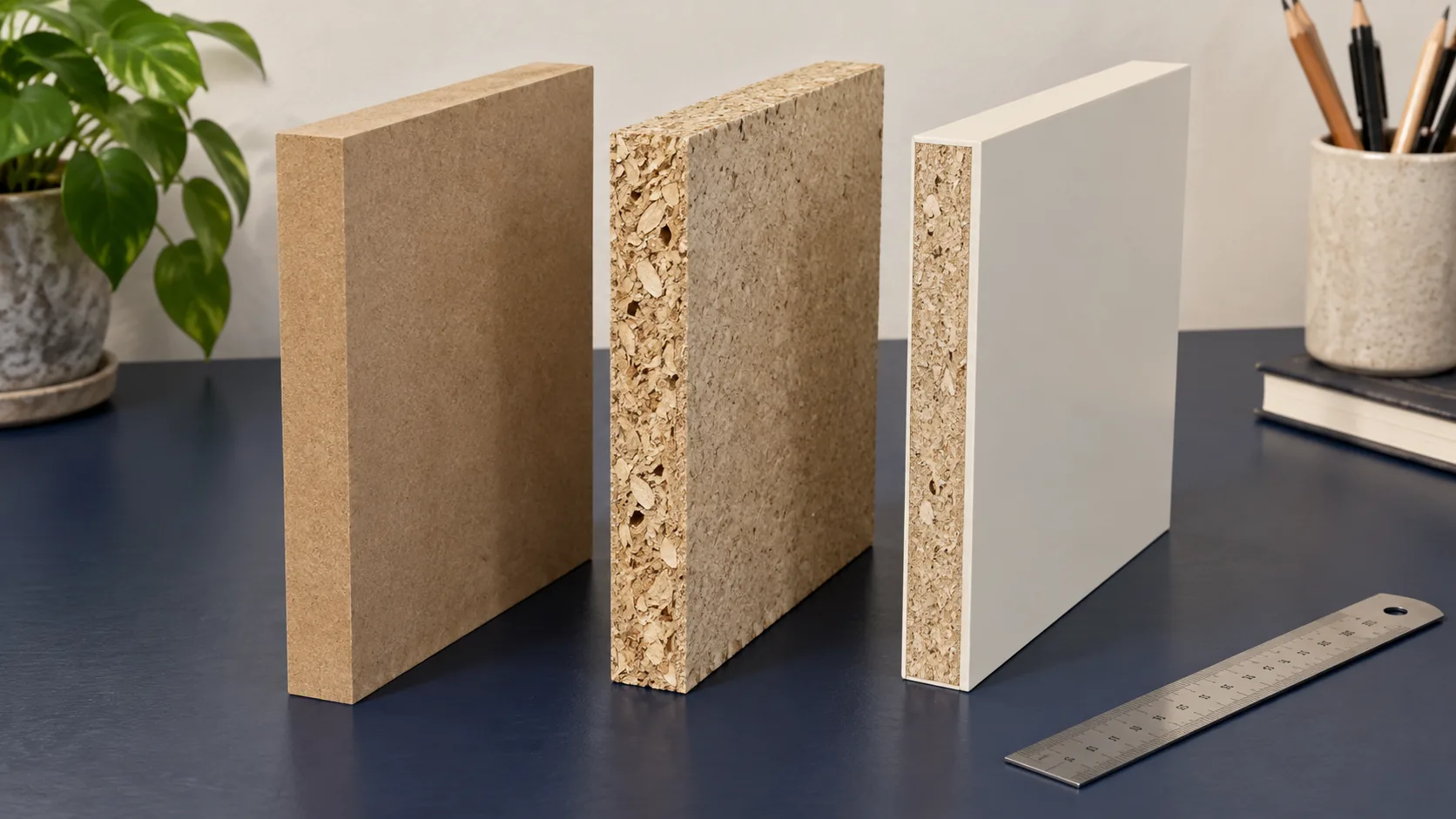
MDF is made from fine wood fibers and is smooth and dense all the way through; particleboard is made from larger wood chips, is usually lighter and cheaper, and has a coarser core. Choose MDF for painted doors, routed edges and parts that need a clean finish, and melamine-faced particleboard for budget cabinet boxes, shelves and flat-pack furniture. Neither tolerates water at an unsealed edge.
What is the difference between MDF and particleboard?
Fiber versus chip. MDF is bonded wood fibers; particleboard is bonded wood particles, usually finer at the faces and coarser in the core. That inner structure is what you see on a cut edge and what decides how much work a routed profile needs before paint.
| Feature | MDF | Particleboard |
|---|---|---|
| Basic structure | Fine wood fibers bonded into a panel | Discrete wood particles bonded into a panel |
| Typical surface | Smooth, uniform and without natural grain | Finer surface particles can provide a flat face suitable for surfacing |
| Cut edge | Fine-fiber appearance that absorbs coating | Visible particles and exposed core need appropriate edge treatment |
| Common furniture role | Painted fronts, machined profiles and surfaced panels | Flat faced cabinet parts and panel furniture |
| Shelf selection | Grade, thickness, span and support control sag | Grade, thickness, span and support control sag |
The USDA Wood Handbook manufacturing chapter describes both structures in its particleboard and dry-process fiberboard sections. The coarse chips inside a particleboard sheet don’t mean its face is coarse too, so treat the face and a cut through the core as two separate finishing jobs.
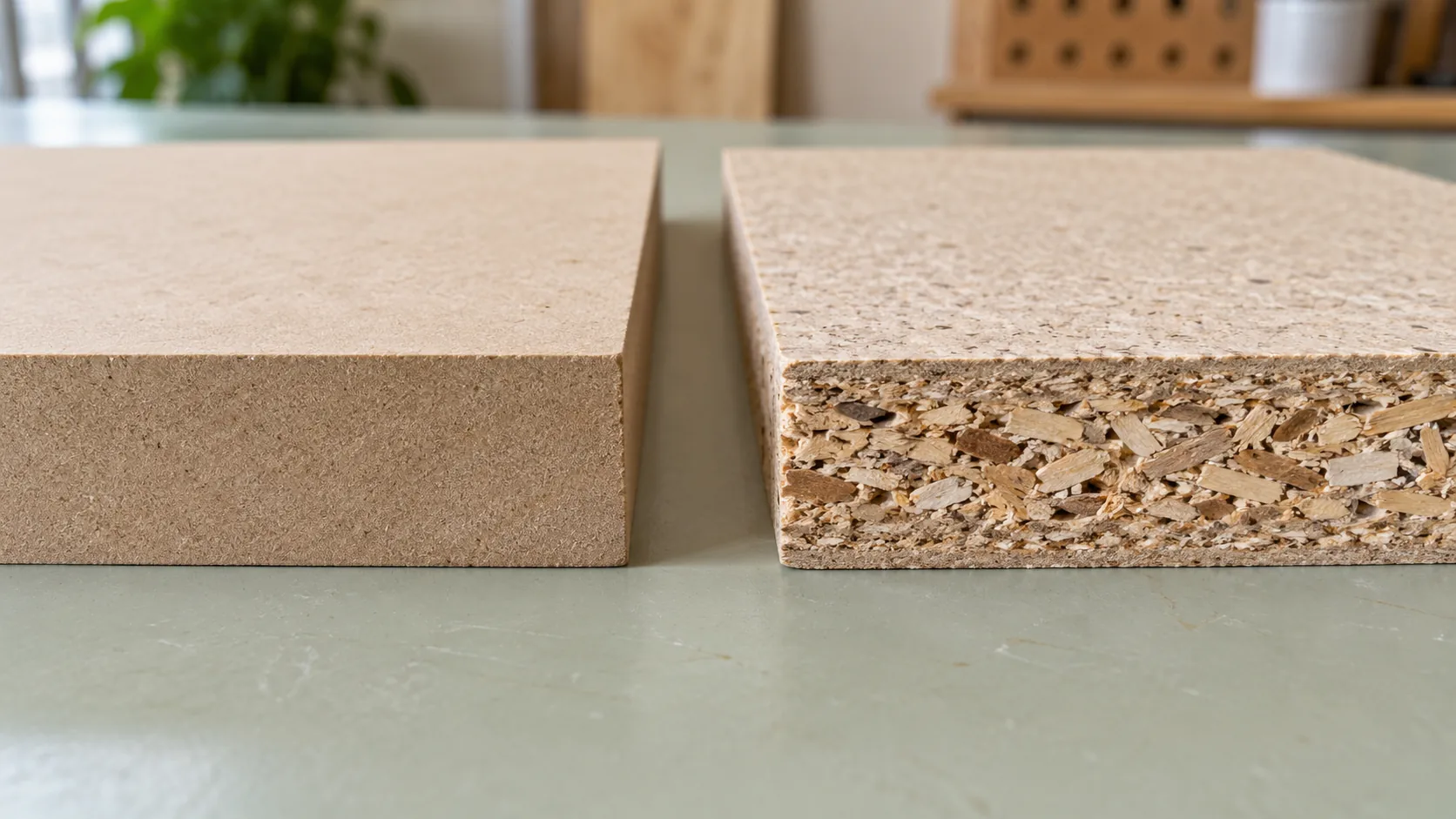
Both are wood-based, not plastic. Any wood grain you see on either sheet usually comes from its face, so check the core separately from the decor printed or bonded on top.
Our MDF definition guide explains fiberboard construction. With either board, a raw sheet, a paper-faced panel and a finished cabinet part are three different things to buy.
Which board suits paint, profiles and faced furniture?
MDF for painted furniture and finely routed profiles; factory-faced particleboard for flat cabinet parts when the finish it comes with is the one you want. You can paint particleboard, but the exposed chips and cut edges add prep work.
The Composite Panel Association’s MDF guidance points to its flat, smooth, even surface and precise machining. That makes MDF the natural start for a grain-free bookcase back, a painted door or an interior molding. Plan the cut-edge prep as part of the paint job.
Particleboard’s particle size, density and process can be tuned for different uses (particleboard guidance). A qualified factory-faced sheet goes straight into a flat cabinet side with no painting. The cut edges, holes and joints still need their own treatment.
To paint particleboard, tell an intact fine face apart from a recess cut into the core. The recess may need filling, sealing and more prep to look the same. A coarse edge means planning that work; it doesn’t rule out particleboard furniture.
Settle the finish before you price the core. Compare ready-faced parts with ready-faced parts and painted profiles with painted profiles. The MDF finishing guide covers painting, and the laminated MDF guide shows how a separate face changes the panel spec.
Which board makes a stiffer shelf?
The one whose grade, thickness, span and supports meet the shelf design. A good particleboard grade can sag less than a low MDF grade.
A shelving bulletin gives a useful historical example. Its tables compare 3/4-inch raw, unfinished panels, supported at both ends, under a 25 psf uniformly distributed load with a span/240 deflection criterion. The values below are from tables 1–2, using the source’s 2016 grade designations; they are not current buying minimums.
| Source material and historical grade | Table span under the stated conditions | What the comparison shows |
|---|---|---|
| Particleboard M-2 | 26.6 inches | Longer listed span than the source MDF115 example |
| Particleboard M-3i | 28.6 inches | A different PB grade changes the result |
| MDF115 | 22.7 inches | The material name alone does not win the comparison |
| MDF130 | 27.3 inches | MDF grade changes allowable span in this example |
| MDF155 | 29.7 inches | Higher source grade gives a longer listed span |
The bulletin leaves out the shelf’s own weight and uses its deflection limit to control long-term sag. Real shelves are loaded unevenly. A row of hardbacks bunched at one end loads a shelf unevenly, unlike those tables, so recheck the design when load, span or finish changes.
To stiffen either shelf, shorten the span, add a center support or add a designed front stiffener. A thin back panel that merely touches the shelf carries nothing. Show how the supports are fixed and how the load reaches them on the drawing.
In a bookcase, choose the shelves separately from a thin painted back. The MDF and solid-wood comparison covers another route, and a different core still needs the same span and load check.
How should you design screws and reusable joints?
Drill proper pilots for ordinary screws in MDF, and use fittings made for the particleboard grade you have. For furniture that gets taken apart often, design a reusable connector instead of backing the same screw out of the same raw hole.
EPF’s MDF fixing guidance gives a general pilot diameter of 85–95% of the screw core diameter, drilled at least 1 mm deeper than the screw will go. Core diameter means the root between the threads. Those rules are for MDF; particleboard and branded connectors have their own.
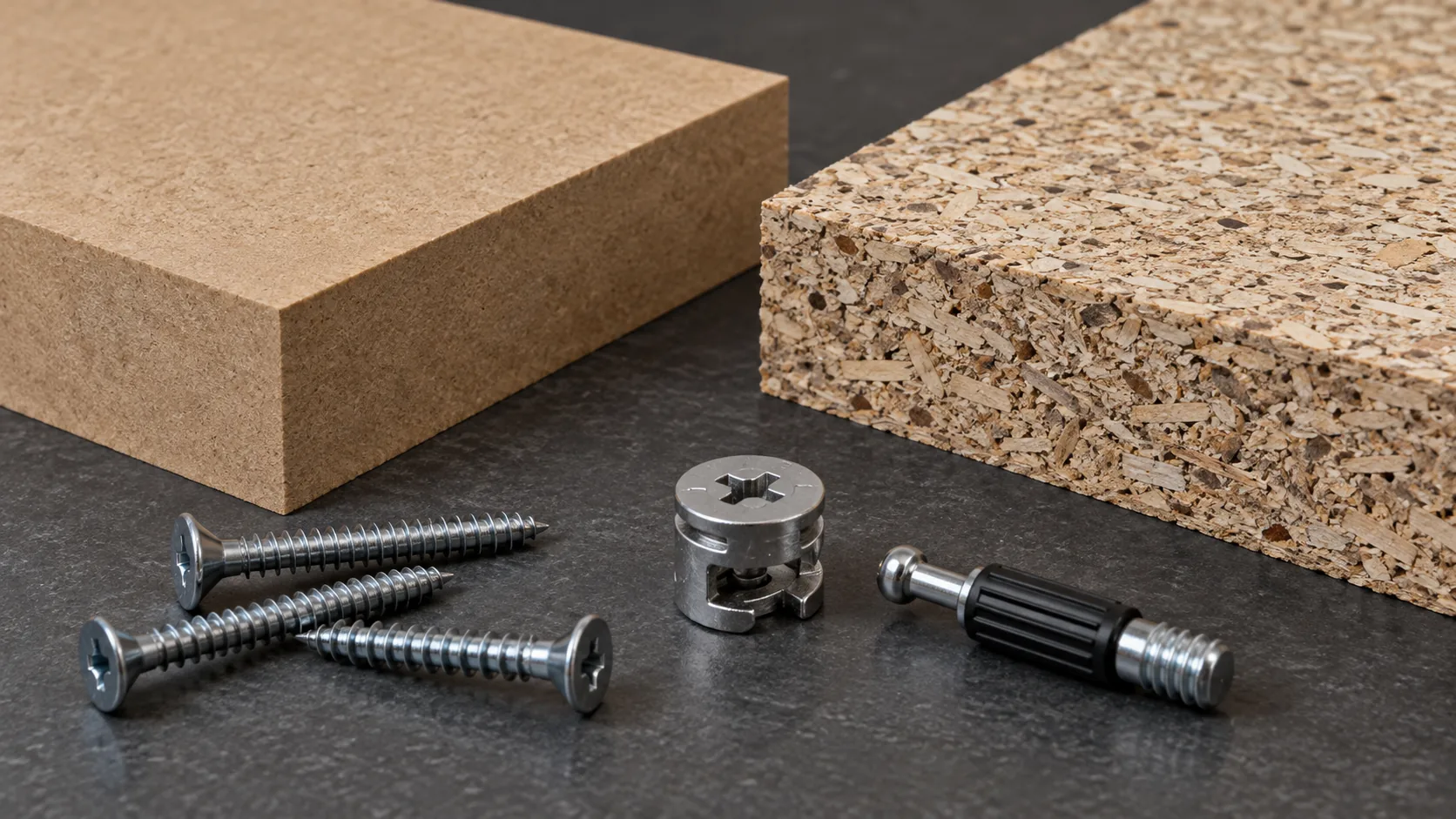
On a cabinet side, check whether the fitting goes into the face or the edge and how much solid core surrounds it. A hinge cup, an edge screw and a through-bolt each load the board differently. A longer screw can break through the far face or into a nearby recess, so put the connection on the drawing.
EPF adds that withdrawal-strength comparisons need the same screw type and test method. When reading supplier data, check board grade, direction, depth and pilot. A figure for one screw at one depth says nothing about a different connector.
If the piece will be assembled and taken down repeatedly, such as trade-show furniture or a rental flat’s wardrobe, pick a purpose-made connector, insert or through-bolt and test it in that board and shape. The MDF cutting guide covers clean part prep before fixing.
How do moisture grade and finishing affect cost?
Dry-use boards for dry rooms, documented humid-interior grades where the room needs them. Then compare cost per accepted finished part, with the face, edging, processing and yield included.
Both boards move as moisture changes. The dimensional-stability bulletin explains moisture response, the swelling left after heavy wetting and the effect of balanced construction. A decorative face doesn’t seal every cut, hole and joint.
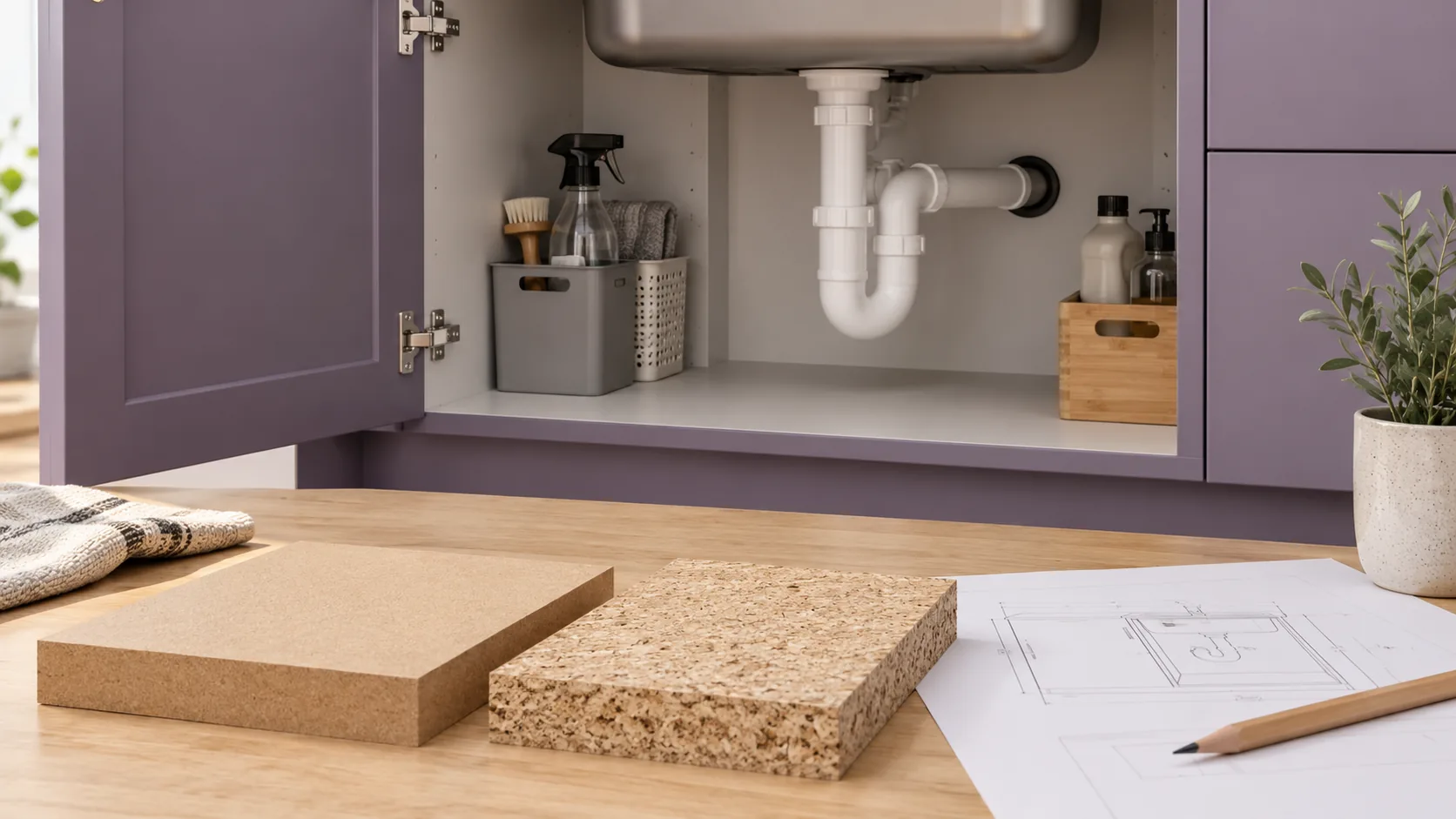
State the room the product is for. A moisture-resistant grade is for humid interiors; it isn’t permission to soak a cabinet or install it outdoors. The supplier’s declaration should name the humid-interior category and the face and edge protection needed. The MDF moisture guide goes into that in more detail.
For cost, add material, processing, rework and disposal, then divide by the number of accepted finished parts. Count scrap once.
A quote for a faced cabinet side should say which face work is included. A quote for a routed painted door should include filling, sealing and prep of the exposed core. On the same drawing, look and conditions, a cheap raw-sheet quote can lose its lead once that work is added, which matters most on painted kitchen doors.
What should a batch purchase specify?
The exact board grade and the finished part: face, back, edges, fixings and acceptance rules. That ties a repeat order to measurable parts instead of a loose material name.
| Item | What to specify | Why it matters |
|---|---|---|
| Core | Exact product and grade, thickness and service category | Identifies the material behind the facing |
| Geometry | Finished drawing, dimensions, recesses and tolerances | Controls fit after machining and surfacing |
| Finish | Face, back, edge treatment and appearance limits | Includes the complete visible result |
| Shelf design | Loading, span, support and accepted deflection | Prevents a grade name from becoming a load promise |
| Connections | Fitting, location, entry direction and preparation | Makes assembly reproducible |
| Records | Applicable emissions documents and batch traceability | Connects the order to the supplied product |
EPA’s composite-wood FAQ lists panel emission-test limits of 0.09 ppm for particleboard, 0.11 ppm for MDF and 0.13 ppm for thin MDF, defined as 8 mm or less. These are regulatory limits by category, not a measurement of your batch or an indoor-air limit.
The current standards directory lists ANSI A208.1-2022 for particleboard and ANSI A208.2-2022 for MDF for interior use. The grade tables themselves are licensed, so keep the shelf example above tied to its own edition.
On each repeat delivery, check the documented core, finish and batch ID against the order, then check sizes and visible edges against the drawing. Record any substituted face, back or grade. The MDF lamination guide explains why the surface process belongs in the panel spec too.
Where does organosilicon decorative film fit?
On top of the right flat furniture core. Choose the core first; the film and its bonding process then cover the look and processing, while the core, supports and joints carry the structure.
Puremorfilm makes decorative film with a silicone functional surface for flat-laminated furniture panels on MDF or particleboard. SGS tested the submitted film at 100°C for 600 minutes; after 14 hours’ recovery at room temperature, length changed by 0.06% and width by 0.10%. That is the film’s result, not the finished panel’s. The silicone surface is inherently flame-retardant, with higher grades up to UL 94 V-0 available on request, and the film uses a No DOP formulation.

For a flat front or cabinet side, send the board grade, drawing, back build and edge details, and say whether you want film rolls for your own line or finished film-faced panels.
Our furniture decorative-film page introduces that route. It is not for floors, cooktop countertops, shower floors or other walked-on areas.
Which board should you choose for your finished part?
MDF for a smooth painted profile, faced particleboard for a flat finished cabinet part, and whichever documented grade and support layout meets the load for a shelf. The finished shape, the room and the full part cost settle the rest.
- If your line does its own facing, compare raw-core supply with your full in-house cost.
- If you buy parts already finished, check that the face, back and edges match the agreed scope before comparing quotes.
- For furniture that is assembled and taken apart often, price the reusable connector with the part.
Whichever core you pick, our paint-free silicone face can finish the flat parts, as a different surface from PVC, melamine, PP and PETG. Contact us with the core grade, drawing and service conditions.
Frequently Asked Questions
Is MDF always stronger than particleboard?
No. MDF is denser and often stronger, but some particleboard grades beat lower MDF grades: in one CPA shelving example, M-2 particleboard had a longer listed span (26.6 in) than MDF115 (22.7 in).
Can particleboard be painted?
Yes. An intact face takes paint after normal prep; exposed core, cut edges and deep profiles need extra filling and sealing.
Is faced particleboard waterproof?
No. The melamine face sheds splashes, but water at a cut edge, hole or joint swells the particles, and the damage doesn’t fully reverse.
Which is better for cabinets, MDF or particle board?
MDF for doors and drawer fronts, especially painted or routed ones; melamine-faced, edge-banded particleboard for boxes and shelves in dry areas. Plywood beats both for boxes where screw holding and moisture matter most.
How can you tell MDF from particle board?
Look at a cut edge. MDF is smooth and even, like dense cardboard; particleboard shows chips, finer near the faces and coarser in the middle. Particleboard is also usually lighter for the same size.