
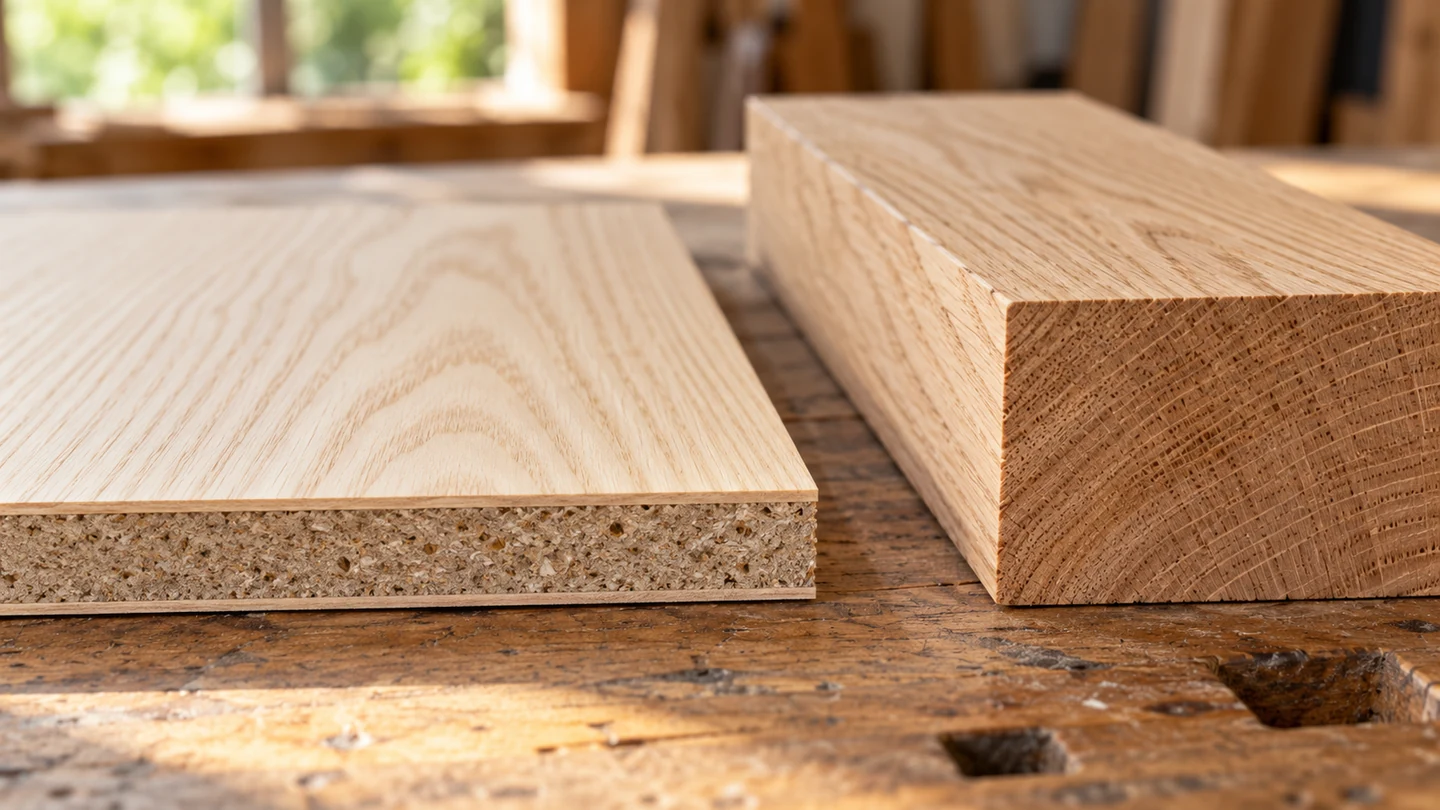
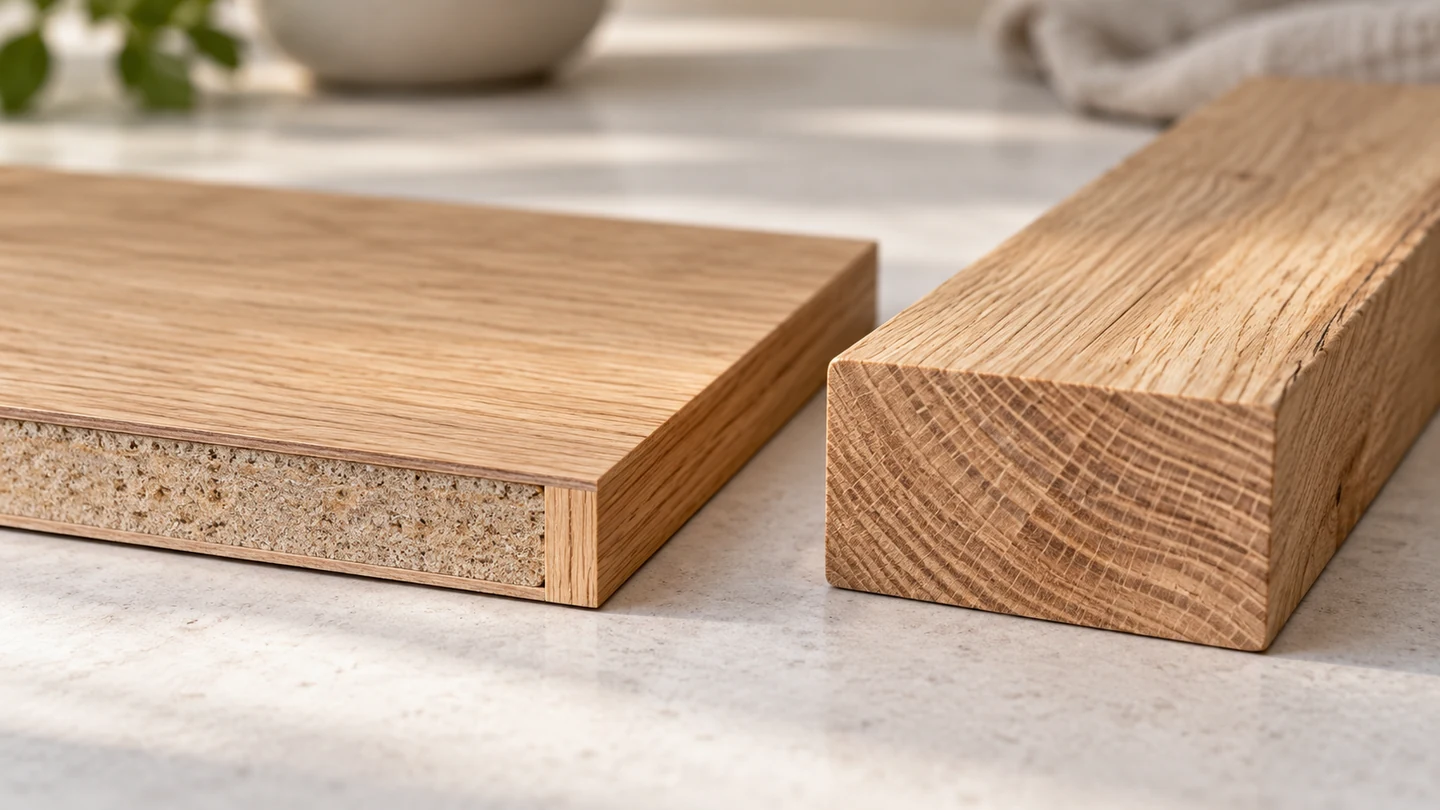
Wood veneer is a real-wood face, typically 0.51–1.0 mm thick when sliced, bonded to a core such as MDF or particleboard; solid wood runs through the full thickness of the part. Choose veneer for wide, flat panels that need to stay flat and match, and solid wood for legs, edges and tops that take knocks and may need sanding more than once.
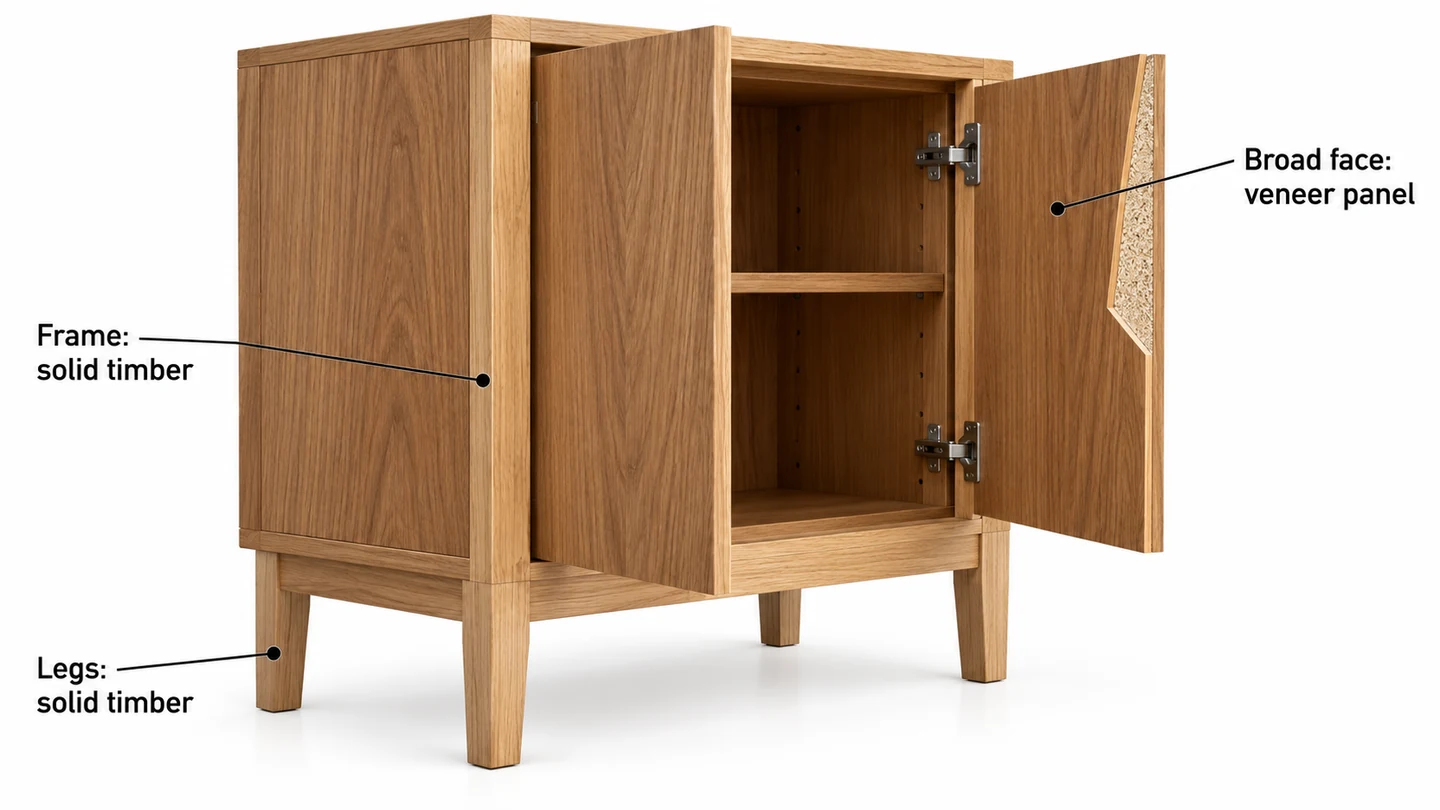
That makes wood veneer vs solid wood a decision you often make part by part, not once for the whole piece. A cabinet can sensibly have veneered sides and a solid frame, and a table can pair a veneered top with solid legs.
What is the difference between wood veneer and solid wood?
Veneer is a thin natural wood face over a supporting core, while solid wood is timber all the way through the part. A veneered table can show genuine oak or ash on top without a thick slab of that species underneath.
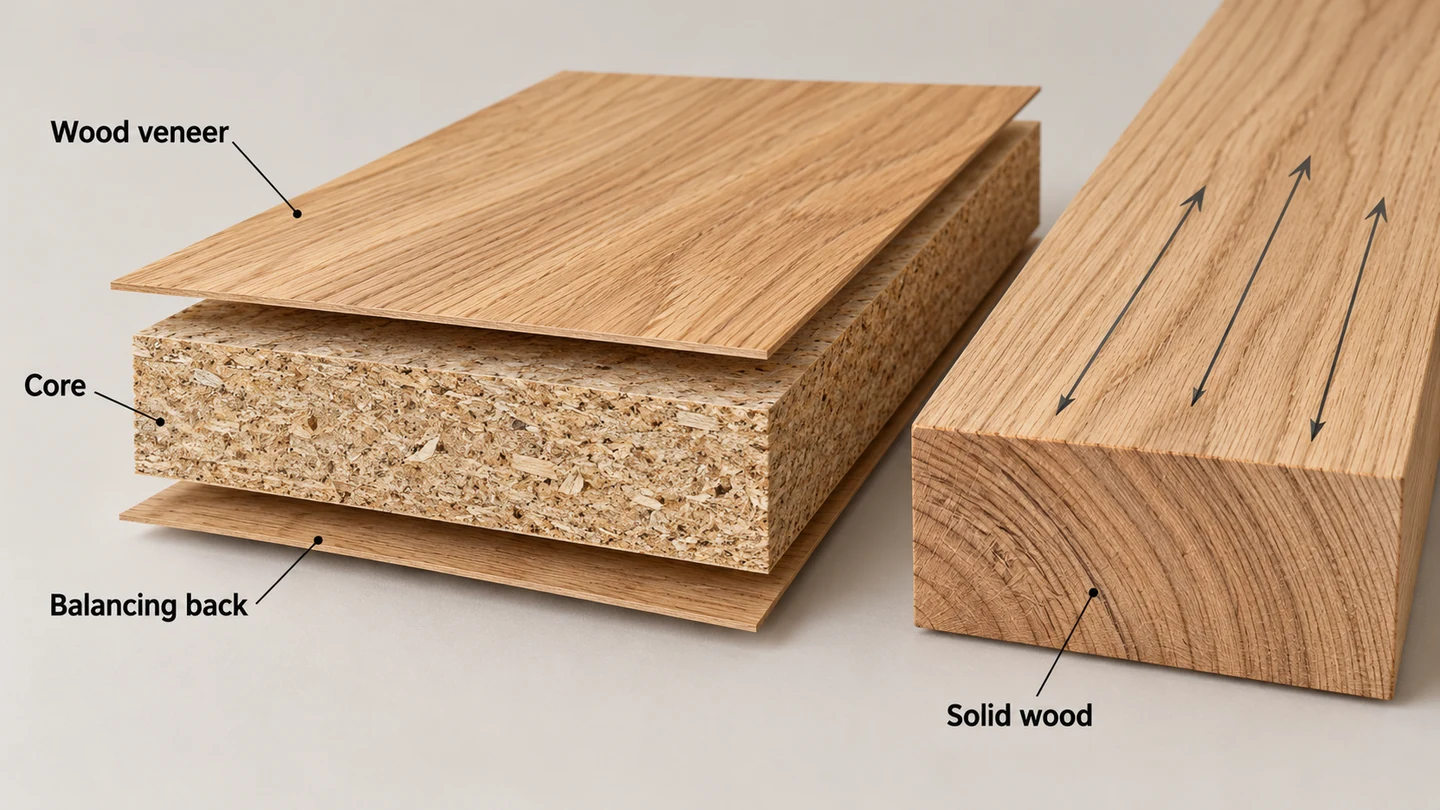
The Composite Panel Association’s veneer overview describes sliced veneer laid on flat substrates such as MDF and particleboard. The face supplies the grain you see; the core supplies most of the thickness, and a balanced back keeps the panel flat.
| Feature | Wood veneer construction | Solid wood construction |
|---|---|---|
| Visible face | Real wood, a thin decorative layer | The surface of the timber itself |
| Beneath the face | A core, with a balancing back as needed | Timber throughout the part |
| Wide flat parts | Stays flat when built as a balanced panel | Needs room to move across the grain |
| Deep repair | Limited to light sanding before the core shows | Can be sanded and refinished more than once |
| Grain arrangement | Leaves can be laid as deliberate matched patterns | Follows the boards selected and joined |
| Where the money goes | Face species, core, matching, edges and finish | Species, board quality, yield, joinery and finish |
Most furniture mixes the two. A solid frame around a veneered panel is still wood furniture, so ask what each part contains. Our laminated MDF explanation covers how a face and a core work together.
Is veneer real wood, and is it the same as laminate?
Yes, natural veneer is real wood, and no, it is not laminate: the wood-look laminate sold for furniture uses a printed decorative face. A thin wood face is still wood, not a printed imitation.
On a veneered cabinet door, the grain variation comes from the wood leaf itself. On a wood-look high-pressure laminate or melamine face, a printed decor paper creates the look. Both can cover a wood-based core, so finding MDF inside a door does not tell you what its face is.
“Laminate” also has a broader meaning: anything bonded in layers. When a listing uses the word, look for the face material it names. Our wood veneer vs laminate comparison covers that face-material choice in more detail.
For the wider range of options, compare decorative surface types. This article stays with the choice between a natural wood face on a core and a solid timber part.
Which stays flatter on wide panels, doors and tabletops?
A balanced veneered panel usually stays flatter on a wide, flat part, because solid wood swells and shrinks across its grain as humidity changes. Solid wood can still make a good wide top, provided it is attached so it can move.
Wood moves most around the growth rings (tangentially), about half as much across them (radially), and only slightly along the grain, according to the USDA Wood Handbook, 2021, Chapter 4. That is why a wide solid tabletop changes in width far more than in length.
Therefore, a solid top needs fixings that let it move; rigid restraint can cause problems even with good timber. A frame-and-panel door handles the same behaviour by letting its panel float inside the frame.
Veneered panels rely on balance instead. The CPA dimensional-stability bulletin explains that a panel stays flat when the face and back restrain it equally, and that particleboard and MDF can swell in thickness under high humidity or water without fully recovering when they dry.
So for a bathroom vanity or a cabinet by the sink, look at the core, the back and the sealed edges, not just the word veneer. Our MDF vs solid wood guide expands on the core choice.
What handles knocks, scratches and refinishing better?
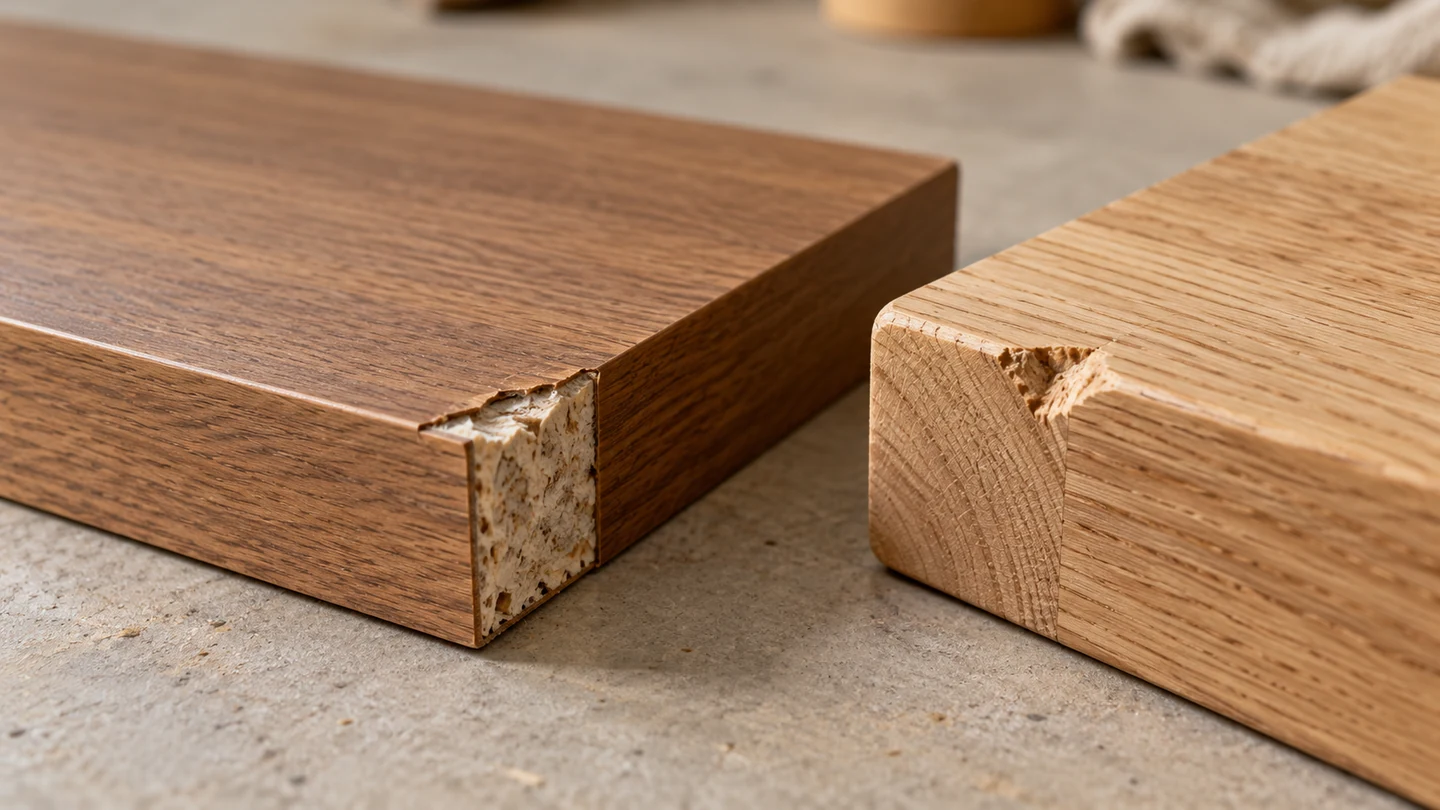
Solid wood, for repair: it can be sanded and refinished more than once, while veneer only tolerates light sanding before the core shows. For everyday light scratches, the finish matters more than the construction underneath.
Treat the 0.51–1.0 mm sliced-veneer figure as the starting thickness of new veneer, not what is left on an old table. Earlier sanding and local wear can leave much less, and sanding through exposes the core and removes the grain you wanted to keep.
A solid top can usually take a deeper repair, such as sanding out a dent. Split joints, deep penetrating stains and shallow finish marks still need different work, whatever the construction.
For care, follow the finish. The Timber Veneer Association’s care guidance advises against prolonged wetting and abrasive cleaners, suggests mild non-abrasive cleaners suited to the finish, and recommends trying a cleaner somewhere hidden first. Sunlight also changes the colour of both the wood and the coating over time.
For a dining table you expect to refinish, choose a substantial solid top or at least a solid edge. For a wide cabinet face that only meets light contact, a well-finished veneer does the job without a thick piece of an expensive species.
Which parts of a piece should be solid wood and which veneer?
Use solid wood for legs, frames and exposed edges that take knocks, and veneer for broad faces where matching and flatness matter. A dining top can go either way, depending on how much repair you expect it to need.
| Furniture part | Usual construction | What to examine |
|---|---|---|
| Leg or exposed frame | Solid timber | Joints, grain direction and finish |
| Wide cabinet side or door panel | Balanced veneered panel | Core, back construction and edges |
| Heavily used tabletop | Solid timber when deep repair matters | Movement allowance and thickness |
| Desk or media-unit top | Veneer or solid timber | Expected wear, coating and repair route |
| Exposed panel edge | Edge banding or solid lipping | Joint quality and continuous protection |
Mixed construction is normal even in mass-market furniture. The LISABO table lists an ash veneer face, other timber and wood-based layers inside the top, and solid birch legs. Its name tells you only part of that, which is why the top and the legs deserve separate questions.
Edges need a close look on any veneered core. A good edge band or solid lip protects the panel, finishes the visible transition and affects later repairs. Our MDF edge-banding guide covers that part of a panel, and the MDF vs plywood comparison deals with the cores.
Will veneer panels and solid wood frames match in color?
Often not exactly, especially under a natural or light finish, even when both are sold as the same species. A darker stain narrows the difference.
One published walnut cabinet example shows a solid face frame noticeably darker than the veneered side next to it. One project does not prove every solid part will be darker, but it shows why a small loose sample cannot settle how two adjacent materials will look.
You have three ways to handle it. A stain, even a light one, reduces the contrast but hides some of the natural variation. Doors built all-solid or all-veneer keep the fronts consistent. An exposed cabinet side can be covered with a finished panel that matches the doors. Each option changes the look, and sometimes the cost.
View the frame and panel together under the light where the furniture will stand. Check the join from the front and from the side, especially on the cabinet at the end of a run, and decide whether the variation looks intentional before you commit to a natural finish.
How can you tell whether furniture is veneer or solid wood?
Check the edges, underside, back and the seller’s materials list together. No single grain line proves solid wood, because veneer can be wrapped around an edge and a solid lip can surround a composite centre.
On an accessible edge, look for a thin face above a different core, an applied edge strip or a separate solid lip. On a solid board, the end grain at an exposed end looks different from the long face. Follow the part around, allowing for joints and edge treatments that can hide what is inside.
Look at the underside of a top and the back of a panel where you can. A solid drawer front tells you nothing certain about the drawer bottom or the cabinet side beside it.
Then ask a precise question: what are the top, legs, frame, sides and drawer fronts made from? Ask for the materials description for the exact version you are considering. Weight and the sound of tapping are weak clues, because size, core density and hollow construction affect both.
For the species, look at the grain and end grain where visible, then compare them with the seller’s declaration; a tinted finish can make a quick visual guess wrong. In a shop, inspect without scratching or prying.
Is veneer furniture cheaper, and what are you paying for?
Usually, for the same species and size, because veneer uses far less of the expensive wood. The finished price still depends on species, size, core, matching, edging, joinery and coating, and those can outweigh the saving.
Two U.S. retail listings observed on 18 October 2026 show real completed tables:
| Retail example | Listed construction and dimensions | Observed price |
|---|---|---|
| LISABO 702.943.39 | Ash veneer-faced top incorporating birch veneer, solid birch, birch plywood, particleboard and fiberboard; solid birch legs; 55 1/8 × 30 3/4 inches | $299.99 |
| SKOGSTA 806.118.84 | Solid acacia round table with clear acrylic lacquer; 47 1/4-inch diameter | $399.99 |
These two differ in timber, size, shape and construction, so their price gap is not a veneer discount or a solid-wood premium. Check tax, delivery, assembly and current availability separately.
Compare pieces that do the same job. A matched veneer face on a carefully built core can cost more than a basic solid timber table. Look at the edges, drawer construction, finish and repair options alongside the material label, and pay for attractive grain when the rest of the piece suits how you will use it.
Where does printed wood-grain film fit beside natural wood?
It fits where a printed wood look is acceptable and an easy-wipe surface matters more than real grain. Puremorfilm makes a printed wood-grain decorative film with a silicone functional surface for furniture panels; it is not real wood and cannot be sanded back like veneer.
The silicone surface is inherently flame-retardant, with higher grades available on request up to UL 94 V-0. In the manufacturer’s laboratory tests, coffee, red wine and other stated stains left at 25°C for 24 hours wiped away with no obvious change. The formulation is No DOP and formaldehyde-free.
Supply focuses on rolls for PUR flat lamination, with film-faced panels available on request. Our newer paint-free approach uses silicone surface functionality, distinct from PVC, melamine, PP and PETG decorative faces. See our wood-grain decorative film for panel finishes.
Veneer or solid wood: what should you buy?
Buy solid wood for the parts that take knocks and repeated refinishing, and veneer for broad panels that must stay flat and match. Judge each component on its own.
| Your priority | A practical choice |
|---|---|
| Dining top you plan to refinish | Solid timber, attached to allow movement |
| Legs, frames and exposed edges | Solid timber |
| Wide cabinet sides, media units and desk tops | A balanced veneered panel with well-finished edges |
| A natural finish across mixed parts | View the actual frame and panel together first |
| A printed wood look on flat panels | A decorative film on a board, not real wood |
For a furniture decorative film alternative with a printed wood look, contact us with the component, its size and the grain or sample you want.
Frequently Asked Questions
Is timber veneer good?
Yes. A well-built veneered panel gives a genuine wood face on a broad, stable part. The finish, core, sealed edges and distance from standing water decide how well it lasts.
Is wood veneer and laminate the same thing?
No. Veneer is a thin slice of real wood; wood-look laminate is a printed decorative face bonded in layers.
How do I tell what wood my furniture is made of?
Look at the edges, underside, back and materials list to tell veneer from solid wood, then use the grain and end grain to judge the species. Where a finish makes that uncertain, rely on the seller’s declaration.
Can veneer furniture be sanded and refinished?
Yes, lightly. Only limited sanding is possible before the core shows, so an old or previously refinished veneer needs extra care.
Is veneer furniture cheaper than solid wood?
Yes, usually, for the same species and size, because it uses less of the expensive wood. A well-matched veneer panel can still cost more than a basic solid piece, and the two retail tables above differ in size and timber.