
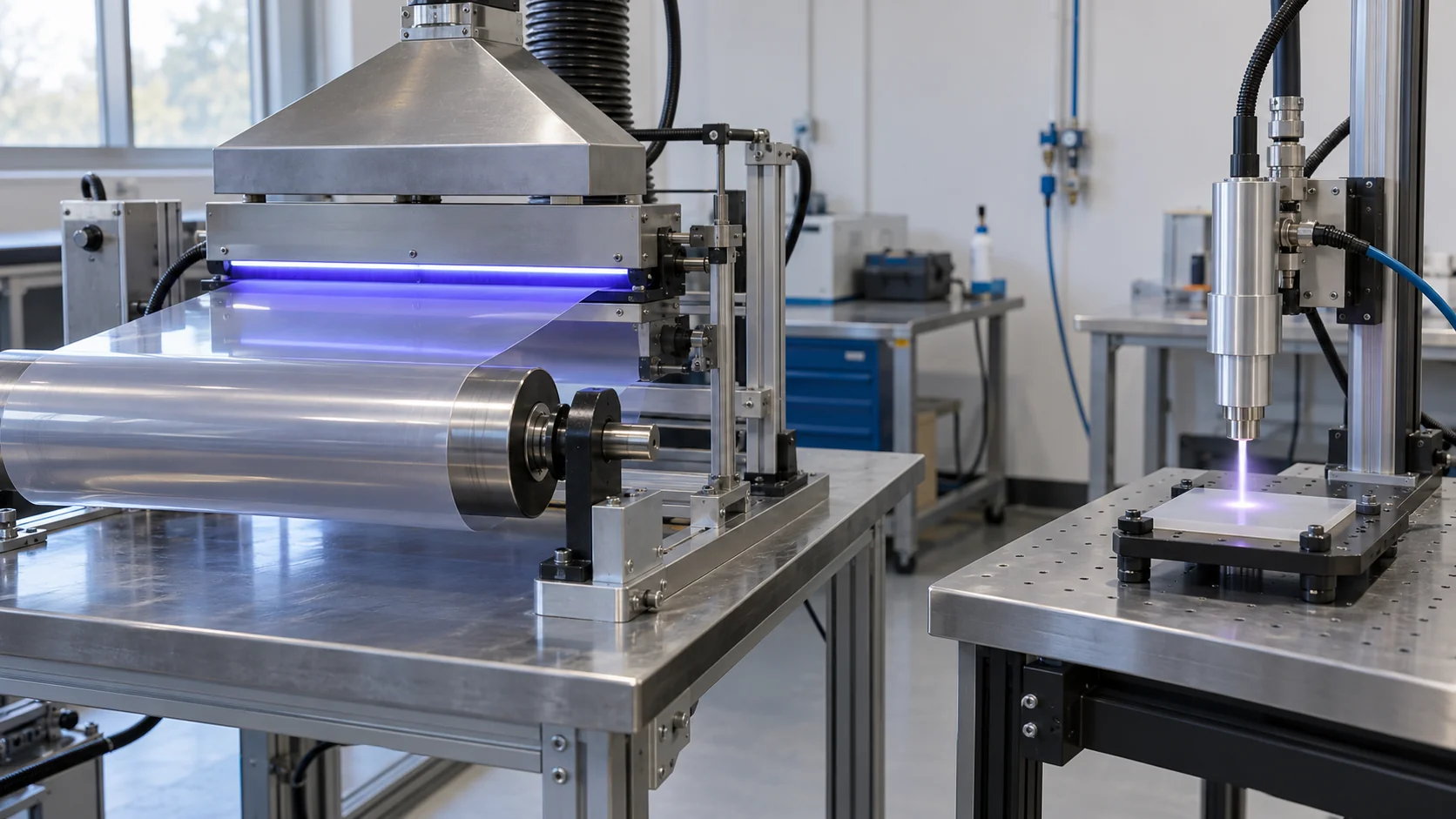
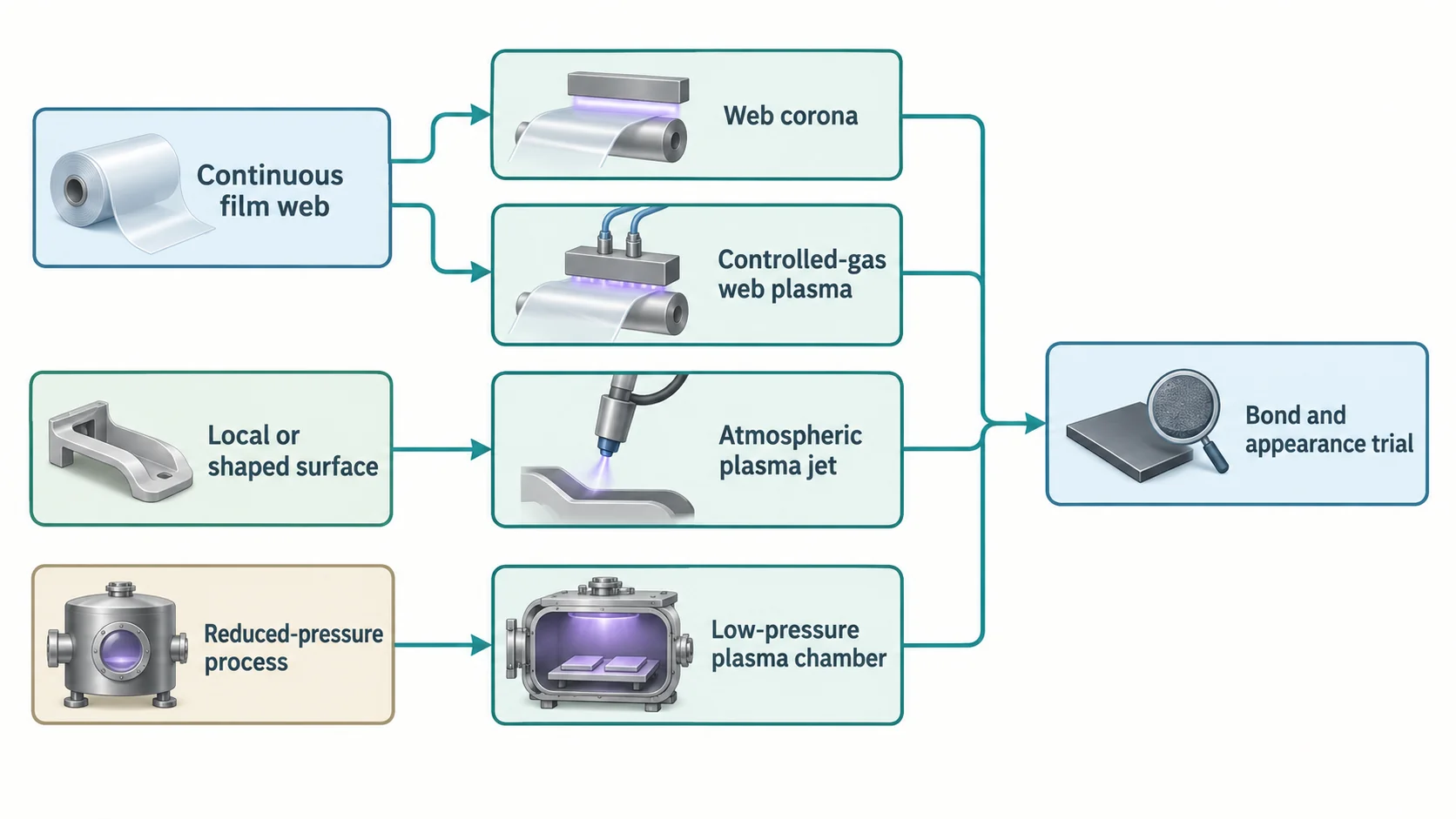
Corona treatment vs plasma treatment is really a choice between equipment routes, because corona is itself a plasma discharge in air. For a film lamination line, the options are air corona, controlled-gas web plasma, atmospheric plasma jets and low-pressure chambers. Air corona is the usual starting point for one side of a moving film; the other routes earn their place when you need a specific gas, a hard-to-treat material, a thick or shaped part, or a treatment that lasts longer.
Whichever route you pick, settle two things first: which face the adhesive will touch, and which face must stay as it is.
Corona Treatment vs Plasma Treatment: What Is the Difference?
Air corona treats a moving web with a discharge in ordinary air next to a grounded roll; the other plasma routes change the gas, the pressure or the way the part reaches the discharge.
| Route | Gas and pressure arrangement | Work format | Integration question |
|---|---|---|---|
| Air corona | Discharge in ambient air | Commonly continuous film or web | Can the station treat the required side evenly at production speed? |
| Gas or chemical corona | A controlled alternative gas around the discharge | Continuous web equipment where configured | How are gas delivery, containment and exhaust managed? |
| Atmospheric glow or web plasma | Controlled atmospheric discharge and gas arrangement | Continuous web systems where configured | What uniformity and process window does the supplier demonstrate? |
| Atmospheric plasma jet | A directed nozzle operating at atmospheric pressure | Local tracks, edges or parts; arrays may cover larger areas | How do nozzle spacing, distance and travel speed cover the part? |
| Low-pressure plasma | Reduced-pressure treatment in a chamber | Parts or web systems designed for that chamber | What handling, vacuum cycle and throughput fit production? |
Enercon’s route comparison separates air corona, gas corona and atmospheric glow plasma, which is a reminder that “plasma” does not always mean a nozzle. Plasmatreat’s overview describes atmospheric nozzle equipment and sealed low-pressure chambers.
Flame treatment is a fourth route with its own trade-offs; a flame-versus-corona comparison says nothing about electrical plasma. When a supplier quotes “plasma,” ask for a drawing of the station, gas supply and web path.
For the full sequence from board preparation to bonding and inspection, see how to laminate MDF.
How Does Corona Treatment Work on Plastic Film?
A high-voltage discharge in the air gap above the film adds polar groups to the surface, so inks, coatings and adhesives wet it more easily.
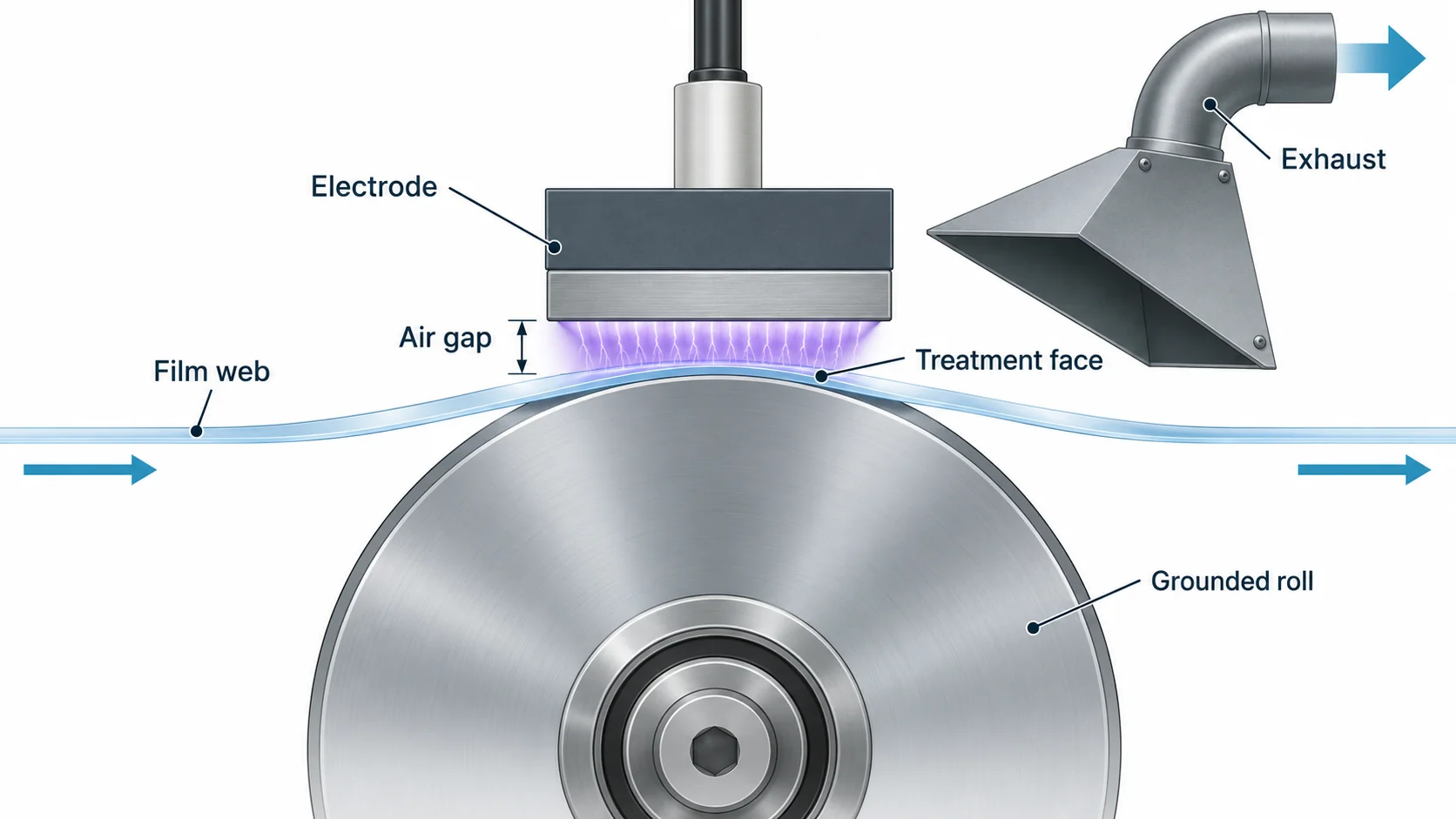
In a typical roll station, an electrode faces a grounded roll and the film runs through the gap between them. The discharge also produces ozone, so the station needs exhaust or ozone destruction, planned in from the start.
The classic shop-floor problem is backside treatment. Pillar’s explanation of unwanted backside treatment traces it to air trapped between film and roll, from dirty rolls, wrinkles, tension or static. The side you did not mean to treat gets treated, which can cause blocking or picking in the roll and steal energy from the intended face.
“Backside” here means the face opposite the electrode, not necessarily the adhesive side of a decorative film. Mark both faces on the line drawing so nobody fixes a bonding problem by treating the decorative face.
If you already have peeling panels, find the failed interface first with the delamination failure-plane guide. Treatment is one process intervention to evaluate after that diagnosis.
What Can Plasma Treatment Do That Corona Can’t?
Plasma routes can use a chosen gas, reach shaped parts and thick materials, treat some polymers corona barely touches, and even deposit a functional coating.
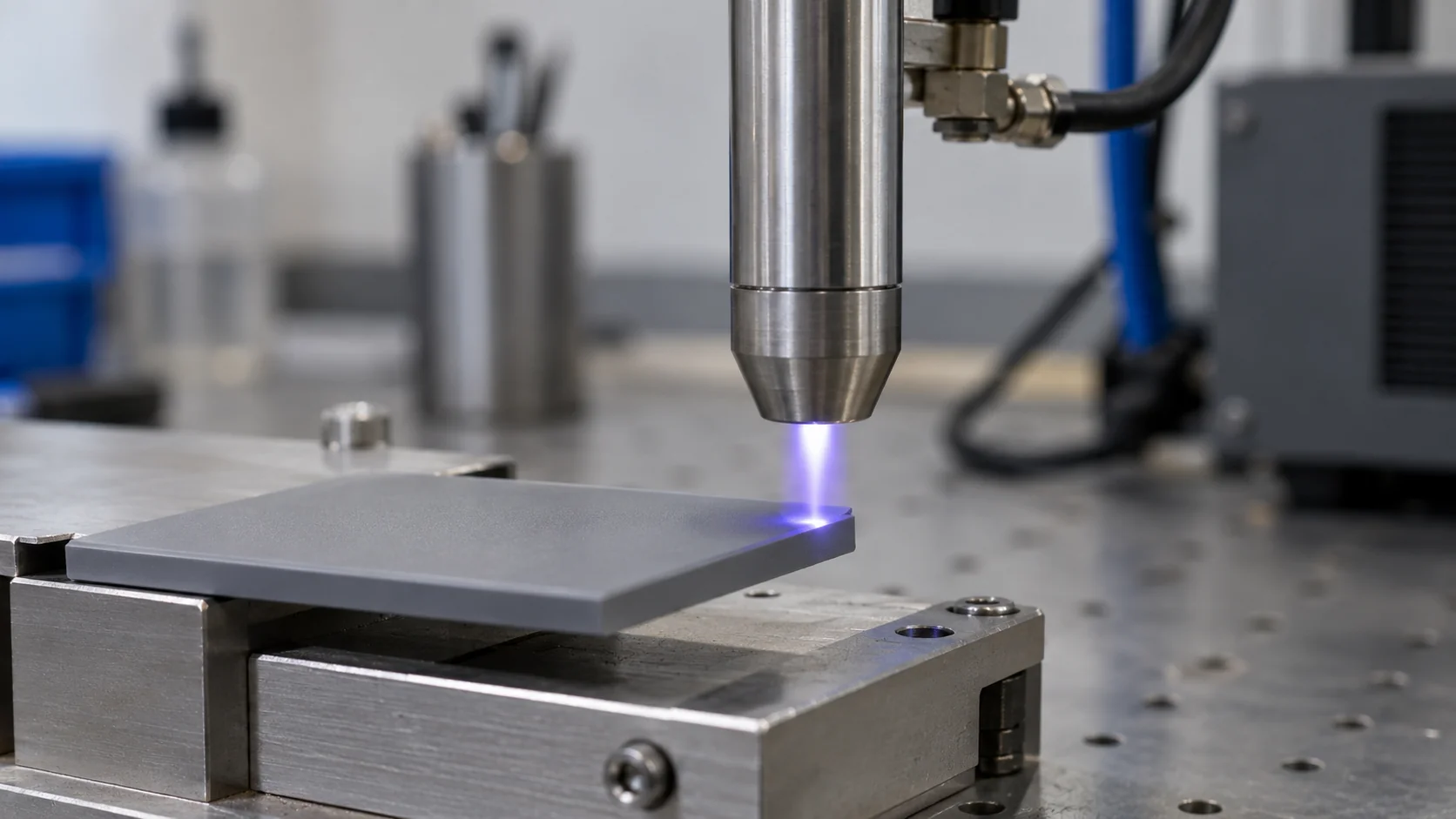
A corona station works across a fixed gap, so thick sheets and three-dimensional parts are hard to treat, a limit that two plasma equipment makers describe. A jet can follow an edge or a molded part instead. Enercon also reports that fluoropolymers such as PTFE do not respond to corona but do respond to plasma, and that plasma-treated films hold their treatment level longer. Those are vendor claims, so ask for a demonstration on your own film.
Fraunhofer IFAM separates plasma cleaning and activation from plasma coating, with examples that promote adhesion and others that repel water. Plasma does not automatically make a surface easier to bond; the gas and purpose decide the result.
That matters for decorative film. You want the adhesive to wet the bonding side while the functional face stays untouched, so write the allowed treatment side and the properties to preserve into every trial request.
The carrier name does not tell you what is exposed on each face. Our comparison of PET, PVC and silicone-faced decorative film separates the carrier from the functional surface; check for coatings or primers before planning treatment.
How Long Does Corona or Plasma Treatment Last?
Treatment fades over time, and how fast depends on the film’s additives, its age and how it is stored, so qualify your own time window between treatment and bonding.
Vetaphone’s treatment guidance explains that wetting levels drop with time and drop faster in films with more slip additive, in older stock and in warm storage. Its printing examples come from a different process, so use the principle, not the deadline.
Picture a roll treated on Friday, stored over the weekend and laminated on Monday. Compare it with freshly treated film under the same bonding conditions. Log the treatment date, storage conditions, film grade and lot so a formulation change shows up in the records.
An inline refresh station before the laminator is a common answer, but it adds another treatment pass that needs its own qualification. Better wetting also cannot rescue the wrong glue; the panel-lamination adhesive guide covers that side of the bond.
How Do You Check Treatment Before Laminating?
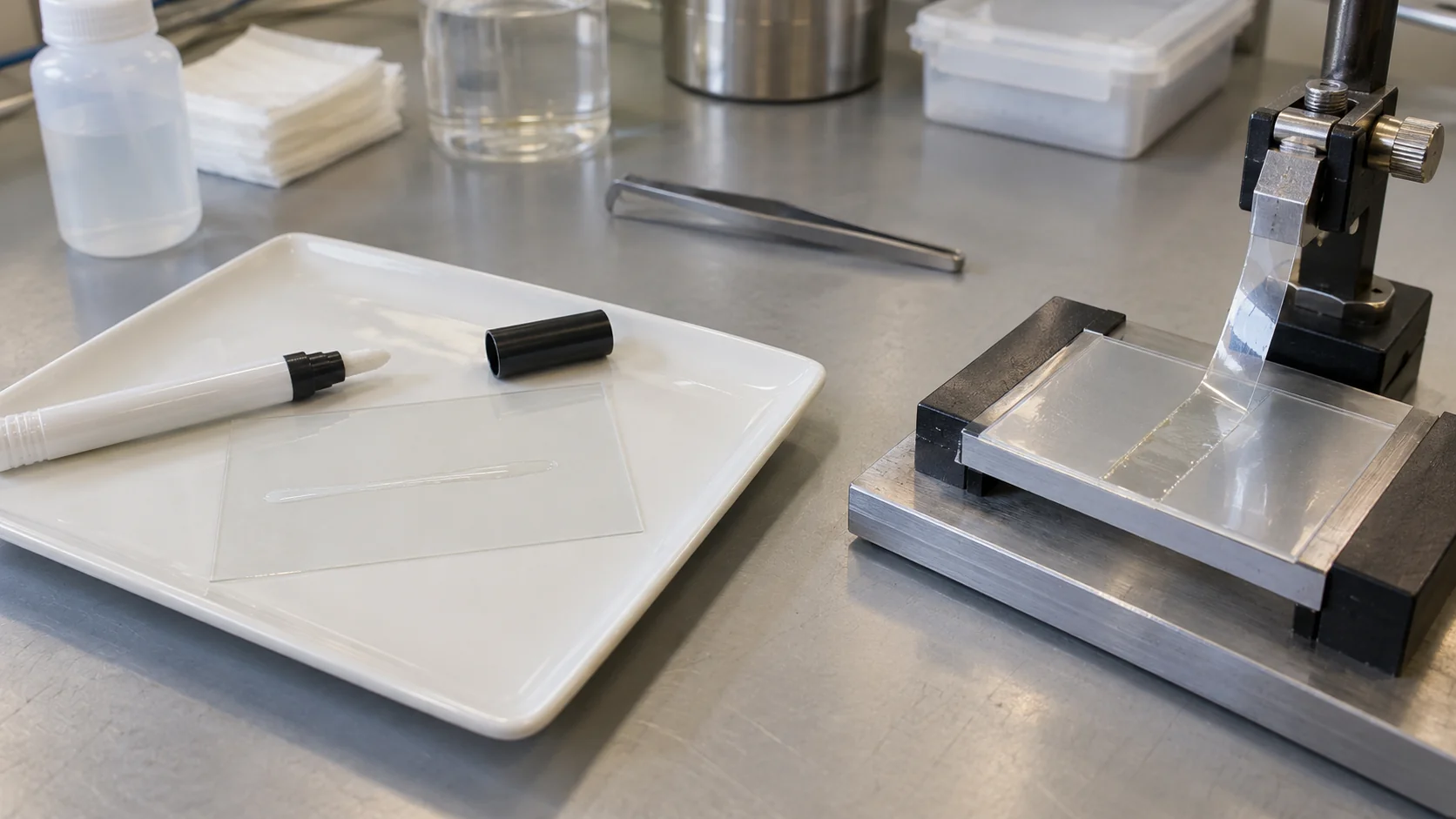
Use a dyne test as a quick screen, then confirm with a peel test on the real construction.
ASTM D2578-23 measures wetting tension on polyethylene and polypropylene film; for other polymers you have to establish what the numbers mean. The standard itself says wetting tension cannot fully predict how well an ink, coating or adhesive will stick.
Its often-quoted 35 dynes/cm example applies to Type 1 polyethylene tubular film for commercial flexographic printing. It is not an acceptance value for a PET-carrier film bonded to a panel with PUR.
Build the correlation yourself. Laminate untreated and treated material with the same adhesive, substrate, cure and test conditions, and check gloss and color as well as bond strength.
For the bond itself, ASTM D903-98(2025) describes a comparative peel method under defined specimen, conditioning, temperature and machine-speed conditions. It does not set a pass force for your construction; agree that with your film and adhesive suppliers. The MDF lamination guide covers the rest of the panel build; change one variable at a time so you know what caused an improvement.
Which Treatment Route Fits a Film Lamination Line?
For continuous film with an accessible bonding side, start with air corona; move to gas corona or web plasma only if trials show you need a different chemistry, and use jets for edges and shaped parts.
Work through it in this order:
- Mark the bonding face and the face to protect.
- Identify the film grade and its slip or other additives.
- Size the equipment. Power, line speed, effective treatment width and the number of treated faces are linked: at the same power, a faster or wider web gets less energy per area. Ask for the effective width, especially with segmented electrodes.
- Set the longest allowed time from treatment to lamination and prove it with peel samples.
For jets, record nozzle layout, working distance, travel speed and overlap in the supplier’s terms; they do not translate into a web-corona power setting. For PET-based panels, the PUR adhesive selection guide covers the adhesive questions. It does not give a treatment setting, which has to come from your own film, glue and machine.
What Should a Surface-Treatment Spec Include?
A usable spec names the film, the face, the route, the time window and the test, so another shift can repeat it; a single dyne number is not enough.
| Item | What to specify | Why |
|---|---|---|
| Film identity | Grade, lot, carrier and known coatings or additives | The exposed surface and formulation affect treatment behavior |
| Target face | A marked drawing of the bonding side and protected decorative side | Prevents treatment of the wrong interface |
| Equipment route | Air corona, gas web system, jet or chamber; actual configuration | Technology labels alone leave important differences unresolved |
| Gas and exhaust | Gas identity, delivery arrangement and equipment exhaust requirements | Makes the operating environment reproducible |
| Production geometry | Effective treatment width, face count and line or travel speed | Relates the setting to the area processed |
| Timing | Treatment date, storage conditions and allowed time before bonding | Captures retention and handling history |
| Surface screening | Suitable method, measurement location and established interpretation | A reading needs context and correlation |
| Bond trial | Adhesive, substrate, application, cure and selected test conditions | Compares finished constructions fairly |
| Acceptance | Agreed bond behavior and appearance criteria | Preserves function as well as adhesion |
| Process changes | Conditions requiring another qualification | Makes material and machine changes visible |
Write the whole laminated MDF construction into the spec, not just the film name. If the core, adhesive or cure changes, the bond can change while the treater stays the same, and the treater gets blamed for nothing.
Where Does a Silicone-Surface Decorative Film Fit?
Do not corona- or plasma-treat a silicone functional face; it is part of how the film performs, and only the bonding side is a candidate for treatment.
Puremorfilm makes furniture decorative film with a silicone functional surface on a thermoplastic carrier, currently produced on PET. Anchoring components bond the silicone chemically to the carrier inside the film. The silicone surface is inherently flame-retardant, with higher grades up to UL 94 V-0 available on request. In the manufacturer’s laboratory tests, coffee, red wine and soy sauce left for 24 hours at 25°C wiped off with no obvious change.
The formulation is No DOP. We supply mainly rolls, plus panels made by PUR flat lamination; standard supply has no back adhesive, and back adhesive can be added on request. Confirm with us which side bonds for your model, and we provide technical guidance once you start laminating. It is a paint-free silicone face, unlike PVC, melamine, PP or PETG decorative faces.
Corona Treatment vs Plasma Treatment: Which Should You Choose?
Start with the simplest route that gives the agreed bond and keeps the face intact; move to gas systems, jets or chambers only when a trial shows you need them.
| Your requirement | Route or check to prioritize |
|---|---|
| Continuous film with accessible bonding face | Evaluate a suitable web-corona station against the required bond |
| A demonstrated need for different gas chemistry | Compare a controlled-gas or atmospheric web-plasma system |
| Local access to a shaped part or edge | Evaluate a directed atmospheric jet with confirmed coverage |
| Treatment requiring a reduced-pressure environment | Evaluate chamber handling and achievable throughput |
| Good initial wetting but poor adhesion after storage | Investigate retention, the adhesive and the qualified time window |
| Functional decorative face must remain intact | Confirm side selection and appearance before treatment |
If you are developing a decorative-film lamination line, contact us with the film construction, bonding side, adhesive, line speed and treatment route.
Frequently Asked Questions
How does corona treatment work?
A high-voltage discharge in the air gap over a grounded roll oxidizes the film surface so liquids wet it better.
What is air plasma?
Air plasma is ionized air. Both air corona stations and atmospheric nozzles that run on compressed air use it.
Does the Jet plasma treatment really work?
Yes, when the nozzle distance, speed and coverage are set for the part. A peel test on the real bonded part is the proof.
What does plasma technology do?
It cleans, activates or coats a surface; the gas and settings decide whether the result bonds better or repels water.
What are common corona treatment problems?
Backside treatment, treatment that fades in storage, uneven treatment across the web and ozone that needs extraction.