
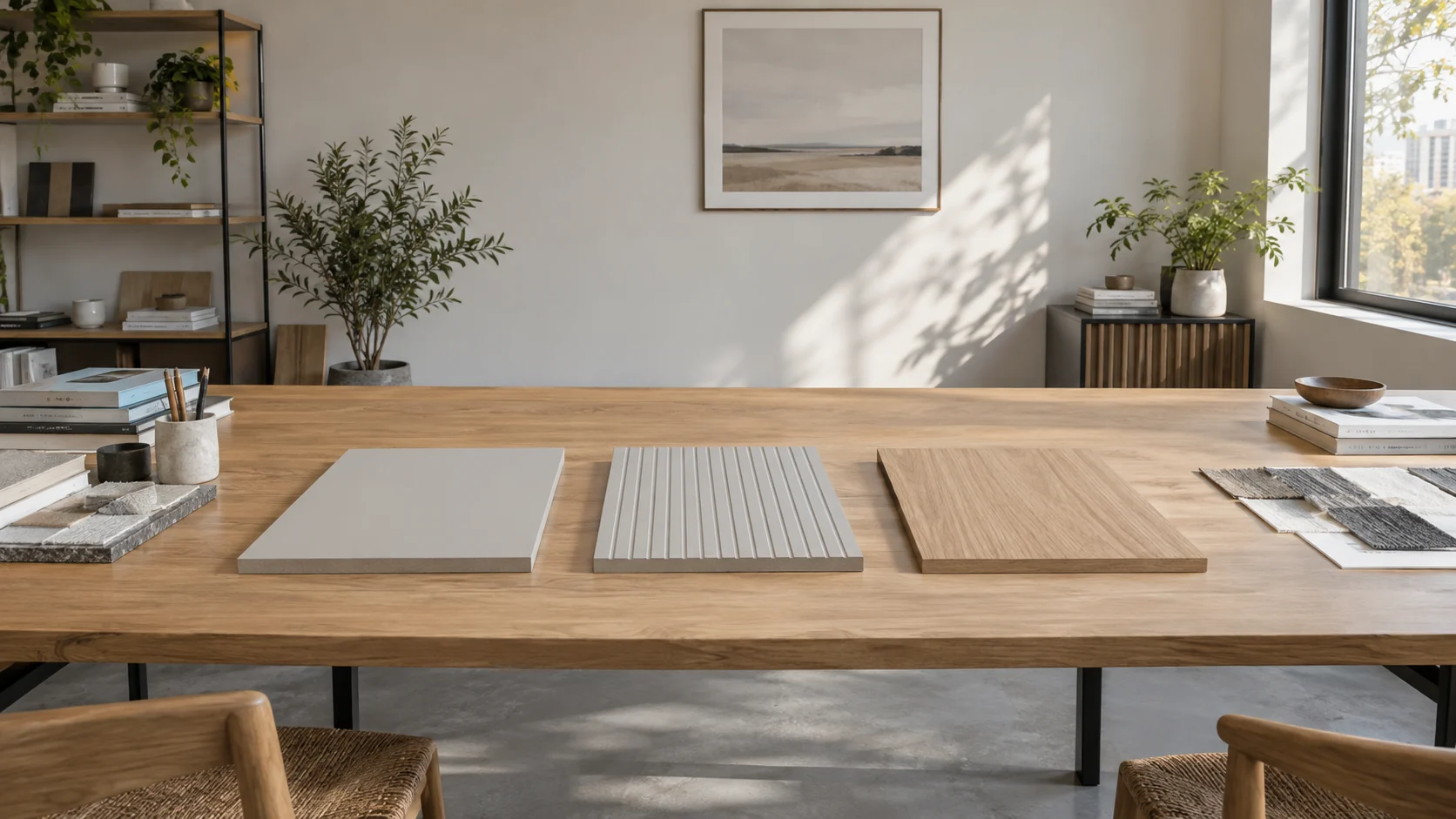
MDF wall panels pros and cons start with a smooth face and easy shaping. However, plan for moisture sensitivity, handling weight, vulnerable edges, emissions and secure fixings. A painted feature wall can look convincing as a small sample. Once it is up, problems can show at the base, joints or fixing points.
Choose MDF for a dry interior wall where painted detail or a flat decorative facing matters. If the wall will get wet, carry heavy equipment or needs a stated acoustic or fire performance, settle the grade and the complete wall system first, and pick the visible finish last.
What are the main advantages and drawbacks of MDF wall panels?
MDF makes good decorative interior paneling: its uniform fibers take smooth finishes and repeated profiles well. Its wood-based core still needs protection from water and a fixing design that suits it.
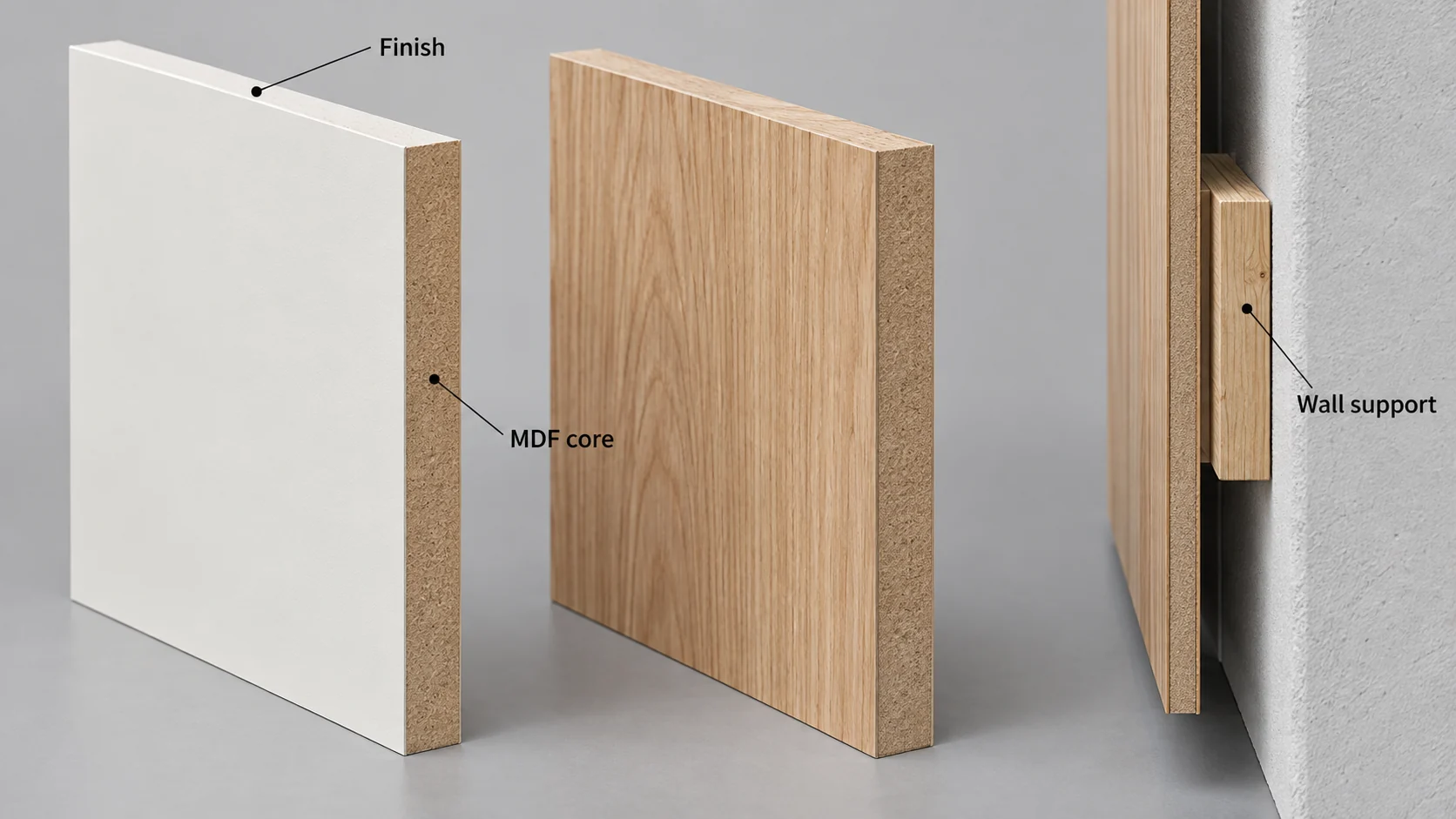
Medium-density fiberboard is wood fiber bonded with resin or another bonding system under heat and pressure. It can be a complete decorative sheet, shaped strips, or the core under veneer and other facings. So a wood-looking surface tells you little about what sits behind it.
| Wall-panel priority | MDF advantage | Limitation to plan around |
|---|---|---|
| Painted appearance | Smooth face without visible knots or natural grain | Exposed edges and routed surfaces need their own finishing treatment |
| Decorative detail | Consistent material for grooves, moldings, and repeated shapes | Thin projecting details and corners can be damaged during handling or use |
| Budget | Can suit economical painted millwork and repeat production | Finishing, handling, backing, and installation affect the completed cost |
| Moisture | Humid-interior grades are available | Standard MDF and MR MDF have different exposure limits; direct wetting remains a concern |
| Installation | Flat sheets offer predictable layout surfaces | Panel mass, wall condition, and connections determine the attachment |
The Composite Panel Association’s MDF overview covers its smooth face, clean machining and use for decorative facings. Those properties make it useful for a painted wall.
When you collect quotes, price the same wall area, profile, finish and installation. A raw-board quote and a finished-panel quote cover different work. Our explanation of MDF uses, strength and grade choices gives the wider material background; this article stays with the vertical wall and what it is exposed to.
To compare panels with the other wall finish categories, see the types of wall coverings.
Why does MDF suit painted or decorative wall finishes?
Because its face is smooth and its structure is consistent, there is no grain or knot pattern to show through the paint or the design.
On a painted wall, you choose the color without worrying about the core’s appearance. On a veneered wall, the veneer supplies the wood grain and the core supports it. Solid wood has grain all the way through; a veneer-faced MDF panel has a thin wood surface over fiberboard. That changes how scratches look and how you repair them.
A flat sample hides some of the finishing work. Grooves expose material below the face, and a cut edge has a different surface from the factory-sanded sheet. Look at those areas on the sample under side lighting, which shows roughness, steps at joints and uneven sheen. A flat panel can still have routed details that need different coating preparation.
Use the MDF finishing guide for face, edge, primer and paint preparation; a pre-primed label does not mean the wall is finished. A finished panel should arrive with a defined decorative face and edge detail, not on the assumption that every visible surface got the same treatment.
The USDA Wood Handbook, 2021, Chapter 11 describes how MDF is made and used for interior trim.
For a film-faced option, see the surface film for wall panels.
How do weight, fixings, and impact affect the choice?
Panel weight and the load path into the wall decide the attachment. Edge exposure and likely knocks decide whether the decorative detail is practical.
Use the board’s stated mass, or calculate it as density multiplied by finished panel volume in consistent units. Add the facing, backing and any hardware. Panel size matters as much as the material: a full sheet and a narrow strip are very different to lift and fix. MDF is not automatically heavier than every plywood or solid wood; thickness and density decide.
Chapter 12 of the USDA Wood Handbook, 2021 treats bending, internal bond and fastener holding as separate properties. A dense-looking board gives you no anchor rating. The wall behind, the fastener engagement, the panel connection and the direction of load all go into the design.
Fix shelves, televisions and other heavy items into framing or designed blocking, not into the decorative cladding just because a screw will go in. Mark where those fixtures go before you finalize the panel layout, so you don’t have to cut into a finished feature wall later.
In a hallway or behind dining chairs, projecting ribs and lower edges take far more contact than an upper feature wall. For that kind of wall, specify a protected corner, a replaceable lower section, or a panel with documented impact performance. The MDF and plywood comparison goes further into core and connection tradeoffs.
Where do humidity and water make MDF a poor fit?
Standard MDF belongs on dry interior walls. A documented moisture-resistant grade can handle humid interiors, but walls that get wet directly need a different level of protection and product approval.
Judge the wall’s actual moisture exposure. A bathroom wall away from the bath sees humidity; a shower enclosure gets soaked. However, a basement that is dry today can still have a leaking wall, a damp slab edge or condensation behind the cladding. Find out what the wall actually experiences before you cover it.
As a raw-board example, MEDITE MR’s current FAQ allows humid interior use, including kitchens and bathrooms, says to avoid wetting, requires full sealing and coating in humid conditions, and excludes exterior use. In practice: MR suits a humid interior wall, and that wording gives no approval for a shower or an outside wall.
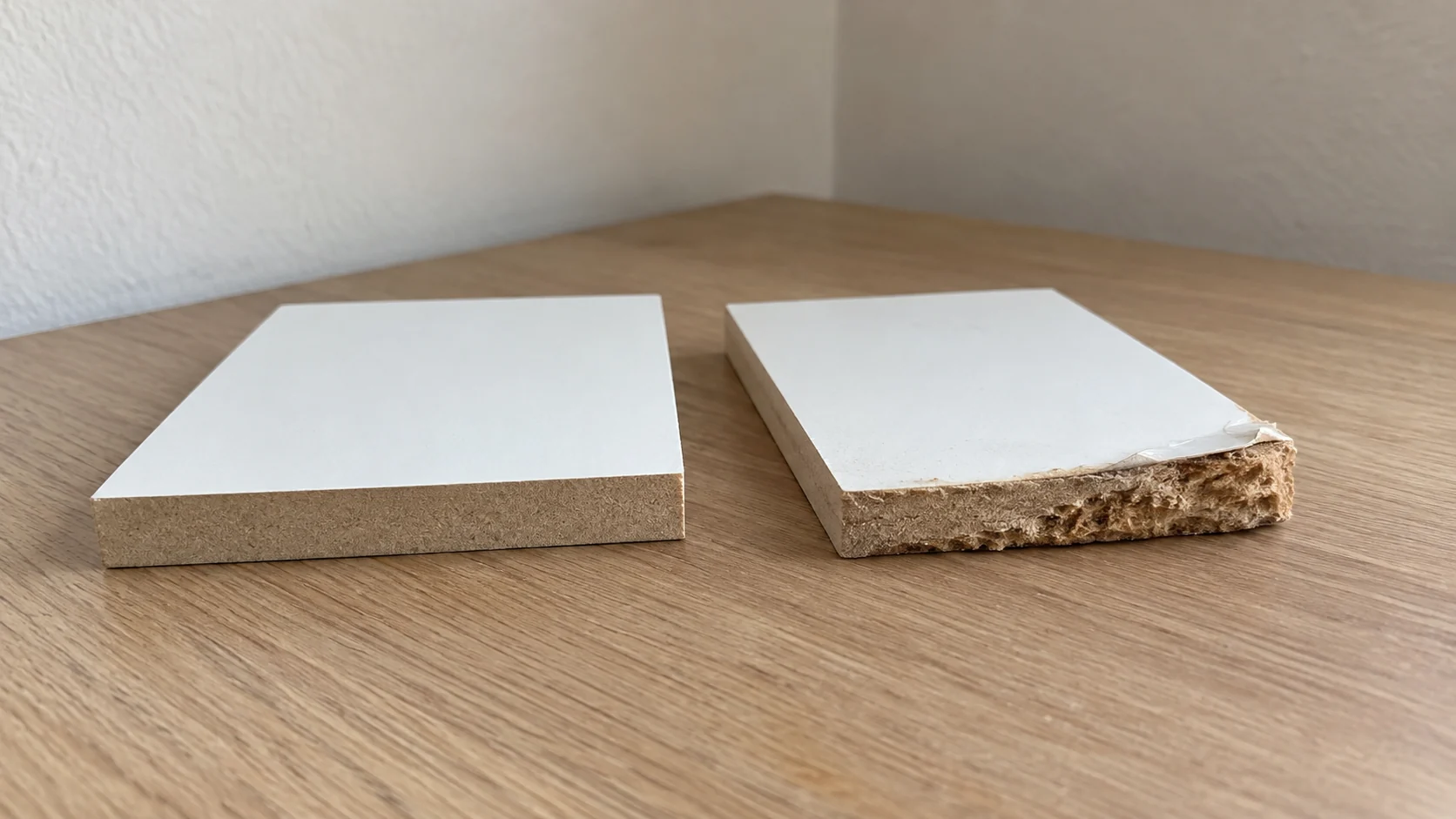
Water reaches the core through cut ends, joints, fixing holes and the back, even when the face looks fine. Watch the wall base, where mop water or a leak collects. Swollen edges or a soft core mean the damaged material needs replacing; a new facing over the top leaves the damage in place.
Moisture correction comes first in the EPA’s moisture and mold guidance, which also explains that mold is hard to remove from porous materials. Fix damp or mold before you panel over it. The MDF water-resistance guide covers grades and exposure beyond wall paneling.
What should you check about indoor emissions?
For a US project, check that the MDF core complies with TSCA Title VI and that the finished panel carries its own documentation. Then check any further indoor-air requirement against the actual finish and adhesive.
The EPA’s consumer FAQ on composite wood standards lists formaldehyde emission standards of 0.11 ppm for MDF and 0.13 ppm for thin MDF. These are product-emission limits measured under the rule’s test method, not room-air targets.
The same FAQ explains labeling. Core-panel labels name the producer, lot, recognized third-party certifier and a compliance statement; finished-goods labels carry the fabricator, production date and compliance statement. Keep the records that belong to the product you buy, and ignore an untraceable “eco” description.
A no-added-formaldehyde claim describes what went into the resin. A low-emissions claim describes a tested result. Neither covers the paint, the installation adhesive or anything else in the finished wall. If your project has a wider indoor-air specification, ask for finished-product test evidence and check which construction it covers.
Cutting and sanding create dust, which is a separate exposure from emissions after installation. Use extraction and follow the board’s safety instructions in the workshop. A compliant core doesn’t remove the need for dust control, and a decorative face doesn’t replace the core documentation.
Does MDF paneling provide sound absorption or fire protection?
Plain MDF paneling gives you a decorative surface. Any acoustic or fire claim needs test evidence for the exact panel construction and installation.
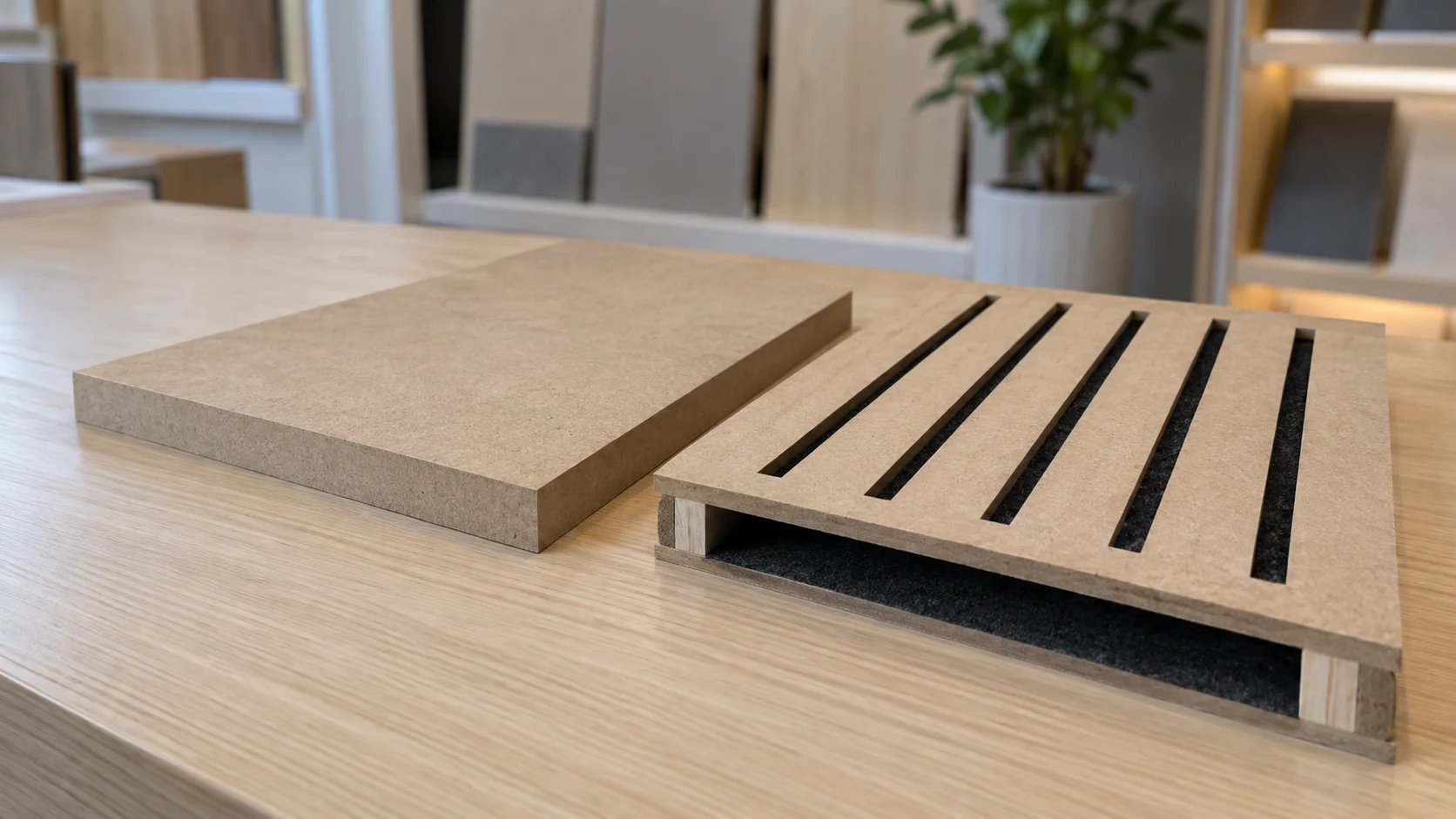
A smooth solid face and a slotted or perforated panel over absorbent backing treat sound differently. For an acoustic product, look at the openings, backing, cavity, mounting and tested performance. Change the installation and the result can change, even if the slats look identical.
ASTM C423-23e1 measures sound absorption in a reverberation room, which tells you about echo in the room. By contrast, sound passing through a partition depends on the whole wall between rooms: framing, cavity, joints and penetrations. An absorption result is not a soundproofing claim for the next room.
For fire, ASTM E84 measures surface burning characteristics, including flame spread and smoke developed. Surface burning and the fire-resistance duration of a wall assembly are different questions.
In a corridor, escape route or any location with a stated requirement, have the project’s fire professional check the accepted construction before you buy. Record the core, facing, adhesive, support and installation the evidence covers. Only the tested assembly carries the rating, so a treated core or a flame-retardant facing on its own gives you none.
When should you choose another material instead?
Choose something else when real wood through the thickness, fixture support, direct wetting or a tested wall performance matters more than a smooth decorative face.
Solid wood suits visible natural grain and details you want in real wood, though you need to allow for movement and species. Veneered MDF gives a real wood face without being solid wood. The MDF versus solid wood guide compares the two; “wood panel” on its own is not a specification.
Plywood suits jobs that need its layered construction and a documented connection design. Face quality, thickness and bond or exposure grade still matter, which is why the APA plywood overview stresses choosing grade and intended use on purpose. A plywood core also needs the right finish and wall detail.
For a wall that gets wet or hosed down, choose a system documented for that use. For example, a suitable polymer or reinforced panel system needs its specified joints and adhesive. A water-tolerant face alone leaves the wall behind and the joints unresolved. For fire-rated partitions, use the tested wall assembly and check how an added decorative finish affects it.
Compare budgets on the same scope. Painted MDF makes sense when you need a repeatable color and profile; a prefinished panel can cut site finishing. Count edge work, waste, fixings, lifting and access for future replacement. Sheet price alone won’t tell you which finished wall costs less.
Compare other wall panel materials before you settle on the core.
What should the wall-panel order specify?
Specify the core grade, finished build, wall exposure and installation evidence. As a result, the delivered panels can match your approved design.
| Item | What to specify | Why |
|---|---|---|
| Core and exposure | Named MDF grade and dry or humid interior use | Prevents substitution based only on color or the word MDF |
| Dimensions and mass | Finished dimensions, thickness, tolerances, and panel mass | Supports layout, handling, and fixing design |
| Face and edges | Paint, veneer, or other facing; routed and cut-edge treatment | Defines the surfaces you will see and maintain |
| Wall attachment | Wall substrate, connection detail, fixture blocking, and installation method | Gives the panel and attached fixtures an identified load path |
| Emissions | Applicable core and finished-product compliance records | Links the claim to the supplied construction |
| Performance and care | Required acoustic/fire evidence, cleaning instructions, and replacement access | Prevents a surface claim from standing in for the whole system |
Ask for a sample with a joint, an exposed perimeter, a profile and a fixing detail. A small face swatch can’t show how two panels meet or how a site-cut edge will look. For a repeat order, list the features of the approved sample the supplier must match.
The CPA’s 2024 storage and handling bulletin ties the panel’s moisture condition to finishing and dimensional stability. Keep panels out of wet storage and let them reach the conditions needed for fabrication and installation. Leave time for that in the delivery schedule.
For faced panels, name both the decorative layer and the core. The laminated MDF guide explains how that construction affects the order, and it stops a change of facing being mistaken for a change of moisture grade.
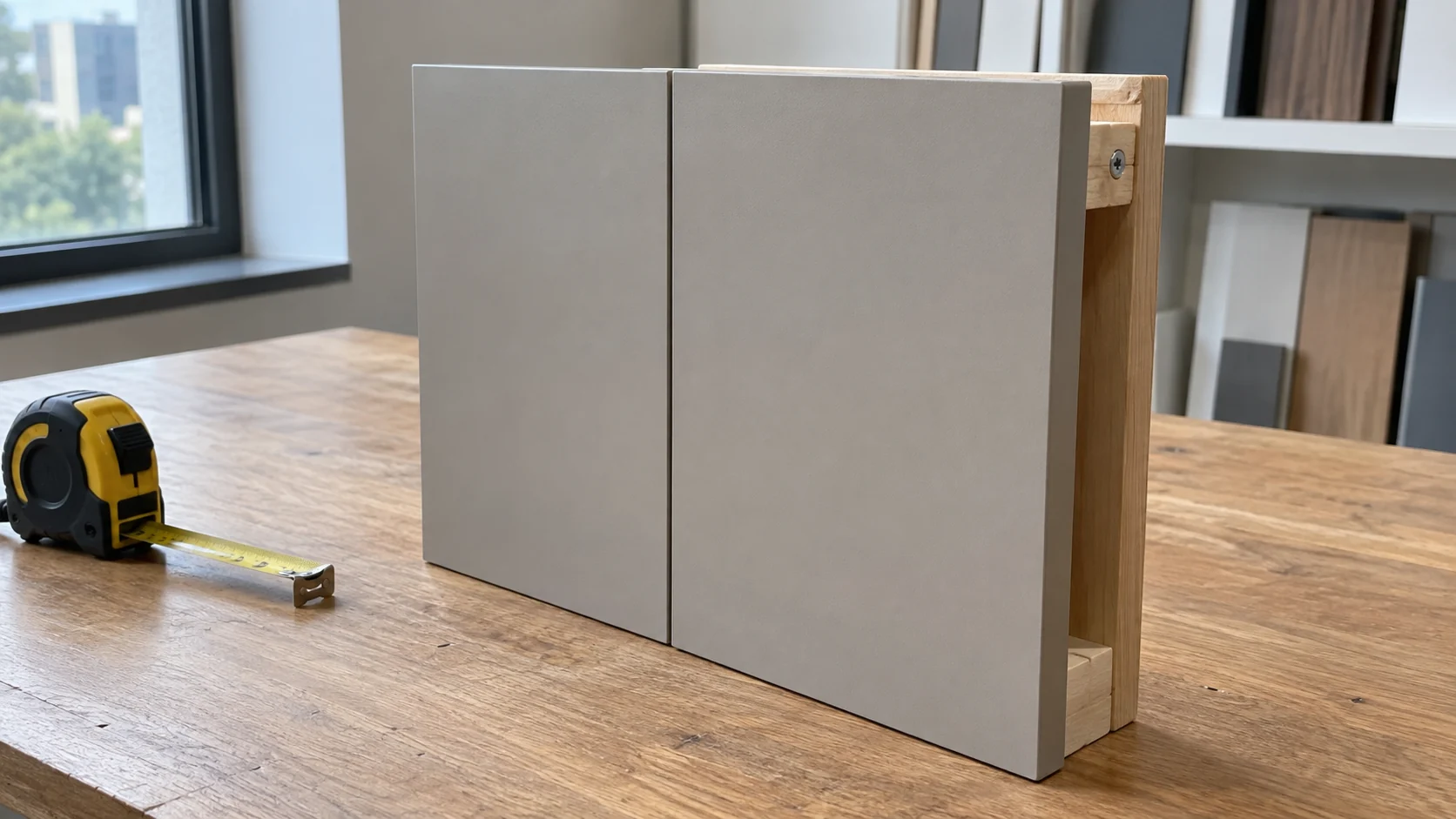
Where does our silicone decorative film fit an MDF wall?
Puremorfilm makes decorative film with a silicone functional surface that can be laminated to flat MDF wall panels in place of paint. The silicone surface is inherently flame-retardant, with grades up to UL 94 V-0 available on request, and the film uses a No DOP formulation and is formaldehyde-free. For cleaning, in the manufacturer’s laboratory tests, coffee, red wine and soy sauce left on the surface for 24 hours at 25°C wiped off with no obvious change.
On an MDF wall, heat and moisture matter too. In an SGS test (report SZIN2608002405PL01), the film’s length changed by 0.06% and its width by 0.10% after 600 minutes at 100°C and 14 hours’ recovery at room temperature. The MDF grade and edge sealing still decide how the wall copes with moisture.
We supply the film mainly in rolls, with film-faced boards on request, for PUR flat lamination; profile wrapping is not part of this route. It is a new paint-free facing whose silicone functional surface differs from PVC, melamine, PP and PETG decorative surfaces. See the decorative wall film page.
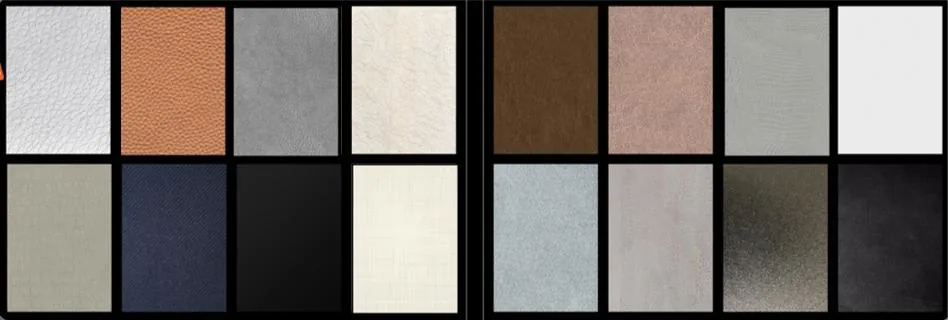
Which MDF wall-panel construction should you choose?
A finished MDF construction for a dry decorative wall, a documented MR construction for a humid wall away from direct water, and a different approved system when the wall gets wet or must meet a stated performance.
| Wall situation | Practical choice |
|---|---|
| Dry painted feature wall or wainscoting | MDF with completed face, profile, and edge finishing |
| Flat decorative feature wall | Suitable MDF core with the chosen facing and attachment detail |
| Humid room away from direct water | Documented MR grade with the specified complete finish |
| Direct wetting, unresolved damp, or required wall rating | Resolve the exposure or select the documented complete system first |
A living-room accent wall or bedroom wainscoting is the easy case. A bathroom wall beside the vanity needs the MR grade and full sealing. A shower surround or a corridor with a fire requirement is where you stop and choose the system first.
To discuss a flat wall-panel finish, contact us with the room, the core grade, the panel geometry and any project requirements.
Frequently Asked Questions
Are MDF wall panels any good?
Yes, for a dry interior decorative wall where you want a smooth painted surface or consistent shaped detail. In humid rooms, use a documented moisture-resistant grade.
What are 5 disadvantages of MDF?
Water damage, heavy panels, chipping at exposed edges and details, fixings that need careful design, and resin-related emissions that need documentation.
What is the best material for wall panelling?
MDF for smooth painted detail, solid wood for real grain through the section, and a documented wet-area system where water hits the wall. Acoustic or fire requirements call for a tested construction.
How long does MDF board typically last?
There is no single lifespan for MDF wall panels. In a dry room with an intact finish and sound fixings, a panel lasts until water, impact or failed connections damage it; swelling or soft material means it is time to replace it.
Is MDF suitable for use in bathrooms?
Yes, a documented moisture-resistant grade can suit humid bathroom areas if it is fully sealed and coated and kept out of direct water. Inside a shower, use a system approved for that exposure.
What is MDF wall paneling?
MDF wall paneling is wall paneling made from medium-density fiberboard, an engineered wood panel of compressed wood fibers and resin. It is sold as flat sheets, routed panels such as shaker, slat or beadboard designs, and pre-primed or faced boards, and is usually painted or faced on site or in the factory.
Is MDF porous?
Yes. MDF is made of compressed wood fibers, so its cut edges and unsealed faces absorb water, paint and glue. That is why MDF wall panels need sealing or priming before paint, sealed edges and a dry location; moisture-resistant MDF reduces swelling but does not make the board waterproof.