
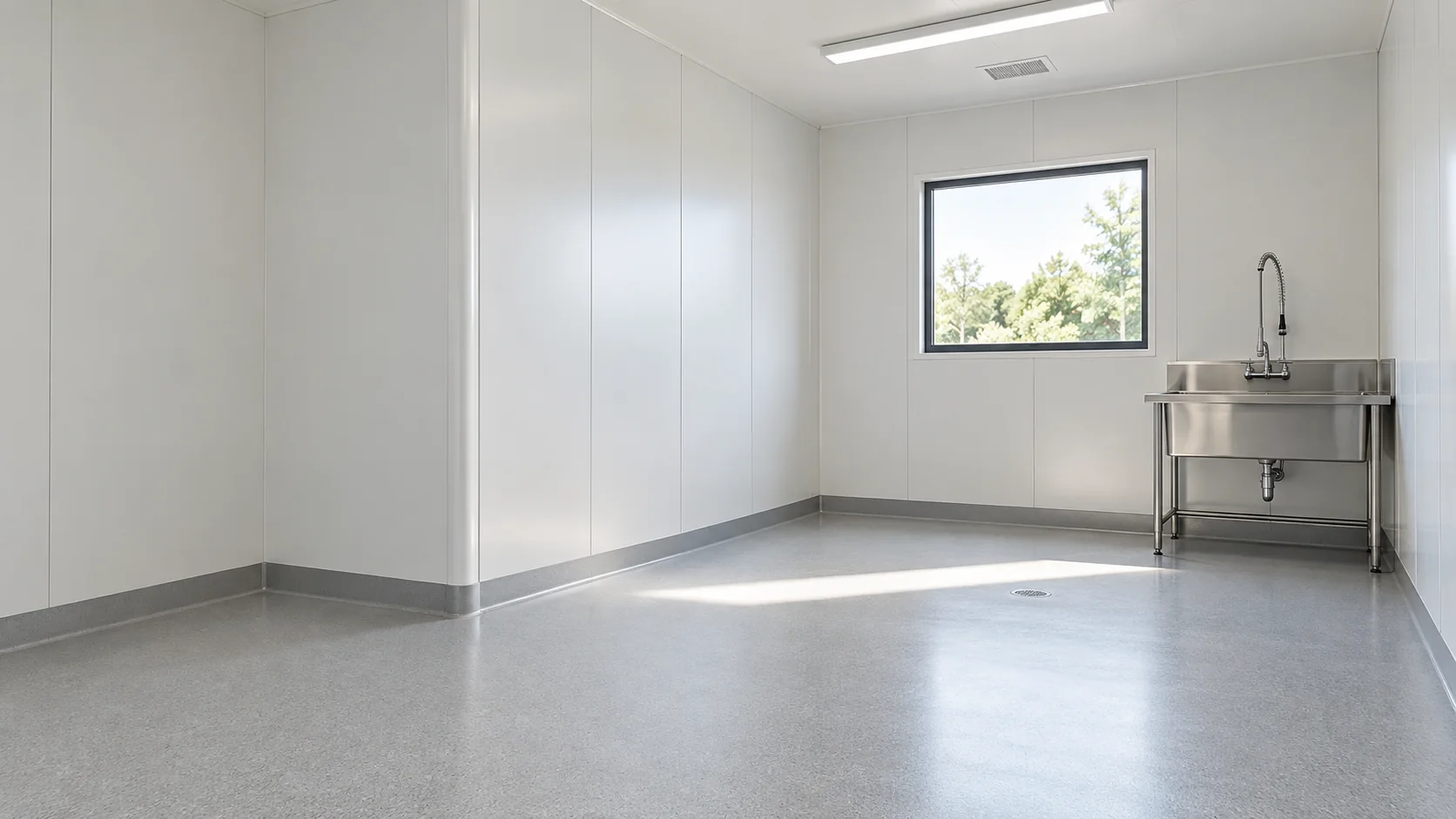
In an FRP vs PVC wall panels comparison, neither material is the better choice for every room; the wall you have and how you will clean it decide. A glued FRP sheet system can suit a porous, flat, dry and sound bonding face. Over a nonporous face you want to keep, compare an adhesive approved for both surfaces with a panel system that has a documented fixing route. Then inspect the joints, corners and openings.
A sample can show the finish you like. The installation details establish whether that finish can become a practical wall in your utility room, corridor or food-service area.
How should you choose FRP or PVC wall panels?
Choose the system that fits your existing wall and cleaning task. Glued FRP sheets can suit a sound porous bonding face; a retained nonporous face needs a compatible adhesive or another documented fixing route. Compare the actual surface, joints, corners and installation scope before deciding which panel to buy.
FRP identifies a reinforced composite family. PVC identifies a polymer used in several panel constructions. Those labels give you a starting point, while a sample section and installation sheet reveal what will actually cover the room.
| Item | FRP sheet option | PVC panel option |
|---|---|---|
| What you are comparing | Identify the reinforced sheet and its exposed finish | Identify the sheet, profile or interlocking panel construction |
| Installation route | A glued sheet system needs an adhesive suited to both bonding faces | Establish whether the proposed system uses adhesive, mechanical fixing or both |
| Existing wall | Check the adhesive’s accepted substrates and the condition of the wall face | Check the specified backing, support and fixing details |
| Joints and corners | Examine the proposed trims, movement allowance and sealed details | Examine the actual joints, trims and openings for that system |
| Cleaning | Match the finish and joint details to your cleaning routine | Match the finish and joint details to your cleaning routine |
| Budget comparison | Include preparation, adhesive, trims, labor and waste | Include the same finished scope, with the proposed fixing system |
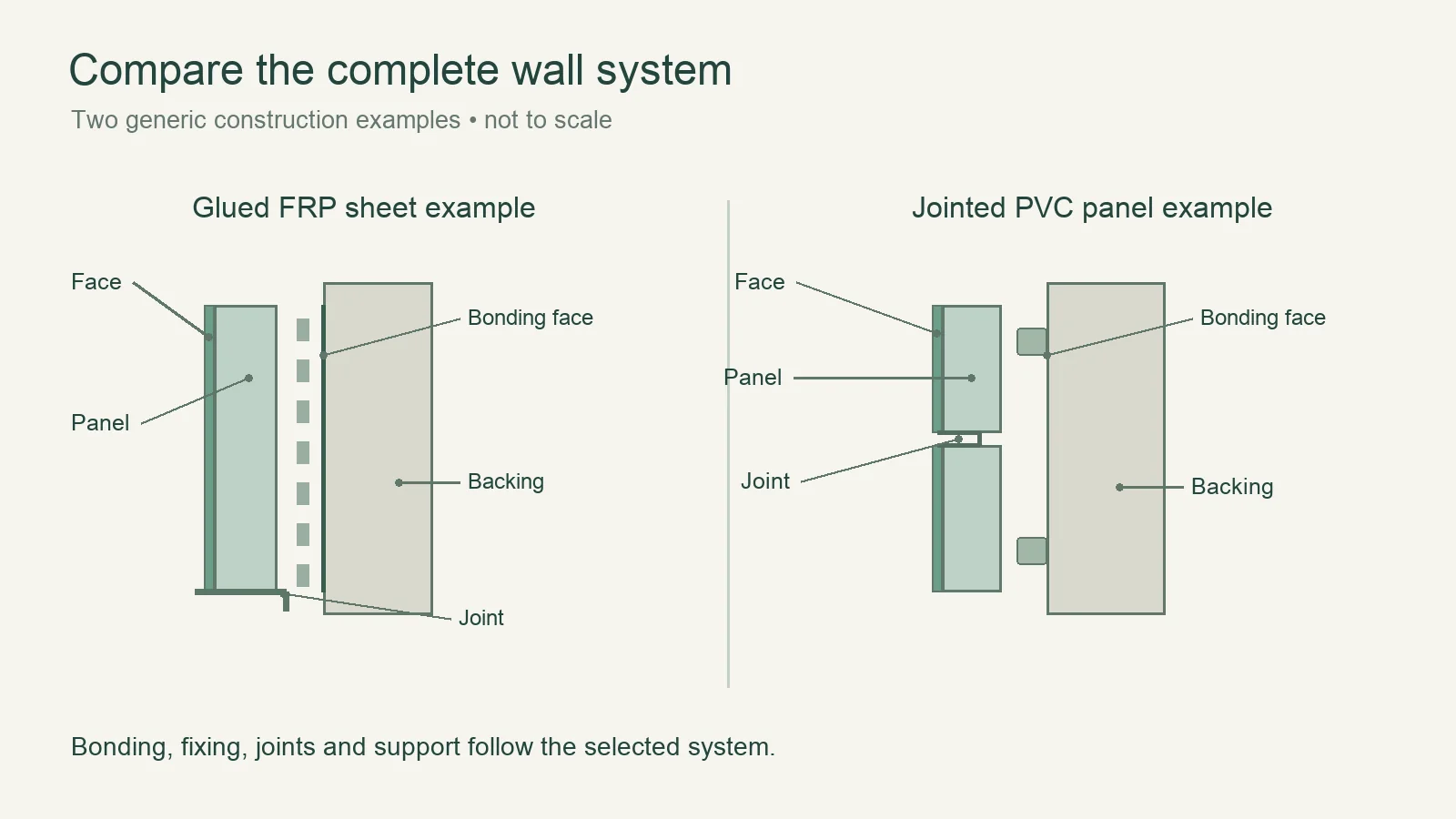
For a dry utility-room wall, inspect how a joined sample looks and how its corners will finish. For a wall washed frequently, give the cleaning and lower-wall details more weight. A broad choice between wall panel materials can help establish the shortlist before comparing complete systems.
How do FRP sheets and PVC panel systems differ?
FRP wall sheets are reinforced composites, while PVC panels use PVC in constructions that can include sheets and profiles. The distinction affects what you need to identify: reinforcement and resin for the FRP sheet, and the actual PVC construction and finish for its alternative. Both still need a defined backing and joint system.
ASTM D5319-26, active and updated October 13, 2026, covers glass-fiber-reinforced polyester wall and ceiling panels for light construction and semi-structural applications. That is the specification’s stated scope, so establish whether the proposed product falls within it before relying on a reference to the standard.
PVC formulations also vary. The Vinyl Institute describes rigid and flexible PVC products and explains how additives and modifiers are selected for a product’s performance requirements.
Ask for a cut section or construction drawing alongside the face sample. Is the decorative finish part of the panel body, a coating or a separately applied facing? How does the joint close, and what supports the panel behind it? A marble-look sheet and an interlocking profile may look similar from across a room while requiring different installation details.
The PVC wall panel guide covers those construction choices in more depth.
Which installation route fits your existing wall?
Identify the surface the adhesive will touch, including any retained paint or sealer. A water-based FRP adhesive intended for porous surfaces can be unsuitable when both bonding faces are nonporous. In that case, evaluate a specifically approved alternative adhesive or fixing system, then check that the existing face is sound enough to retain.
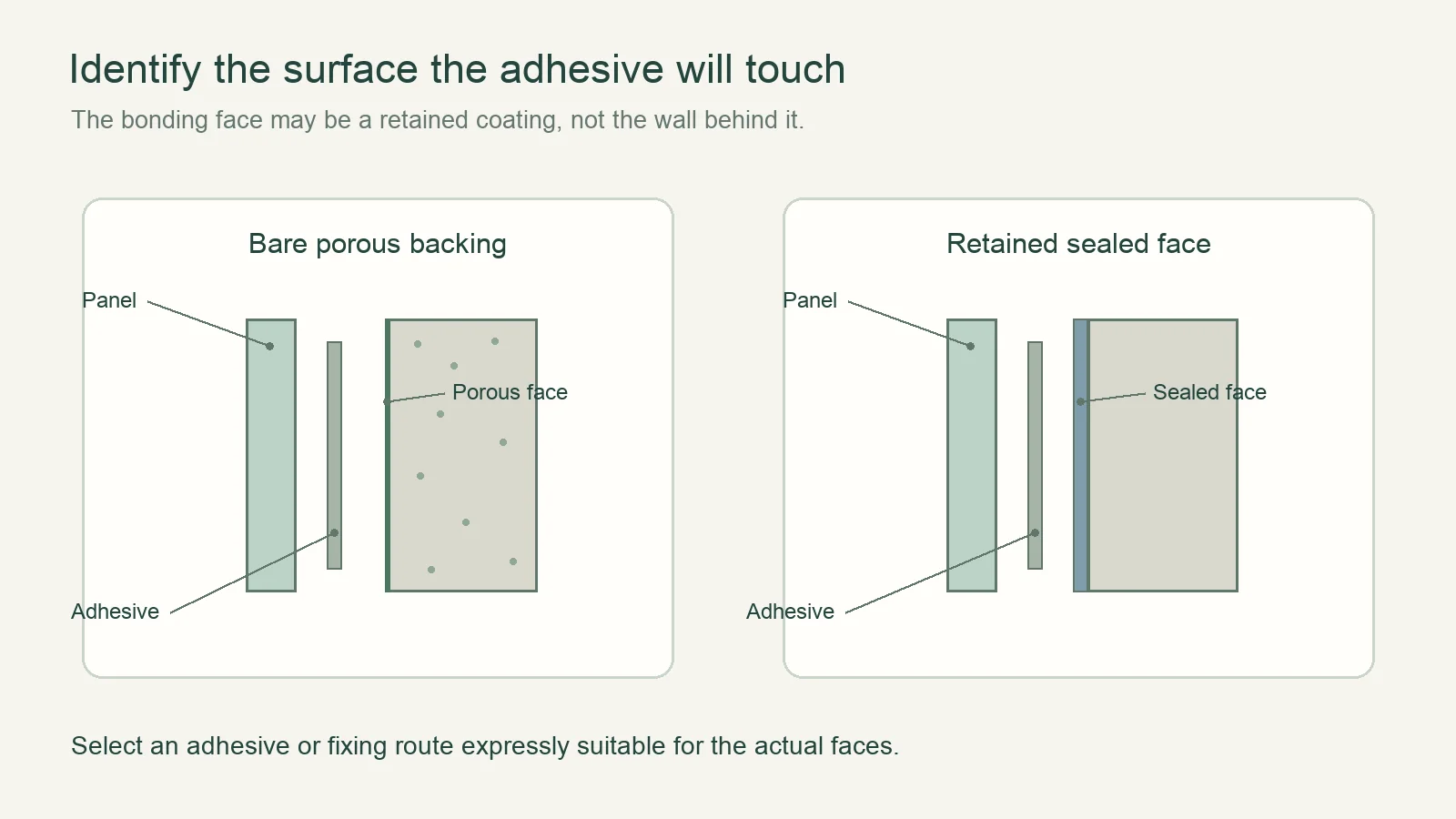
The Fast Grab FRP adhesive instructions list unprimed, unpainted drywall, fiber-cement backer, wood and untreated plywood among accepted porous surfaces. This grade explicitly excludes bonding two nonporous surfaces. Its examples include metal, plastic, sealed concrete and fiberglass-faced or mold-resistant gypsum.
Titebond’s Advanced Polymer alternative is listed for porous and nonporous building materials, including FRP and vinyl/PVC. Its limitations still direct painted, plastered or seal-coated surfaces to technical service. Heavy or uneven panels may need bracing or mechanical fastening.
Use this bonding-face card to organize the site discussion:
| Existing bonding face | Route to consider | Confirm before ordering |
|---|---|---|
| Bare, porous face accepted by the selected adhesive | Glued sheet system | Wall condition, flatness and the exact listed substrate |
| Metal, plastic or sealed surface retained in place | Adhesive expressly suitable for both faces, or a documented fixing system | Coating adhesion, preparation and any technical-service conditions |
| Loose paint, dust, oil or substantial unevenness | Prepare or repair the wall before selecting the final route | Who performs the work and what condition the installer will accept |
| Heavy or uneven panel | System-specific bracing or mechanical support | Fixing locations, backing and the maker’s instructions |
The porous-surface grade calls for dry, clean surfaces without bond-inhibiting dust, oil, high spots or heavy joint-compound build-up. Its instructions also preserve room for panel movement in trims and openings. Settle those details with the installer using the actual panel instructions. The hygienic cladding installation guide provides the wider sequence for assessing the wall and its junctions.
Which system is easier to clean and keep dry?
Choose the system whose face and junctions can be cleaned using the routine your room needs. Look at corners, seams, pipe openings and the floor-wall connection together. A smooth sample is useful, but the installed details determine whether dirt and water can be reached and removed during normal cleaning.
The FDA Food Code 2026 is a model that government jurisdictions can adopt for retail and food-service regulation. Check the locally applicable requirements for your project. Its Chapter 6 text, printed pages 133–135, connects smooth, durable, easily cleanable surfaces with their design, construction and installation; specified moisture-exposed locations also require nonabsorbent surfaces.
The cleaning method changes the detail. Section 6-201.13 distinguishes ordinary cleaning from water flushing: the latter calls for a drained, sloped floor and a coved, sealed floor-wall junction. That is a useful question for the room designer before a panel pattern is approved. A material-family label is not an FDA certification.
Ask the supplier to mark the daily cleaner, cloth or equipment permitted for the particular face. Follow the same check through the joint material and trims. For healthcare or another site with a defined disinfectant routine, the disinfectant-resistant wall covering guide explains why the specific chemical and exposure matter.
Moisture behind the panels deserves a separate inspection. The EPA mold guide makes moisture control central to preventing recurring mold. Find and correct a leak or condensation problem before installing the new finish.
How should you compare impact and fire reports?
Compare reports for the supplied panel construction and its stated support, using the same method and result criteria. Impact evidence concerns a particular specimen and mounting arrangement. Fire evidence also has a defined test scope. Record those details before treating two results as a reason to choose one complete wall system.
For a corridor, identify the likely contact: a suitcase, trolley or another object reaching a particular height. Then ask which tested panel and backing match the proposed installation. The wall protection materials guide helps separate decorative areas from locations that need dedicated protection.
The public scope of D5319-26 points to supplementary impact, chemical-resistance and installation information in an appendix. The public page does not provide a universal finished-wall impact acceptance value. Keep the report’s specimen, support, method, endpoint and observed damage alongside its result.
The same scope warns that a laboratory flammability response does not, by itself, cover every factor in a real fire. Ask which assembly and mounting were tested and what the reported classification actually describes. A surface-burning classification and a wall’s fire-resistance duration answer different questions; the ASTM E84 report guide develops that distinction.
Put the report reference on the sample approval sheet. If the face, backing or fixing changes later, ask whether the evidence still covers the replacement construction before accepting the substitution.
What are FRP vs PVC wall panel costs?
A January 2026 Homewyse FRP example for ZIP 47474 and 500 finished square feet totals $2,932.98–$4,503.86, about $5.87–$9.01 per finished square foot. Use that specified installation estimate as background, then request FRP and PVC quotations for the same wall preparation, coverage, joints, fixing system and labor scope.
The published example uses basic contractor-grade material, medium-cost labor and a complex-shape, one-level room layout. Its material purchase allowance is 534 square feet, while the finished area is the denominator for the unit price. Dividing by the larger purchase quantity would understate the cost per covered area.
Demolition, repair or remediation, systems changes, tax and fees are among the items outside the listed basic scope. A damaged existing wall can therefore change your actual quotation substantially. Ask who is responsible for exposing and repairing the backing before comparing the panel totals.
| Quote line | Ask the installer to include | Why it changes the comparison |
|---|---|---|
| Existing wall | Removal, repair, cleaning and preparation | The two fixing routes may need different preparation |
| Bonding or fixing | Exact adhesive or mechanical system and required support | Panel price alone omits the installation route |
| Trims and joints | Corners, ends, movement details and floor junction | These complete the visible and cleanable wall |
| Openings | Pipes, sockets and other penetrations | Cutting and finishing add work |
| Quantity and waste | Finished area, purchased area and disposal | The quoted area needs a common denominator |
| Cleaning detail | Details suited to the room’s actual routine | Frequent flushing changes the required junctions |
Adhesive coverage also belongs to a named product and tool. The porous-surface FRP grade above lists approximately 50 square feet per gallon with a V-notch trowel measuring 3/16 inch wide, 1/4 inch deep and 1/2 inch center-to-center. Use that instruction to discuss the chosen route; establish actual requirements for the job before ordering.
Compare the price of a completed wall you can maintain. A lower sheet price may be offset by preparation or omitted trims, while a higher total may already include those items.

Where does a silicone surface fit in this comparison?
Puremorfilm supplies decorative wall film with a silicone functional surface for flat interior panels. It is a face-layer option to sample when appearance and documented stain performance fit the brief. The wall film is PVC-free and uses a No DOP formulation; the complete panel still needs its own construction and installation specification.
The silicone surface is inherently flame-retardant, with higher grades up to UL 94 V-0 available on request. In the manufacturer’s laboratory tests, coffee, red wine and soy sauce left at 25°C for 24 hours wiped off with no obvious change.
We mainly supply rolls for PUR flat lamination; standard film has no back adhesive, with back adhesive available on request. Film MOQ is 500 linear metres. Laminated panels are available on request in 1220 × 2440 mm, with a separate MOQ of 200 panels. Samples are free.
Our paint-free wall film uses a silicone functional face, distinct from PVC, melamine, PP and PETG decorative faces. Its leather-like feel and elasticity make it unsuitable for floors, stovetop counters, shower floors and other walked-on areas.

Which panel system should you approve for your site?
Approve the system that connects your existing wall, cleaning task and budget to a complete installation. Start with a compatible bonding or fixing route, inspect a joined sample and its corner details, and compare quotations at the same finished scope. Keep the selected panel, adhesive or fixing, backing and care instructions together in the approval.
| Site situation | Start with | Confirm before approval |
|---|---|---|
| Intact porous wall face | A glued sheet system with an adhesive accepting that substrate | Preparation, flatness, joints and movement details |
| Nonporous face you are keeping | An adhesive approved for both faces or a documented fixing route | Retained coating condition and system-specific support |
| Frequently flushed room | A complete cleanable system designed for that routine | Locally applicable requirements, drainage and the floor-wall junction |
| Decorative flat wall | A sampled decorative face on an appropriate panel system | Appearance, relevant exposure evidence, backing and fixing |
Work through four steps. First, describe the room and its cleaning routine. Second, identify the actual bonding face or support and shortlist compatible systems. Third, inspect the proposed corners, seams, openings and access for replacement. Finally, compare complete quotations and record the approved sample and construction.
For a decorative indoor facing sample, contact us with the intended use, proposed substrate, desired face effect and quantity, and whether you need film or laminated panels.
Frequently Asked Questions
What does FRP stand for in walls?
FRP stands for fiberglass-reinforced plastic. The wall and ceiling panel specification discussed here covers glass-fiber-reinforced polyester panels within its stated scope. The supplied product still needs an identified finish, backing and installation system.
How long do PVC wall panels last?
PVC wall panels have no reliable universal lifespan. The particular construction, installation, exposure and care affect service, so compare the product’s stated warranty and replacement arrangements for your intended room.
What are the different types of PVC panels?
PVC panel offerings include rigid or flexible sheets, decorative marble-look sheets and interlocking profiles. Identify the actual section and exposed finish, since the polymer name alone does not describe the fixing or joint system.
What is the main difference between PVC marble and FRP panels?
PVC marble panels identify a PVC-based decorative construction with a marble appearance, while FRP panels use a reinforced composite. Compare the supplied sheet and complete installation details; the appearance label does not establish an installation or durability advantage.
Are PVC marble sheets waterproof?
No, not as a finished wall on their own. The sheet face, joints, cut edges, openings and backing form different parts of the installed system. Suitability for a wet location needs the specific system’s instructions and details.