
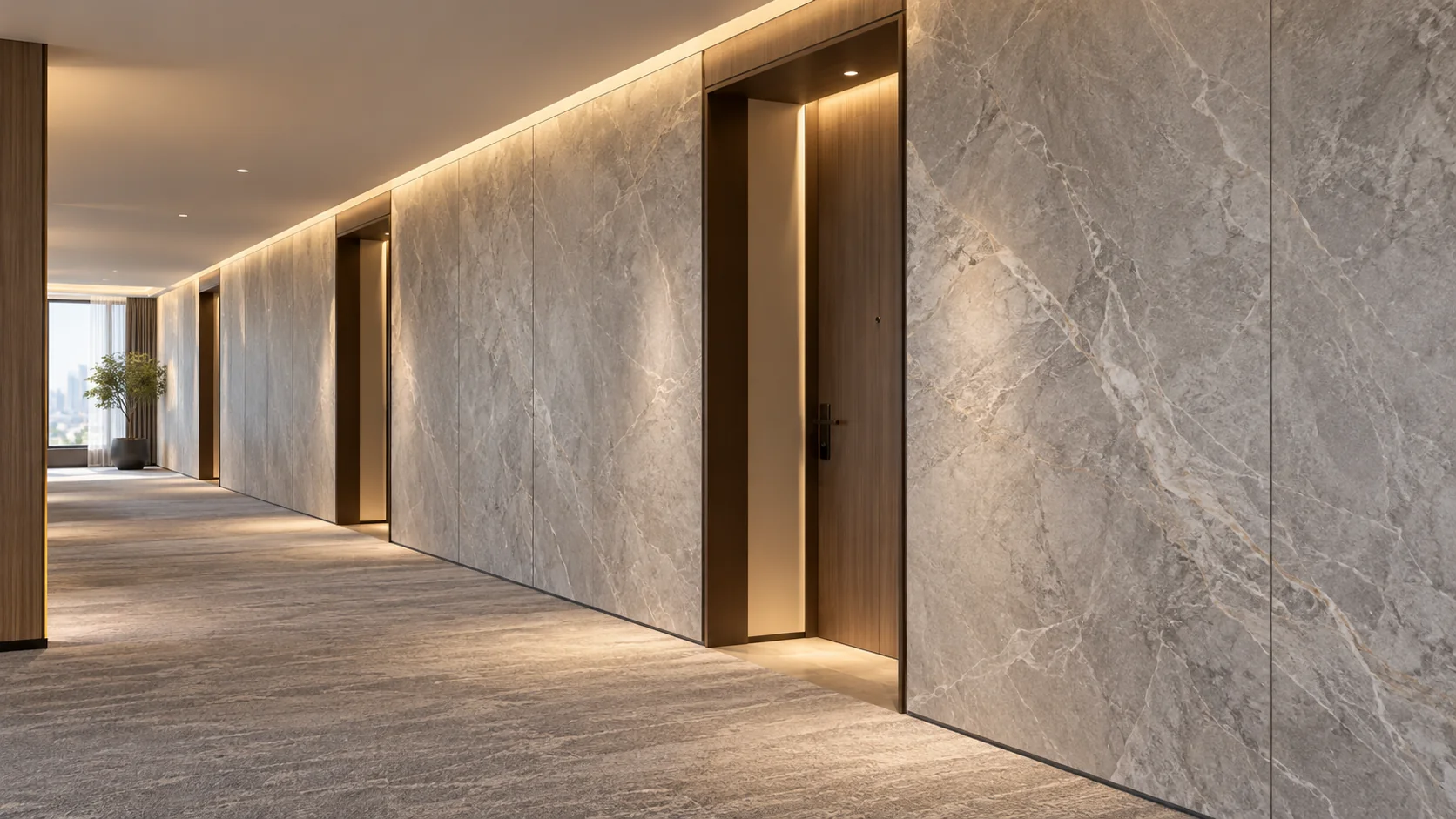
Neither label is the better choice on its own, because SPC vs PVC wall panels can share the same polymer: many SPC panels use PVC to bind mineral powder, and panels sold as PVC can also contain calcium carbonate. Choose by the proposed panel’s cross-section, measured weight, exposed finish and fixing system for the wall it will cover.
A dry feature wall, a shower zone and a busy corridor ask different things of a panel. Start with those demands, then compare samples and quotations. The better choice should meet the project’s material requirements and be practical to install in that location.
What is the difference between SPC and PVC wall panels?
SPC means stone plastic composite: a mineral-and-polymer construction that commonly uses PVC as its binder. PVC names the polymer and can also describe a mineral-filled panel. Compare the complete construction, because either label leaves the cross-section, exposed face, fixing method and evidence for the intended wall to be identified.
A PVC wall-panel production line from Acemien uses PVC resin and calcium carbonate to produce decorative panels. Mineral filler therefore appears in products sold under the PVC label as well as in stone-plastic composites.
| Item | “SPC wall panel” label | “PVC wall panel” label |
|---|---|---|
| What the name identifies | Mineral powder combined with plastic, commonly a PVC binder | The PVC polymer family, which may include mineral filler |
| Can it contain PVC? | Often yes | Yes |
| Cross-section | Identify whether the supplied section is solid or hollow | Identify whether it is compact, foamed or hollow |
| Exposed face | Identify the decorative film, wear layer or other finish | Identify the decorative film, coating or other finish |
| Fixing system | Identify the system specified for the location | Identify the system specified for the location |
| Performance still to establish | Weight, surface wear, wet-area suitability and fire evidence | Weight, surface wear, wet-area suitability and fire evidence |
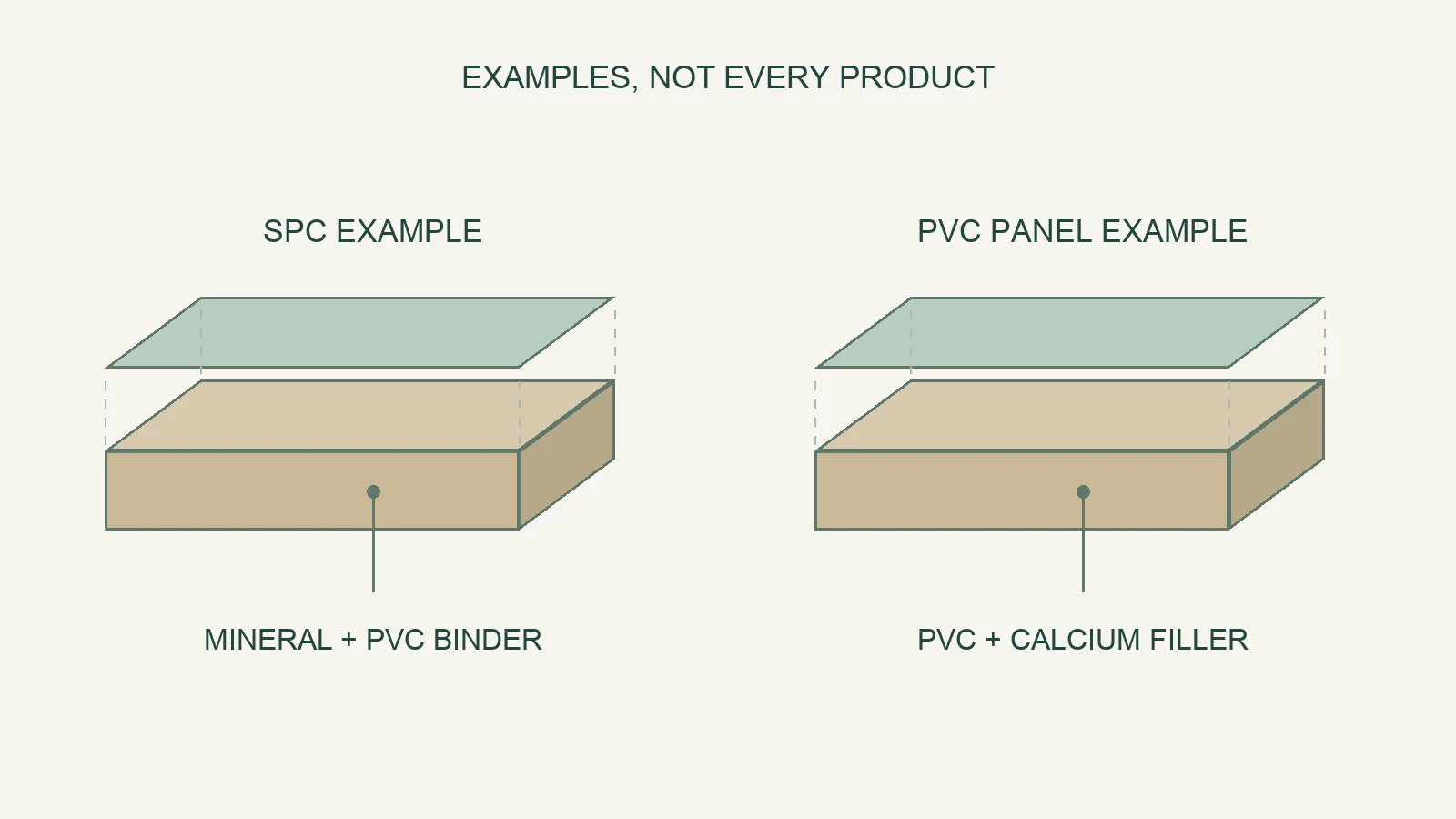
Use this table to describe each quotation before comparing prices. Two differently named products may have closely related ingredients, while their joints, faces and handling weight differ considerably.
For a bedroom feature wall, compare a joined sample and an exposed edge as well as the pattern. A stone effect can look convincing on a small swatch yet repeat awkwardly across the wall. The wall panel materials guide places these products alongside the wider material families.
Does an SPC wall panel contain PVC?
Yes, often. A common SPC wall-panel route combines mineral powder with PVC. If your project excludes PVC, a panel using that recipe fails that requirement. Review the composition of the core, decorative layer and wear layer before accepting SPC as an alternative to a panel explicitly sold as PVC.
Sunshine Machinery’s wall-panel equipment description states: “The main raw materials of SPC Wall Panel are PVC calcium powder and stone powder.”
Treat a PVC exclusion as a material requirement when reviewing the submittal. A stone-plastic product with a PVC binder should be removed from that shortlist, even if its mineral content is prominent in the sales description. For a permitted alternative, the composition declaration needs to cover the proposed product’s layers.
Read the requirement’s scope too. It may concern the facing you are buying or the entire finished panel. Where it covers the whole panel, a declaration for the outer film leaves the core and other layers to be addressed. Write the scope beside the sample reference so purchasing and installation teams use the same requirement.
Other environmental or indoor-air requirements need their own evidence. For projects with broader material restrictions, our Red List Free wall-panel explanation covers the declarations used to assess them. Keep the selection tied to the clause your project actually uses.
Is an SPC panel always solid and heavier than PVC?
No. Some stone-plastic wall panels are made as hollow profiles, and a label cannot tell you the mass of the sample in front of you. Compare the cut section and measured whole-panel weight, then divide that weight by its face area to compare mass per square meter.
Benk’s wall-panel equipment guide states that the stone-plastic wall panels made on that equipment family are hollow panels.
Record both proposed products in the same sample card.
| Item | Sample A | Sample B | Why it matters |
|---|---|---|---|
| Cross-section | Record observed solid, foamed or hollow section | Record observed solid, foamed or hollow section | Shows the construction behind the face |
| Weight per panel | Measure the complete panel in kg | Measure the complete panel in kg | Establishes the load to handle |
| Face area | Calculate from the stated size in m² | Calculate from the stated size in m² | Makes unlike panel sizes comparable |
| Weight per m² | Divide panel mass by face area | Divide panel mass by face area | Compares mass on the same area basis |
| Exposed face | Name the supplied outer layer | Name the supplied outer layer | Identifies the finish you will touch and clean |
| Joint and fixing method | Record the system’s method | Record the system’s method | Connects the panel to its support and location |
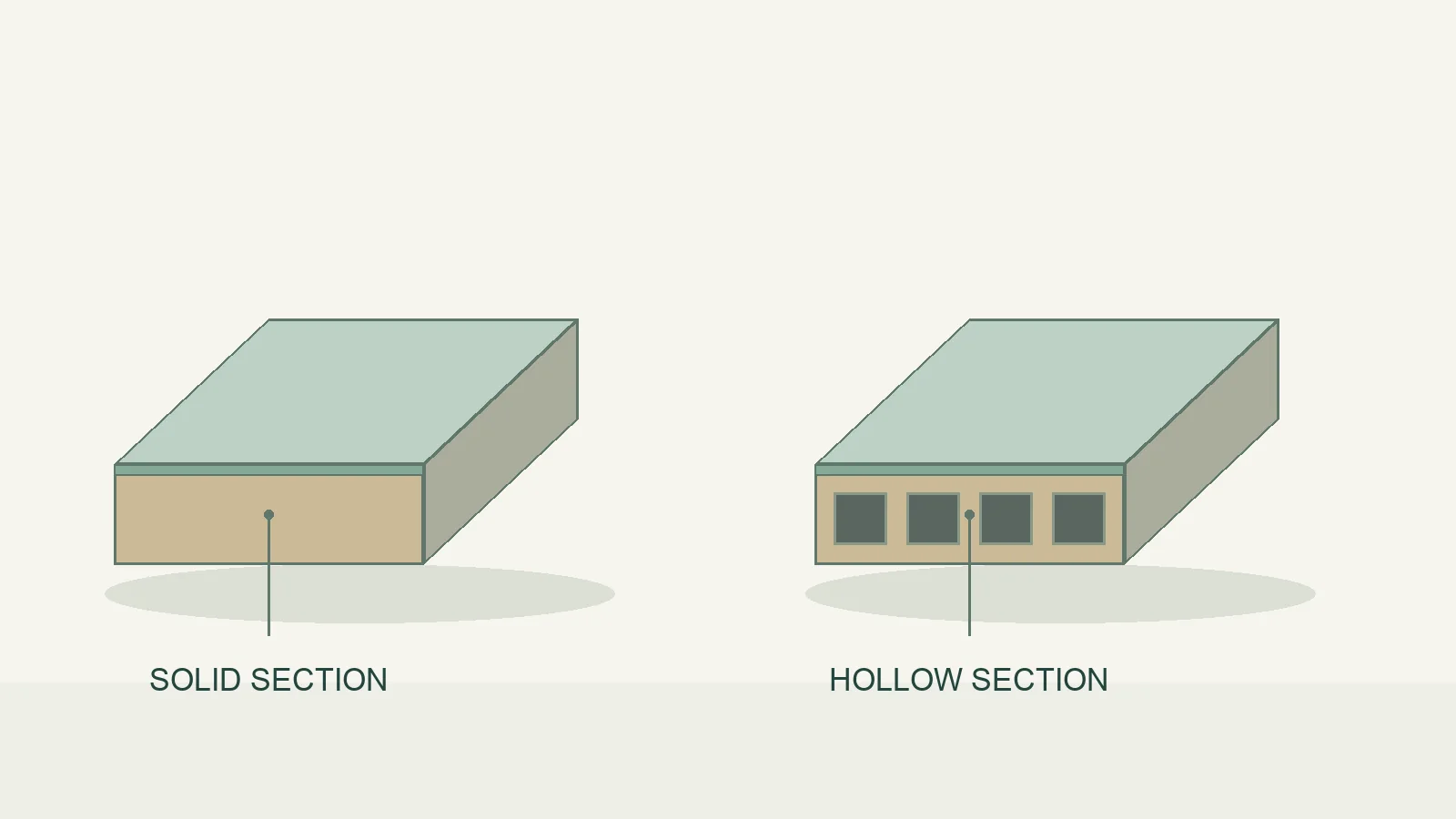
For a rectangular panel, calculate face area as length in meters multiplied by width in meters, then divide the panel mass in kilograms by that area. Weigh the panel without transport packaging and record its supplied size. A small cut sample helps show the section; a complete panel establishes handling weight.
For high work or solo installation, start with the verified lighter suitable construction and a fixing system covering that position. Impact resistance needs separate evidence for the installed panel. Our PVC panel construction comparison covers hollow, compact and faced forms in more detail.
Which panel surface handles scratches and cleaning better?
Compare the exposed finishes for scratching and cleaning, and the whole panel for impact. A core with more mineral filler does not assign the decorative surface a wear score. Prefer the tested face with stronger relevant results under matching conditions, then check that cleaning retains its appearance.
Gestión de Compras describes an SPC manufacturing route, published June 17, 2024, that combines a PVC profile with a color film and wear-resistant layer. Its description explicitly includes wall panels.
ASTM D4060-25, updated February 14, 2025, evaluates abrasion resistance of coatings on a plane, rigid surface. A reported coating result should identify the finish tested and the conditions used. Our laminate abrasion test guide explains how to read those results.
In a quiet feature-wall position, compare color, texture, gloss and joints. In a reception or hotel luggage zone, add face-wear and panel-impact evidence to that appearance review. A hard-looking stone pattern gives little information about how the exposed finish will respond to rubbing or a suitcase corner.
Use a sample to review the proposed care routine, with only the cleaners permitted for that finish. Look at the appearance after cleaning beside an untouched area. For a frequently cleaned wall, preserving the approved color and gloss is part of the selection, alongside any laboratory result.
Are SPC or PVC panels better for a bathroom or shower?
Neither label decides it: choose the complete panel system documented for your specific bathroom location. The panel, joints, trims, adhesive or fixings, and backing must work together for that exposure. A system intended for a dry decorative wall and one specified for a shower enclosure require different details, even when the visible patterns look similar.
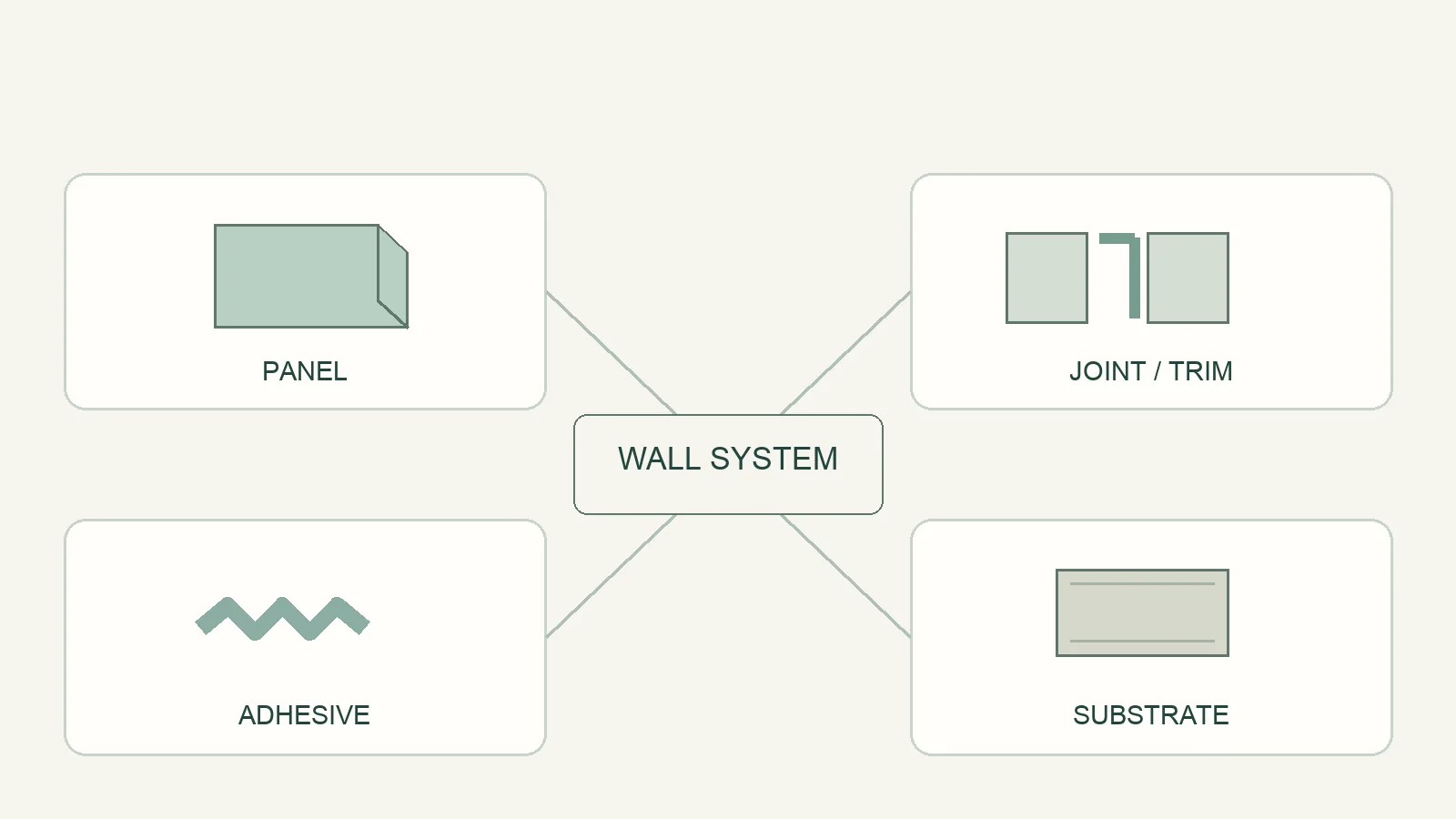
Bostik’s wet-room vinyl system illustrates this approach in healthcare and elderly-care facilities: it integrates floor and wall coverings with a tailored adhesive solution. It is one defined system example, not evidence that every decorative SPC or PVC panel belongs in a shower.
Read the proposed model’s installation instructions before approving it for direct water exposure. The intended location, substrate, corners, openings and junctions should all be covered. If the instructions do not cover a shower zone, choose another system for that zone.
A dry vanity wall can be selected mainly for its finish and care routine; water around a shower reaches details that a face sample cannot show. Fix existing leaks before covering the wall, as the EPA’s moisture guidance advises. For the wider renovation choice, see bathroom wall panels versus tiles.
Which wall panel costs less after installation?
The lower matched installed quotation is the cheaper choice for your project; neither material label establishes that outcome. Price the same covered area, exposed finish, preparation and fitting work. Compare panel counts and inclusions alongside the total so that a low sheet price is evaluated with the work required to finish the wall.
Angi’s March 18, 2026 wall-paneling guide lists PVC panels at $7–$20 per square foot in its US residential installed-paneling context. This is a planning benchmark, not an SPC price range or a fixed price difference between the two labels.
Record the scope of each quotation beside its price.
| Item | Quote A | Quote B |
|---|---|---|
| Covered area | Record the wall area priced | Match the same wall area |
| Panel size and count | Record dimensions and quantity | Record dimensions and quantity |
| Exposed face | Name the approved finish | Identify the finish being compared |
| Trims and corners | List included finishing pieces | Check the equivalent inclusions |
| Adhesive or fixing | Identify included system items | Identify included system items |
| Wall preparation | List repairs and preparation | Match the preparation scope |
| Labor | Identify the work included | Match the installation work |
For per-panel pricing, multiply the stated length by width to find the area covered before cutting, then divide the panel price by that area. Use consistent units. Add the proposed layout, offcuts, corners, openings and installation items to price the finished job.
A more difficult wall can shift the budget toward preparation and fitting. Compare those operations explicitly, especially where old finishes must come off or existing corners need repair. Keep film prices separate from faced-panel prices when comparing factory quotations, because turning film into a panel adds materials and a lamination step.
Where does a silicone-faced decorative wall film fit?
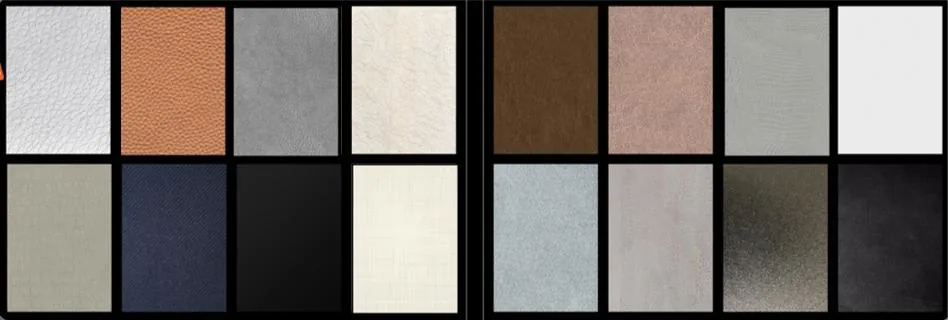
Puremorfilm makes decorative wall film with a silicone functional surface on a plastic film base for interior walls and furniture. The wall film contains no PVC and uses a No DOP formulation. For a whole-panel PVC exclusion, the chosen core and other layers also need to meet the clause.
The silicone surface is inherently flame-retardant, with higher grades up to UL 94 V-0 available on request. In the manufacturer’s laboratory tests, coffee, red wine and soy sauce left at 25°C for 24 hours wiped off with no obvious change.
Standard film has no back adhesive and is for PUR flat lamination; back adhesive can be provided on request. We mainly supply rolls, with a film MOQ of 500 linear metres. On-request laminated panels measure 1220 × 2440 mm and have a separate MOQ of 200 panels. Samples are free.
Our paint-free wall film uses a silicone functional face, distinct from PVC, melamine, PP and PETG decorative faces. Because of its leather-like feel and some elasticity, it is not for floors, cooktop countertops, shower floors or other walked-on areas, and it is not a shower waterproofing system.
Which wall panel should you choose for your project?
Choose the construction that meets the material clause and the wall’s exposure: a documented PVC-free build for a PVC exclusion, a verified lighter suitable panel for easier handling, and tested faces plus panel-impact evidence for busy areas. For a shower, choose a system specifically covering that use; for a dry feature wall, compare appearance and joints.
| Project condition | Choose | Confirm before ordering |
|---|---|---|
| PVC-exclusion clause | A construction meeting the exclusion across its specified scope | Layer composition, including the core and face |
| Ceiling, high work or one-person installation | A verified lighter construction with a suitable fixing system | Complete panel weight, access and permission for that position |
| Corridor, reception or hotel luggage zone | A finish and panel supported by wear and impact evidence | Tested face, panel construction and care routine |
| Shower or wet zone | A complete system specified for that location | Instructions for the backing, joints and junctions |
| Dry feature wall | A panel selected for its pattern, texture and joint appearance | Joined sample, edges and layout |
| Budget comparison | The lower quotation for equivalent required work | Equal area, preparation, trims and installation scope |
In a hotel, separate guest-room decoration from luggage-contact and service areas; the hotel wall-panel guide develops that planning. To make the selection:
- Write down the wall location and any material-exclusion clause.
- Complete the sample card for section, weight, outer face and joints.
- Review the proposed system’s fixing and wet-area instructions for that location.
- Compare matched quotations and approve the chosen sample.
For a decorative wall-facing sample, contact us with the wall location, area, desired pattern and gloss, whether you need film or laminated panels, and any PVC-exclusion requirement.
Frequently Asked Questions
Is SPC better than PVC?
No, not across the whole category. A particular SPC panel may suit your wall better, but its section, exposed face, fixing system and relevant performance evidence decide that. A PVC-containing SPC panel also fails a project requirement that excludes PVC, whatever its stone content.
What is the difference between SPC and PVC wall panels?
SPC is a mineral-and-plastic composite, commonly using PVC to bind the mineral powder. A PVC wall panel uses PVC and may also contain calcium carbonate. The finished products can differ in section, outer face, joints and installation method, so compare those details alongside the ingredient description.
What is the disadvantage of PVC wall panels?
The main drawbacks depend on the build you receive: a lightweight hollow profile needs the support and fixings its system sets out, and each finish has its own care limits. The PVC label alone does not tell you which build you are getting.
What is the best material for bathroom wall panels?
A complete panel system documented for that bathroom location is the best starting choice. Check that its instructions cover the exposure, backing, joints and openings. A dry-area decorative panel and a shower lining serve different locations, and an existing leak needs repair before either finish is installed.
Are SPC wall panels and PVC wall panels suitable for commercial projects and hotels?
Yes, when the proposed product and installation have the evidence required for that wall location. For surface-burning performance, read the specific panel’s ASTM E84 report, including its mounting and support. ASTM E84-26a, updated April 15, 2026, measures comparative surface flame spread and smoke density; its results concern the tested construction. E84 and UL 94 are different tests, and an E84 result does not state a wall’s fire-resistance duration.