
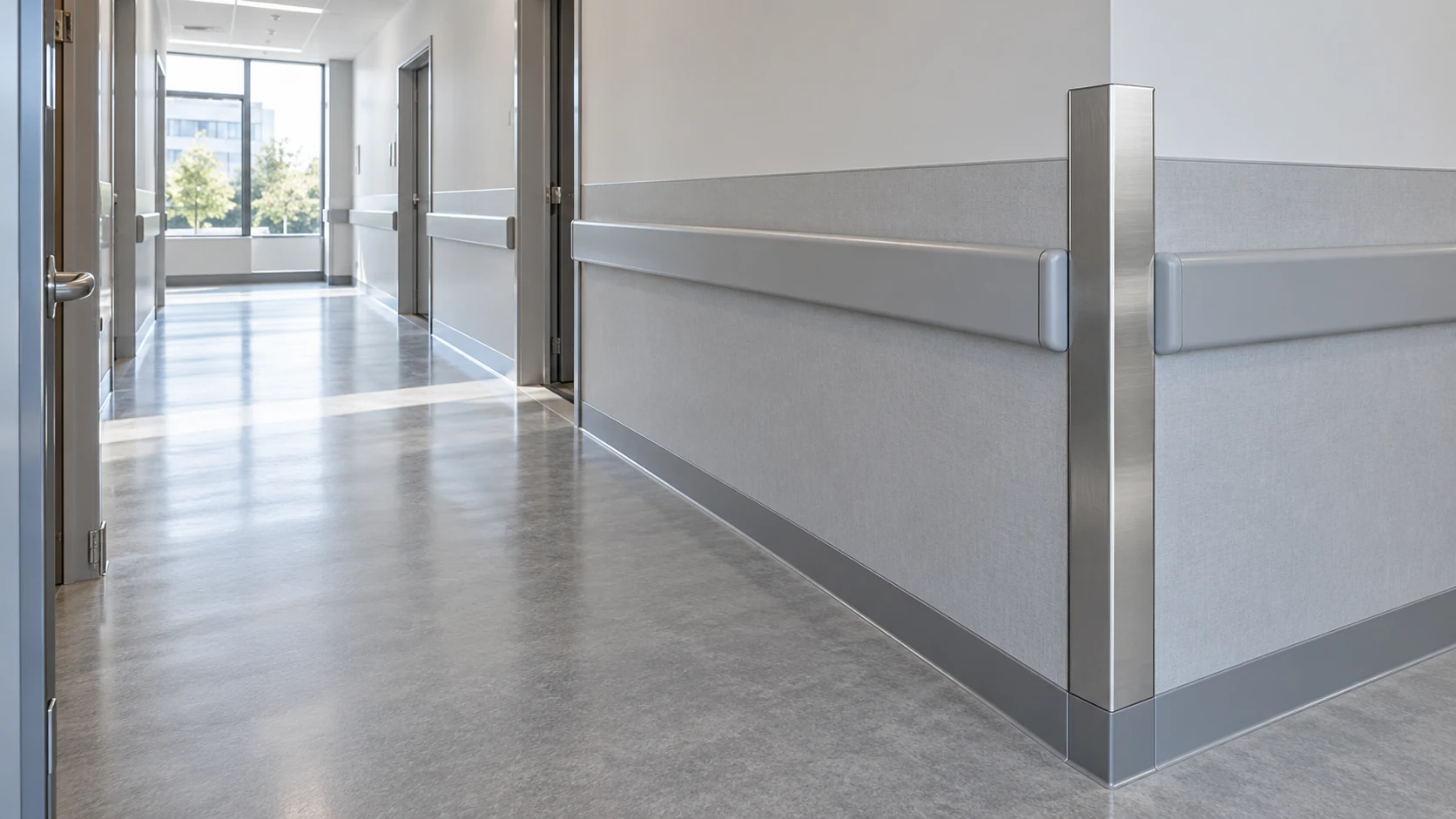
A service cart can damage a corridor corner while leaving the middle of the wall untouched. Common wall protection materials include rigid vinyl or PVC, polycarbonate, stainless steel, aluminum and rubber. Choose the material and profile around the object causing the damage, its contact height and the frequency of impact.
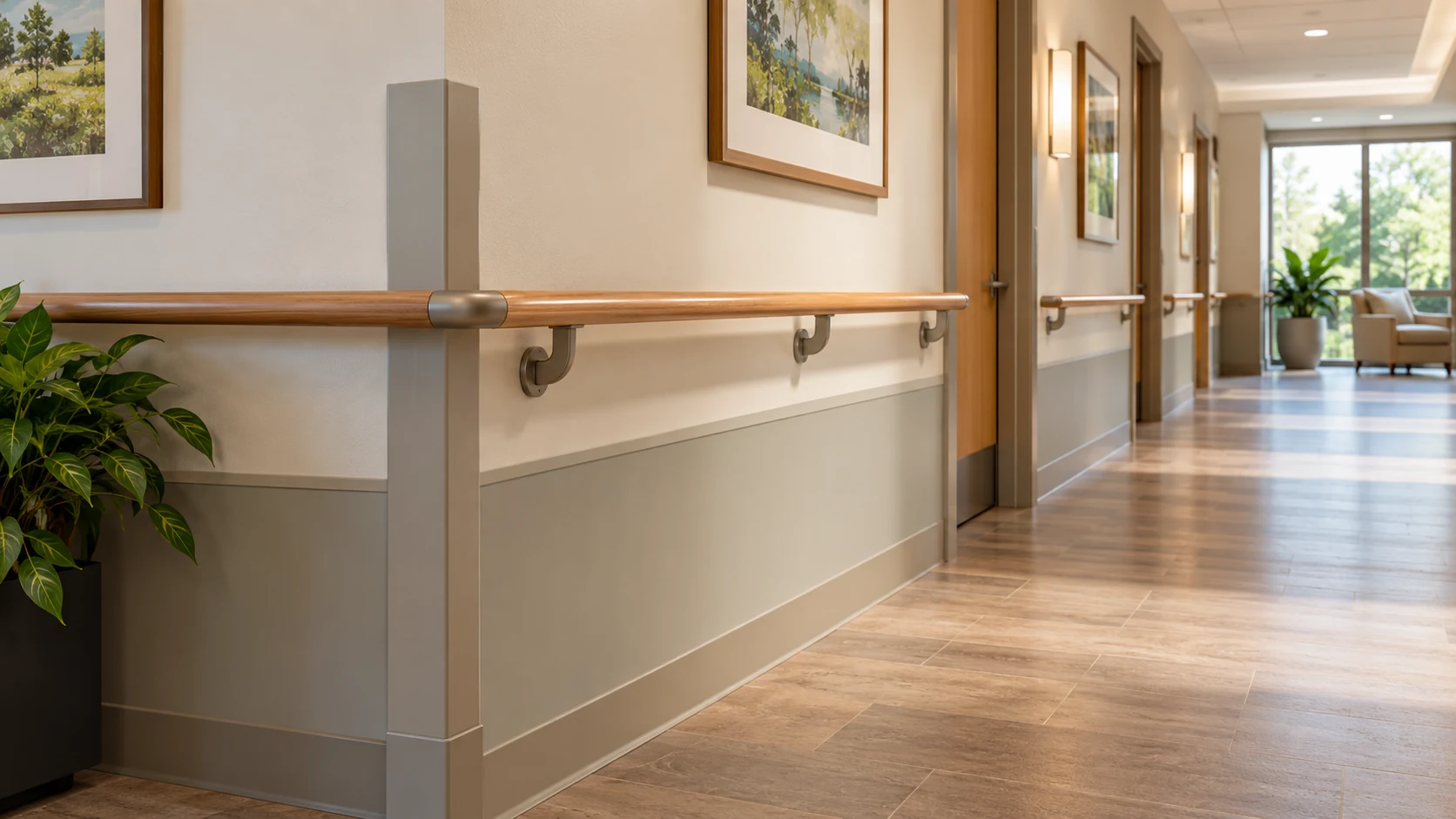
A broad sheet addresses scuffs over an area; a corner guard or crash rail intercepts a more concentrated hit. In a public corridor, the installed depth and any handrail function also affect the choice. Those details can rule out an otherwise attractive material before you compare colors or prices.
What materials are used for wall protection?
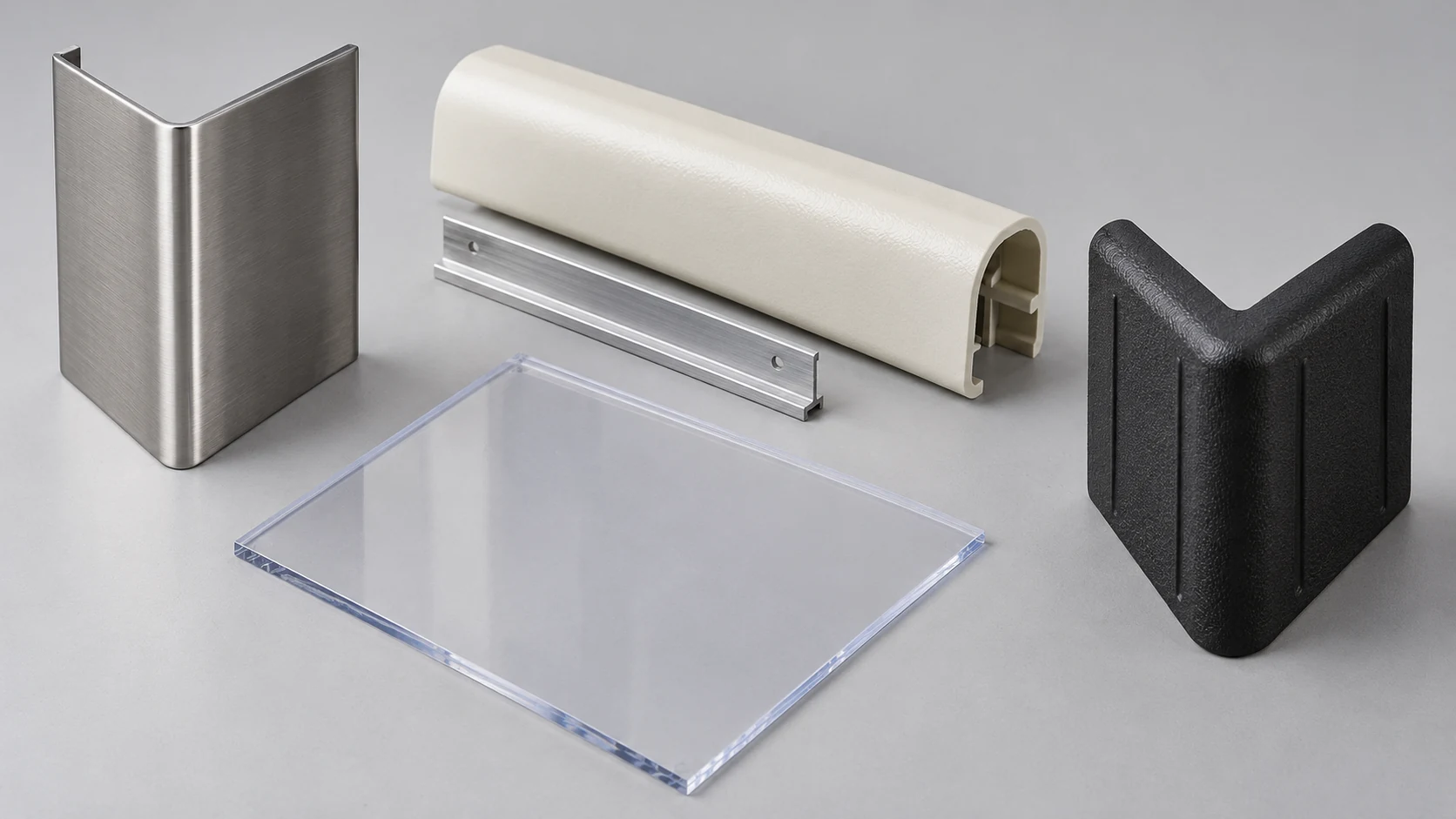
Rigid plastics, metal and rubber cover most permanent wall-protection needs, with cardboard and similar temporary materials used during construction. They arrive as different products: sheets, corner guards, retained rails, covers and bumpers.
The following comparison separates the material from the shape. A stainless sheet and a stainless corner guard share a material, but protect different parts of the wall. The wall protection overview provides examples of these material and product families.
| Material or finish route | Typical form | Useful setting | Detail to examine |
|---|---|---|---|
| Rigid vinyl or PVC | Wall sheets, corner guards, rail covers | Interior corridors and frequently scuffed walls | Cleaning compatibility, joints and the supporting rail or wall |
| Polycarbonate | Clear protective sheets and guards | Places where the underlying finish should remain visible | Scratch visibility, edges and fixing detail |
| Stainless steel | Sheet, corner guard, end-wall protection | Service areas and heavily used corners | Higher upfront cost; edge finishing and fixings |
| Aluminum | Corner profiles, retainers and finished guards | Interior corners and retained protection systems | Profile depth and how the cover attaches |
| Rubber | Bumpers and corner protection | Parking, loading and warehouse areas | Contact position, vehicle clearance and mounting |
| Woodgrain finish | A decorative finish on a specified protective system | Guest-facing and residential-style interiors | The actual material beneath the pattern |
| Temporary cardboard protection | Removable guards or coverings | Construction and moving works | Coverage and replacement as work progresses |
Woodgrain is an appearance, so identify the protective material beneath it. A decorative pattern can help a guard fit the room without telling you its impact capacity. Likewise, a fire requirement needs evidence for the specified construction; our explanation of an ASTM E84 report shows how to read that separate requirement.
Which wall protection material suits each area?
Match the system to the area’s damage and cleaning pattern: public interiors need an acceptable finish, service routes need effective interception of repeated contact, and loading areas need protection suited to the moving equipment.
A hospital corridor can need both a cleanable wall surface and a retained rail at cart height. A hotel lobby may need discreet corner protection that preserves the finish palette. A loading bay puts a different demand on a bumper from a school corridor where chairs and bags scuff the wall.
| Area | Main question | Direction to consider |
|---|---|---|
| Hospital or care corridor | What touches the wall, and what cleaning chemistry is used? | Compatible wall sheets with localized rails and corner protection |
| Hotel lobby or guest route | Which edges are vulnerable without dominating the room? | Discreet guards and finishes coordinated with the interior |
| School circulation area | Are the marks broad scuffs or concentrated corner damage? | Sheets for broad wear, guards at recurring contact points |
| Service corridor | Will the same carts repeatedly strike the same route? | Retained rails, durable corners and repairable components |
| Parking or loading area | Where does equipment or vehicle contact occur? | Appropriately designed bumpers or rubber protection |
For healthcare, verify the actual disinfectant compatibility of the wall covering. “Easy to wipe” is a different question from repeated exposure to a particular cleaning solution. In hospitality, compare the protection with the hotel wall-panel finish beside it so replacement pieces do not look like an afterthought.
What wall cladding is durable and safe for schools?
Durable, safe wall cladding for schools combines a cleanable finish with impact protection where pupils, furniture and equipment hit the wall. Choose the installed assembly for each room’s fire requirements and maintenance routine. Corridors need different protection from classrooms, while damp areas need compatible joints and moisture management behind the finish.
| School area | Material and detail direction | Evidence or check |
|---|---|---|
| Busy corridors and corners | Impact-rated wall sheets with guards or rails at observed strike zones | Assembly impact evidence, secure fixings and retained accessible route width. |
| Classrooms and teaching walls | A cleanable decorative finish with replaceable damaged parts | Cleaning compatibility and safe details around displays and fittings. |
| Washrooms and splash zones | A moisture-suitable panel system with sealed details | Substrate condition, joints and the specified wet-cleaning routine. |
| Protected routes and larger rooms | An assembly meeting the project’s required reaction-to-fire classification | A relevant report covering the face, adhesive, substrate and mounting. |
A school’s own construction brief sets the durability, cleaning and corner-protection requirements for each area. Read the panel evidence against that brief, and compare EN 13501-1 classifications with the fire strategy for the actual project.
Do you need guards, rails, corner guards or full wall sheets?
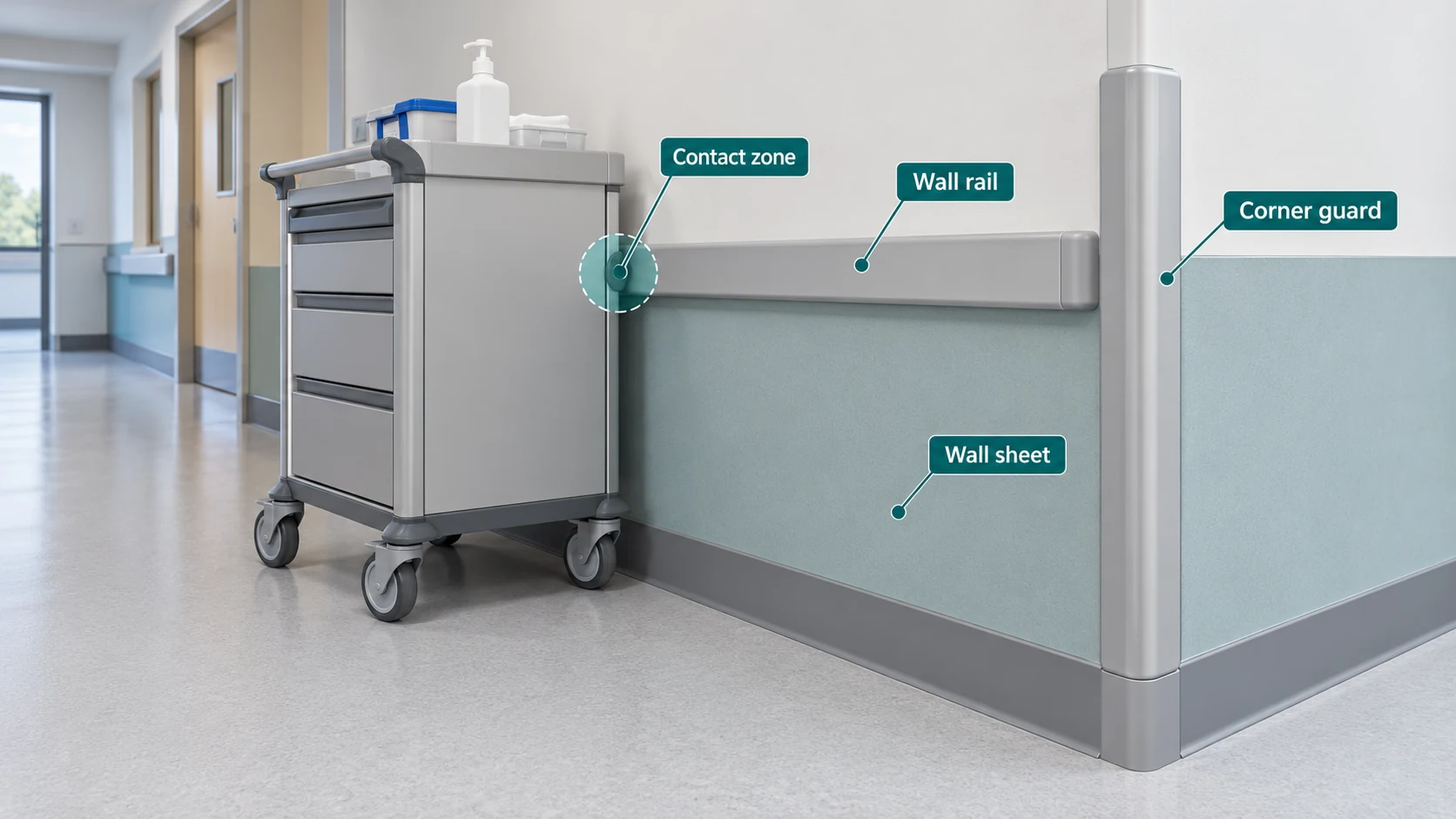
Use a corner guard for a vulnerable corner, a rail for repeated contact along a defined path, and a sheet for wear spread across a larger wall area. A combination often follows the damage more closely than one product covering every surface.
Corners concentrate damage because a cart can catch the edge during a turn. A rail can intercept the same cart’s body along a straight route. Above or between those contact zones, a sheet may handle bags, chair backs and cleaning scuffs. Door edges and frames need their own detail where equipment passes through an opening.
Inspect both sides of the problem: the damaged wall and the object touching it. A guard can be positioned neatly yet miss a projecting handle. A broad sheet may hide old scuffs while leaving a vulnerable corner exposed to the next collision.
Wall sheets are also different from complete wall panels. A protective sheet can be attached over a suitable existing surface; a panel system includes its own build-up and installation requirements. Compare those constructions in our wall panel materials guide before treating every sheet product as a complete lining system.
How high and how wide should wall protection cover?
Cover the actual contact pattern with room above, below and beside it for normal variation in movement. Repeated marks on the existing wall are useful evidence of where protection needs to work.
The facility buying guide recommends selecting the profile and coverage around the damage pattern, including coverage beyond the visible strike line. This matters where different carts use the same route or a load changes the point of contact.
A narrow rail works well when contact occurs within a consistent band. Where contact varies widely, a broader sheet, wider guard or full-height corner protection may be more useful. At a turn, check the guard’s wings as well as its height: damage can extend along the adjacent wall face.
For a new space without existing marks, bring the equipment into the selection exercise. Examine its handles, trays and projecting corners along the intended route. A movement path through a doorway can reveal a vulnerable frame or wall end that a straight corridor elevation misses.
Which corridor clearances affect wall protection?
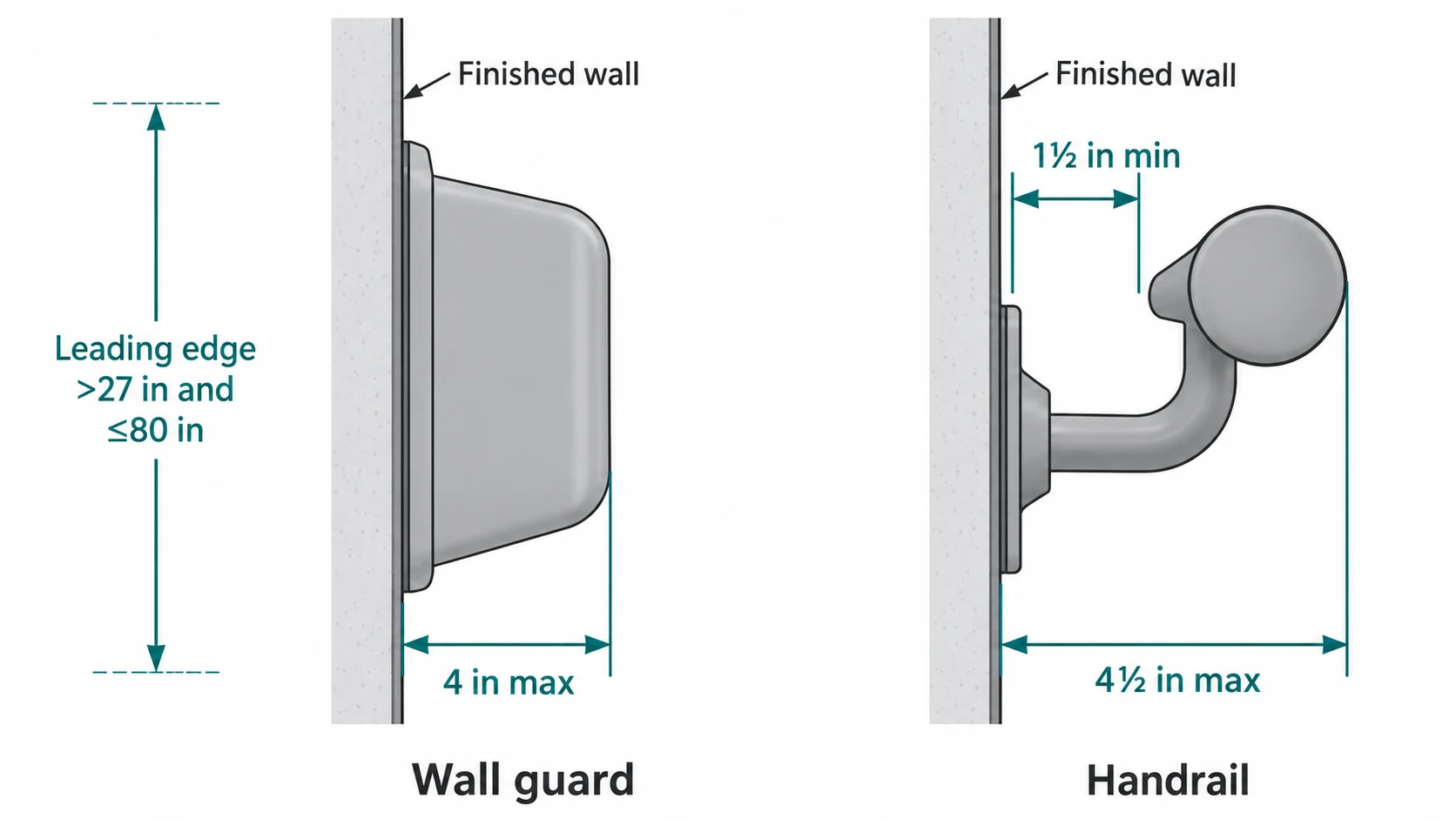
In facilities covered by the US ADA Standards, a projecting object with a leading edge above 27 inches and no higher than 80 inches generally has a 4-inch projection limit into a circulation path. Handrails have a 4½-inch exception, and required accessible-route clear width must still be preserved.
The exact 2010 Standards, section 307.2, state the height band as more than 27 inches (685 mm) and not more than 80 inches (2030 mm). The general projection limit is 4 inches (100 mm); the handrail exception is 4½ inches (115 mm). Section 307.5 separately protects the required clear width.
The same cross-section should show the handrail grip space. Section 505.5 requires at least 1½ inches (38 mm) between the gripping surface and the adjacent surface. Section 505.6 includes a limited bottom-obstruction exception for a handrail integral with a crash rail or bumper guard on a walking surface no steeper than 1:20; its top and sides still need to remain unobstructed.
In practice, ask for an installed cross-section showing the bracket, retainer, cover and adjoining finished wall. Compare the remaining passage width for a shallow profile and a deeper stand-off system. An impact-resistant material in a deep profile can be the wrong choice for the available space.
Measure the projecting rail or guard itself; a continuous wall finish is not the same geometry as an isolated rail. These limits apply within the ADA scoping for the facility and sit alongside its other project requirements.
For a retrofit, take measurements from the completed build-up. Adding a wall finish and then retaining an existing protective system can change the available space. Resolve that section before ordering long lengths of rail.
When does a crash rail also need to work as a handrail?
A rail needs to meet the handrail requirements when it is provided as a handrail under the applicable provisions. A product that stops carts and a product that people can grasp perform different functions, although a designed combination can provide both.
Under sections 403.6 and 505, handrails provided along walking surfaces within scope must comply with the handrail provisions. That includes relevant low-slope walking surfaces where a handrail may be voluntarily provided. It does not mean every level corridor needs a handrail.
The grip-to-wall clearance discussed above is especially relevant when changing the wall finish. A new panel behind an existing rail can consume that finger space even when the rail itself stays in the same position.
A combined handrail and crash rail still needs a usable, unobstructed gripping surface, with any bottom obstruction within the limited exception discussed above.
Where people need support, compare a dimensioned gripping profile and installed clearance as well as impact protection. This matters particularly in senior-living interiors, where the rail’s daily use by people belongs in the selection discussion.
Adhesive or mechanical fixing: what changes the total cost?
The fixing method changes preparation, installation and later replacement work, so compare the whole installed system. A mechanically retained rail can suit repeated impact, while a bonded sheet can provide broad surface protection on an appropriate substrate.
Start with the specified product and the existing wall. Loose paint, a friable substrate or an uneven surface can make an apparently simple adhesive installation more involved. Mechanical fixings need a suitable supporting arrangement, especially where the guard is expected to intercept repeated contact.
Then consider what happens when a component is damaged. A replaceable rail cover can be a different maintenance proposition from a sheet that needs substantial removal work. Corners and end caps also deserve attention because small damaged parts can be prominent along a public route.
A useful specification records the actual damage, product form and installation detail together:
| Item | What to specify | Why it affects the choice |
|---|---|---|
| Contact source | Cart, chair, load or other object and its route | Identifies the part needing protection |
| Coverage | Contact band, corner wings and vulnerable wall ends | Prevents a guard from missing the damage |
| Installed section | Wall finish, brackets, guard depth and any grip space | Allows passage and handrail clearances to be checked |
| Fixing and repair | Supporting wall, retained parts and replacement access | Reveals installation and ongoing work |
The wall-cladding installation discussion explains why preparation and junctions belong in the material decision. Keep downtime and cleaning access in the comparison alongside the initial supply cost.
Where does a silicone-faced wall film fit?
Puremorfilm makes decorative film with a silicone functional surface for wall panels. Our film suits decorative facing areas, with separate guards or rails used where carts strike the wall.
The silicone surface is inherently flame-retardant, with higher grades up to UL 94 V-0 available on request. We use a No DOP formulation, and our wall film contains no PVC. In the manufacturer’s laboratory tests, coffee, red wine and soy sauce left at 25°C for 24 hours wiped off with no obvious change.
SGS tested a submitted film sample to ASTM D4060-25 with CS-10 wheels, 1000 g per wheel and 60 rpm. After 2000 revolutions it showed slight matting, with no substrate exposure or coating peel. That is a surface-abrasion result for the film, not an impact rating. We supply primarily rolls for PUR flat lamination, with faced panels available on request.
Our paint-free decorative material has an organosilicon functional face, distinct from PVC, melamine, PP and PETG decorative faces. See our decorative wall film when selecting the facing between protected contact zones.

Which wall protection material should you choose?
Choose the material and profile together, then check the installed space and repair route. The most useful system is the one that intercepts the actual contact while fitting the way the corridor is used.
| Situation | Selection direction |
|---|---|
| Repeated cart contact along a wall | A rail at the observed contact band, plus vulnerable-corner protection |
| Broad scuffs across a public wall | A compatible protective sheet or facing with appropriate joints |
| Vehicle or loading contact | A purpose-designed bumper system in the correct position |
| People need grasping support | A handrail or documented combined handrail and crash-rail system |
| Decorative wall areas above a contact zone | A facing selected for its appearance and cleaning requirements |
Keep one installed section with the final selection, showing the wall build-up, any projecting guard and the handrail grip space, so finish, protection and circulation are checked together before installation.
For the decorative facing portion of your project, contact us with the room type, contact source and height, supporting wall and preferred color or texture.
Frequently Asked Questions
Are wall guards easy to clean?
Yes, many wall guards have wipeable surfaces, but cleaning compatibility varies by material, finish and product. Joints, textured areas and the space around brackets also affect how easily the installed system can be cleaned.
How do you install a wall protector?
Wall protectors are bonded to a suitable surface or mechanically fixed through a specified retainer or mounting arrangement. The product, wall condition and expected contact determine which construction is appropriate.
Can rubber wall guards be used in parking garages?
Yes, rubber guards and bumpers can protect selected parking-garage contact points. Their position and mounting must suit the vehicle or equipment contact and preserve the space needed to circulate.
What are wall protection sheets?
Wall protection sheets are broad protective layers applied over a suitable wall surface to address wear across an area. They differ from rails and corner guards, which intercept more localized contact.
What is decorative wall protection?
Decorative wall protection is a protective finish or system selected to suit the room’s appearance as well as its wear. The decorative face and any dedicated impact components should each match their intended job.