
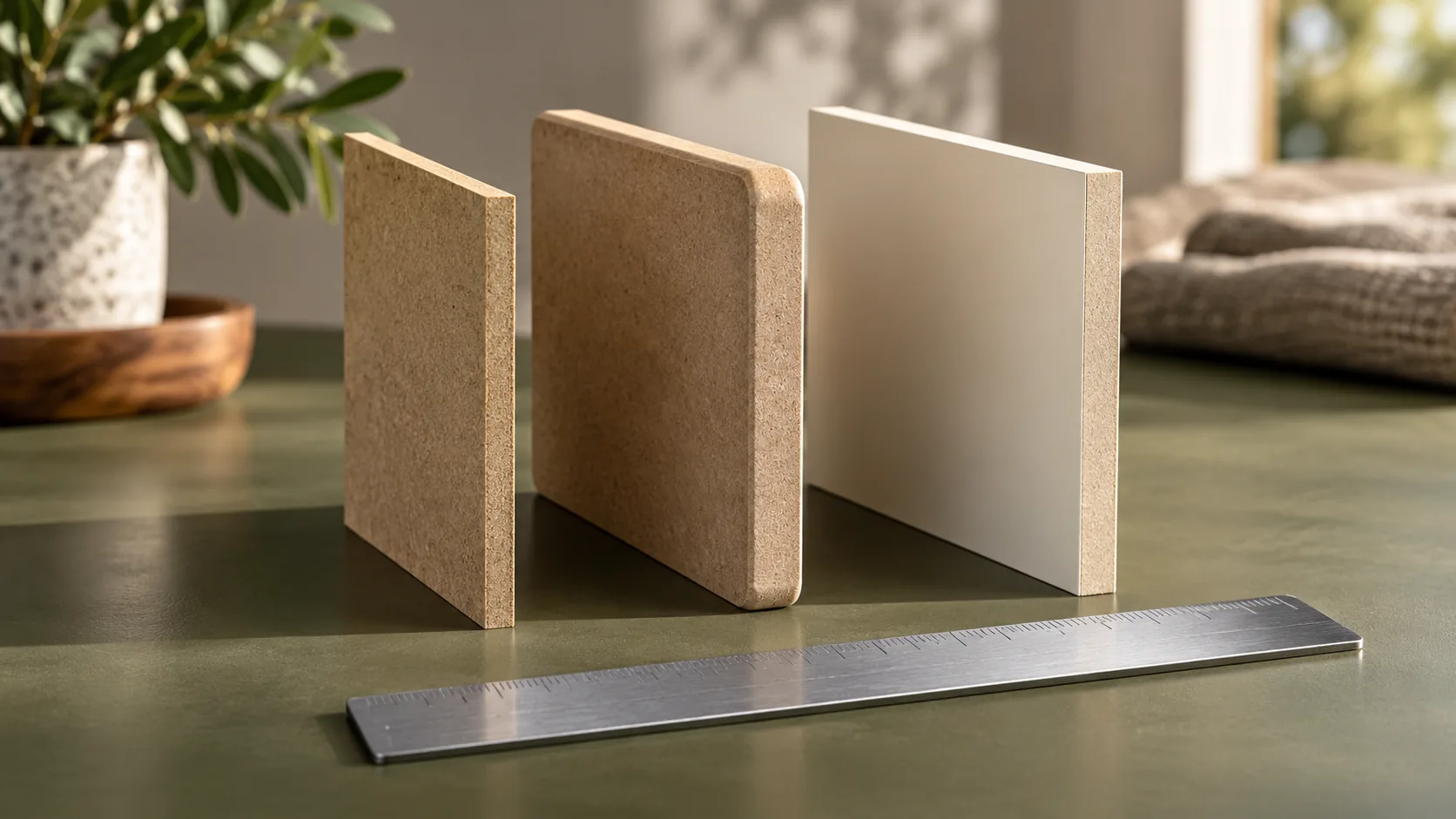
HDF (high-density fiberboard) is denser and harder than MDF. MDF typically runs about 600–800 kg/m³, while HDF is above 800 kg/m³. That splits the two by job. HDF is mostly sold as thin, hard sheets of about 3–6 mm for laminate flooring cores, door skins, drawer bottoms and cabinet backs. MDF is the thicker, easier-to-machine board for cabinet boxes, painted doors, shelves and mouldings.
The short rule in the HDF vs MDF choice: use MDF for most furniture parts thicker than about 9 mm, and HDF where you need a thin panel that resists dents and stays flat in a groove. The sections below cover the numbers behind that rule, the exceptions, and what changes when you put a decorative surface on either board.
HDF vs MDF at a glance
HDF is the thin, hard, dense board; MDF is the thicker board you machine, screw and paint.
| Property | MDF | HDF |
|---|---|---|
| Density | About 600–800 kg/m³ | Above 800 kg/m³ |
| Common thickness | Thin sheets from about 3 mm; furniture boards 16–25 mm | Mostly 3–6 mm; some thick machining grades |
| Surface | Smooth, paints well | Harder and more dent-resistant |
| Machining | Routes clean profiles and edges | Thin sheets are cut, not profiled |
| Screw holding | Good in the face, weak in the edge | Thin sheets take brads, staples and glue |
| Water | Swells when wet; moisture-resistant grades exist | Absorbs more slowly but still swells |
| Weight of a 1220 × 2440 mm sheet | About 40 kg at 18 mm and 750 kg/m³ | About 8 kg at 3 mm and 900 kg/m³ |
| Cost | Lower per cubic meter | Higher per cubic meter, low per thin sheet |
| Typical uses | Cabinet boxes, doors, shelves, mouldings | Flooring cores, door skins, backs, drawer bottoms |
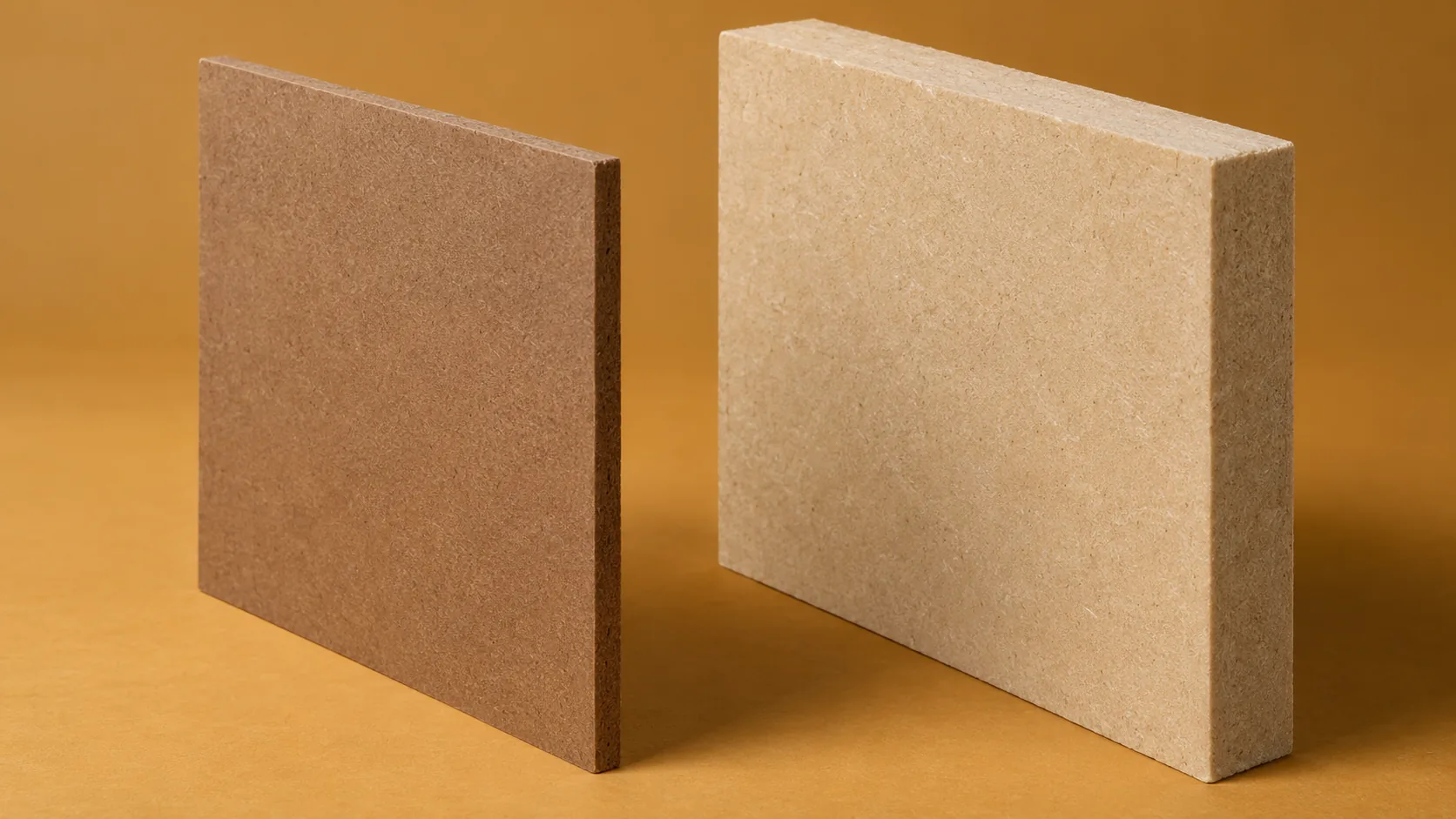
The density bands follow panel maker Pfleiderer. The sheet weights are plain arithmetic (density × volume) with the densities shown, so they shift with the actual product. The point for your workshop: a full 18 mm MDF sheet is a two-person lift, while thin HDF is light enough to carry alone.
Why is HDF denser, and where is the line?
HDF is the same fiber-and-resin board pressed harder. Both are made by mixing wood fibers with resin and hot-pressing them into panels; the wood handbook’s chapter 11 describes dry-process fiberboard made at medium or high density. Pressing harder packs the fibers tighter, which gives HDF a harder face and less room for water to move in.
The density line between the two is a market convention, and real boards straddle it. The property compilation (table 12–1) lists MDF at a specific gravity of 0.7–0.9, which overlaps the low end of HDF. Names overlap too. In North American stores the thin, dense panel is usually sold as hardboard (often tempered); elsewhere a similar product is sold as HDF. Read the product sheet for density and thickness instead of trusting the label. Our guide to what MDF is covers the base material in more detail.
Is HDF stronger than MDF?
Per millimeter, yes; as a finished part, usually not. HDF is harder, resists dents better and is stiffer than MDF of the same thickness. But HDF is mostly sold thin, and bending stiffness rises with the cube of thickness. With the same material, an 18 mm panel is (18 ÷ 3)³ = 216 times stiffer than a 3 mm panel. That is why a 3 mm HDF sheet flexes in your hand while an 18 mm MDF shelf carries books.
So choose by the part. For a shelf or cabinet side, thickness matters more than density: use 16–19 mm MDF, or plywood for long, heavily loaded spans. For a drawer bottom, back panel or a surface that takes knocks, HDF’s hardness is what you want. Thick HDF grades exist for heavy-wear machined parts, but they weigh and cost more than MDF of the same size, so they rarely make sense in ordinary furniture.
Which board should you use for each job?
MDF for the box, doors, shelves and trim; HDF for backs, drawer bottoms, flooring cores and door skins.
| Job | Better choice | Why |
|---|---|---|
| Cabinet boxes and shelves | MDF, 16–19 mm | Thickness gives stiffness; faces hold screws |
| Painted or routed doors | MDF | Clean profiles and a smooth face for paint |
| Mouldings and trim | MDF | Machines into detailed shapes |
| Cabinet and wardrobe backs | HDF, 3–6 mm | Thin, flat and hard enough to square up the box |
| Drawer bottoms | HDF | Fits a groove and resists wear |
| Laminate flooring core | HDF | Dent resistance and a stable click profile |
| Interior door skins and pegboard | HDF / hardboard | Hard, thin face that takes impact |
| Kitchen and bathroom parts | Moisture-resistant MDF | Density alone does not make a board water-safe |
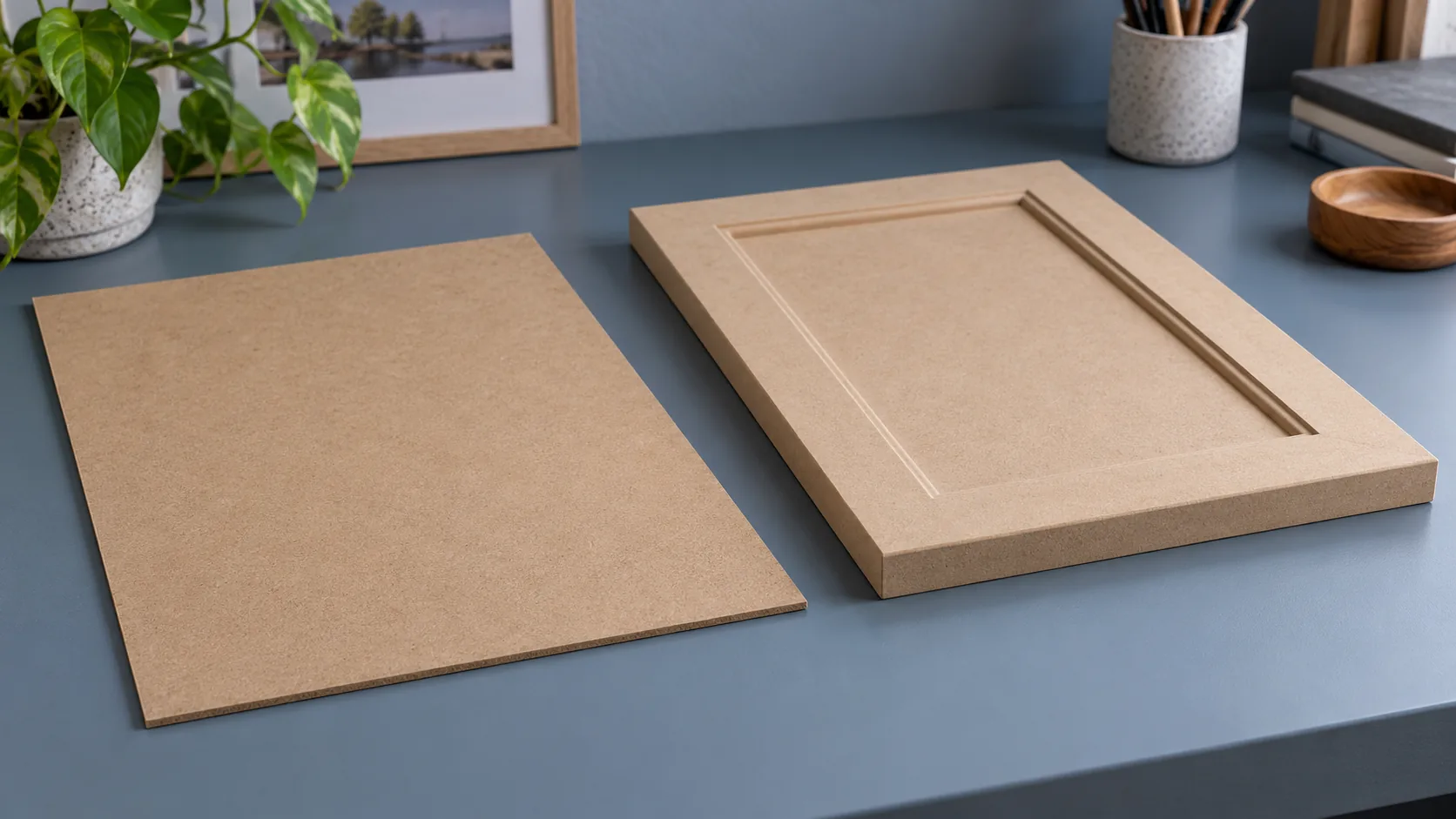
Most cabinets use both: MDF or particleboard for the box and doors, HDF for the back and drawer bottoms. If you are also weighing particleboard, see MDF vs particle board; for a full cabinet breakdown, see our kitchen cabinet materials guide.
How do HDF and MDF handle moisture?
Neither board is waterproof. HDF takes up water more slowly because there is less open space between its fibers, but standing water makes both swell, especially at cut edges. Part of that swelling can stay after the panel dries (dimensional stability bulletin), so a swollen edge usually stays swollen.
For kitchens, bathrooms and laundry rooms, choose a moisture-resistant MDF grade (often dyed green) and seal every cut edge, hole and back face, not only the visible front. Keep any fiberboard away from direct, repeated wetting, such as the floor of a sink base. Our article on whether MDF is waterproof covers edge sealing in detail.
Cutting, screwing and painting each board
MDF is the board for routing, screwing and painting; thin HDF gets cut to size, glued and pinned. Both cut cleanly with carbide blades and make fine dust, so use dust extraction and a mask. For shaped work, the European Panel Federation describes routing MDF into profiles for doors and mouldings, and the uniform core leaves a smooth routed edge.
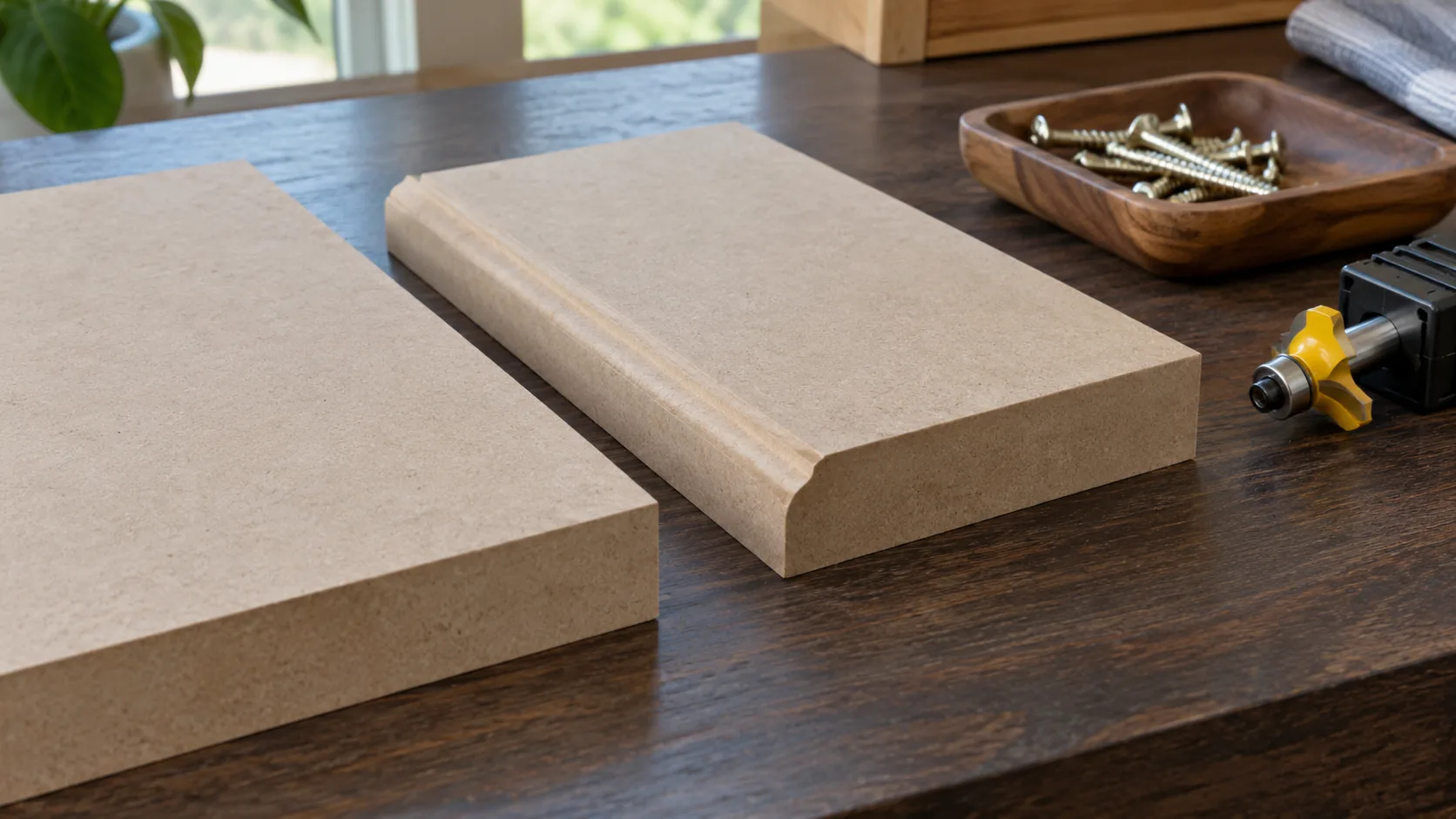
For screws in MDF, drill a pilot hole of 85–95% of the screw’s core (root) diameter, at least 1 mm deeper than the screw goes (EPF screwing guidance). Screws hold well in the face and poorly in the edge, so keep edge screws away from corners and use confirmat screws or dowels for joints. A 3 mm HDF back cannot hold a screw on its own; fix it into a groove or rebate with glue and brads or staples.
MDF faces are smooth, but cut edges soak up primer, so give edges an extra sealing coat before the topcoat (lacquer finishing guide). HDF faces are harder and slicker, so scuff-sand and prime before painting. See how to cut MDF and how to finish MDF for step-by-step methods.
Formaldehyde rules and labels in the US
In the US, MDF sold for furniture and cabinets falls under the EPA’s TSCA Title VI formaldehyde rule, with emission limits of 0.11 ppm for MDF and 0.13 ppm for thin MDF (8 mm or less, per the definitions in 40 CFR 770.3). Some products marketed as HDF still meet the definition of MDF and must comply (EPA stakeholder FAQ). Look for a TSCA Title VI compliance label on the panel or the finished cabinet, whatever name is on the sales sheet.
Laminating a decorative surface on HDF or MDF
A decorative facing changes the surface, not the core choice. Thick MDF, usually 16–19 mm, is the common substrate for laminated cabinet doors and furniture panels because it is flat and stiff. Thin HDF faced on one side tends to bow, so face both sides or use a balancing backer; unequal surfaces pull a panel out of flat. Our laminated MDF guide compares facing options.
Puremorfilm makes decorative film with a silicone functional surface on a PET support for PUR flat lamination to MDF and HDF panels. The film has no self-adhesive backing and uses a No DOP formulation. Flame retardancy is a standard film property; higher fire grades require the corresponding grade-specific report. We supply film rolls, with film-faced panels quoted per project.
Confirm the selected film’s total thickness and usable width before sizing a laminated door. Add the film and adhesive thickness to the core thickness so the finished panel matches its hinges and adjoining parts. The furniture decorative film page covers this paint-free silicone surface for vertical and low-wear faces, distinct from PVC, melamine, PP and PETG decorative faces. Our film is unsuitable for floors, all countertops, stovetops, shower floors and other walked-on areas. To check a part, contact us with the core type, thickness and a drawing of the door or panel.
Frequently Asked Questions
Is HDF stronger than MDF?
Yes, per millimeter: HDF is harder, more dent-resistant and stiffer than an equally thick MDF panel. As a shelf or box side, though, thick MDF is far stiffer than a thin HDF sheet, so choose by the thickness the part needs.
Is HDF waterproof?
No. HDF absorbs water more slowly than standard MDF, but it still swells at cut edges and holes when wet, and the swelling may not fully recover. In damp rooms, use a moisture-resistant grade and seal all edges.
Which is more expensive, HDF or MDF?
HDF, for the same volume of board, because more fiber is pressed into each cubic meter. A thin HDF back panel is still cheap per sheet, since it uses far less material than an 18 mm MDF board.
Is HDF the same as hardboard?
No, but they overlap. In North America the thin, dense panel at home centers is usually labeled hardboard or tempered hardboard; in other markets the same kind of board is often called HDF. Check the density and thickness on the product sheet.
Can you screw into HDF?
No, not into thin HDF on its own: a 3 mm sheet is too thin to hold threads, so it gets glued and pinned in a groove. Thick HDF grades take face screws with a pilot hole, like MDF.
Can HDF be used for shelves?
No, not thin HDF. A 3 mm sheet sags under almost any load. Use 16–19 mm MDF, particleboard or plywood for shelves, and save HDF for supported panels such as backs and drawer bottoms.