When comparing laser edge banding vs PUR, keep an established PUR route for frequent changes of color or edge material. Evaluate laser when a near-invisible seam justifies matching functional-layer tape and activation equipment. For mixed orders, assess a machine configuration that supports both routes.
Should you choose laser edge banding or PUR?
Choose PUR for flexible work on an already qualified adhesive line; evaluate laser when seam appearance leads the specification and suitable tape is available. Laser activates a bonding layer carried on the edge tape. PUR applies a separate reactive hot-melt adhesive, so the two routes place different demands on materials and equipment.
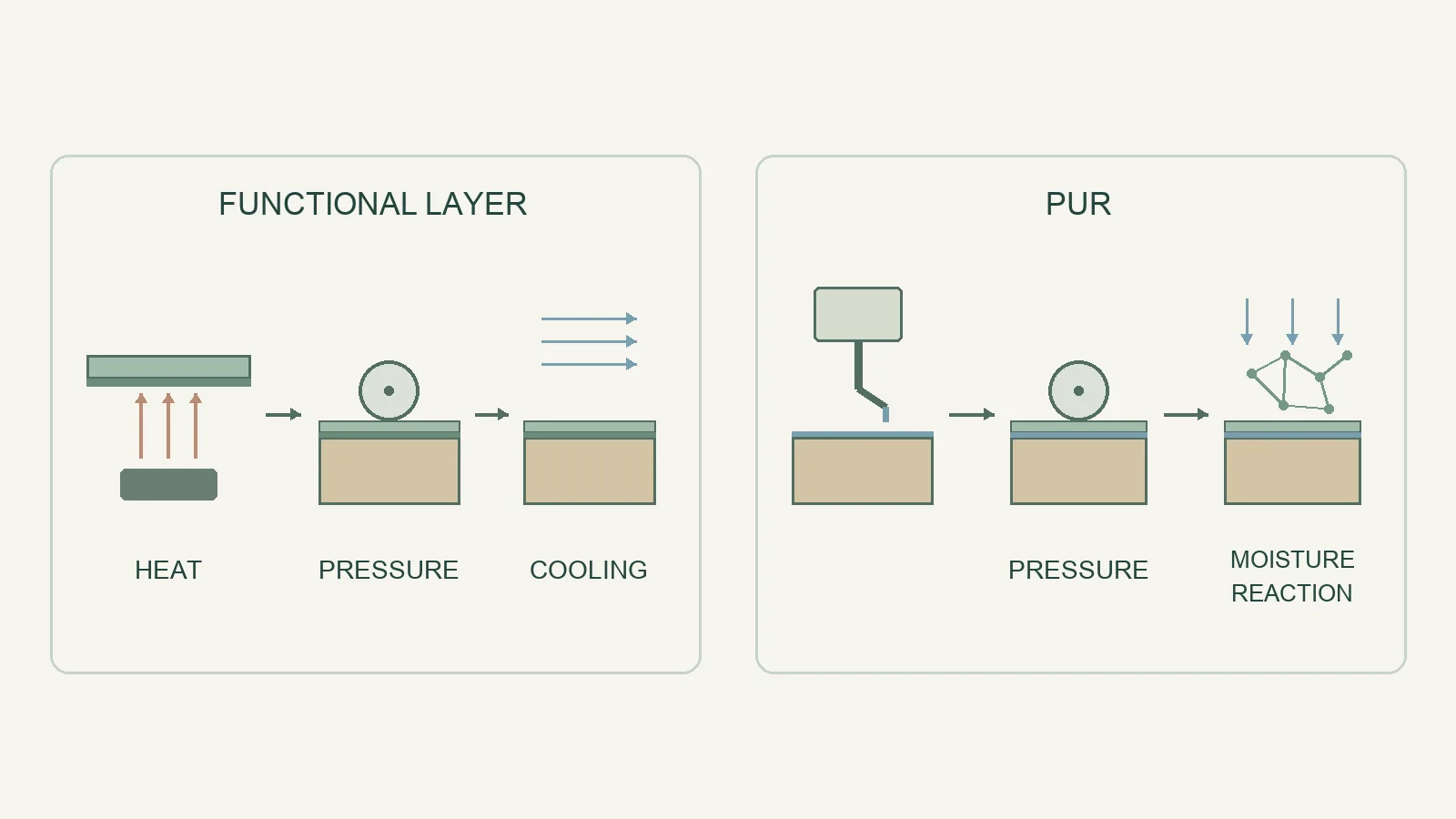
Laserline’s process description explains how the bonding side melts immediately before meeting the panel edge. Pressure rollers bring the surfaces together, and cooling gives enough initial strength for subsequent processing. The supplied functional layer therefore belongs in the tape specification alongside its visible color and material.
| Decision | Laser activation | PUR adhesive |
|---|---|---|
| Bonding layer | Functional layer supplied on the tape | Separately applied reactive hot melt |
| Joint appearance | Matched functional layer and controlled activation produce a narrow seam | Adhesive grade, application and trimming affect the glue line |
| Tape requirement | Tape with a functional layer approved for the activation system | Tape and bonding surface suitable for the chosen adhesive |
| Equipment | Suitable activation unit and pressure section | Suitable PUR melting, application and pressure equipment |
| Switching routes | Requires a machine configuration supporting the alternative | A PUR unit alone provides no laser activation |
| Process time points | Heating, pressing and cooling | Cooling gives initial strength; moisture reaction continues |
| Cost comparison | Tape, energy, changeovers and accepted output | Tape, adhesive, cleaning and accepted output |
Start with the edge your customer will see. A pale slab door makes a contrasting joint conspicuous; a varied woodgrain may make color continuity the stronger priority. Compare the finished face, edge and corner together. Inspect a banded sample as well as the tape swatch to see the completed joint.
Describe the laminated panel construction, including its face, core and back, before assessing the finished component. An attractive edge can accompany different panel constructions, each needing its own evidence for the intended use. The MDF edge-banding comparison explains that adhesive choice in more detail.
Is zero-joint edge banding glue-free or waterproof?
No. Zero-joint edge banding describes a near-invisible joint, while an activated functional layer still bonds the tape to the panel. Whole-door water resistance also involves the core, corners, back and holes. Choose a documented door construction for humid use, and approve its appearance separately from its moisture performance.
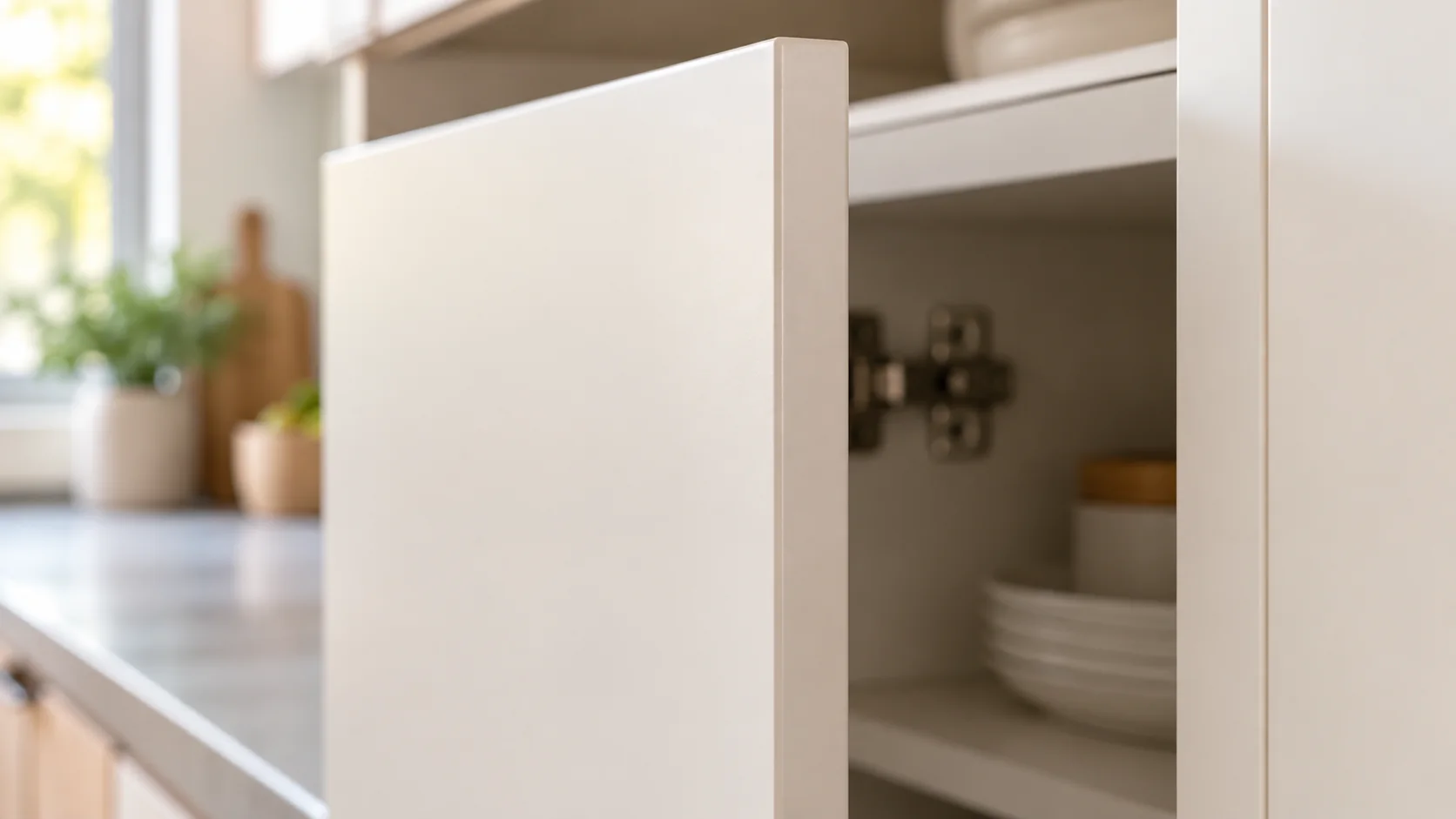
A practically invisible seam is worth examining from normal viewing positions and up close. Look where the edge meets the face and where adjacent edges meet at corners. On a light solid color, the joint’s shade can matter as much as its width.
PUR can also produce an inconspicuous line. Jowat’s 2024 adhesive program, printed page 14, describes grade 608.00 as unfilled, allowing a thin, colorless bondline. Compare physical samples before paying for a seam description that an alternative process may already satisfy.
For a named core example, MEDITE MR is intended for humid interiors, yet its manufacturer says it is not waterproof and wetting should be avoided. A sink-side door has potential moisture routes at hinge holes, corners and damaged edges as well as along its visible seam.
Include the back-facing specification in the panel balance review for the complete door. Assess moisture exposure on that construction, including its machined openings.
Can your current edgebander run functional-layer tapes?
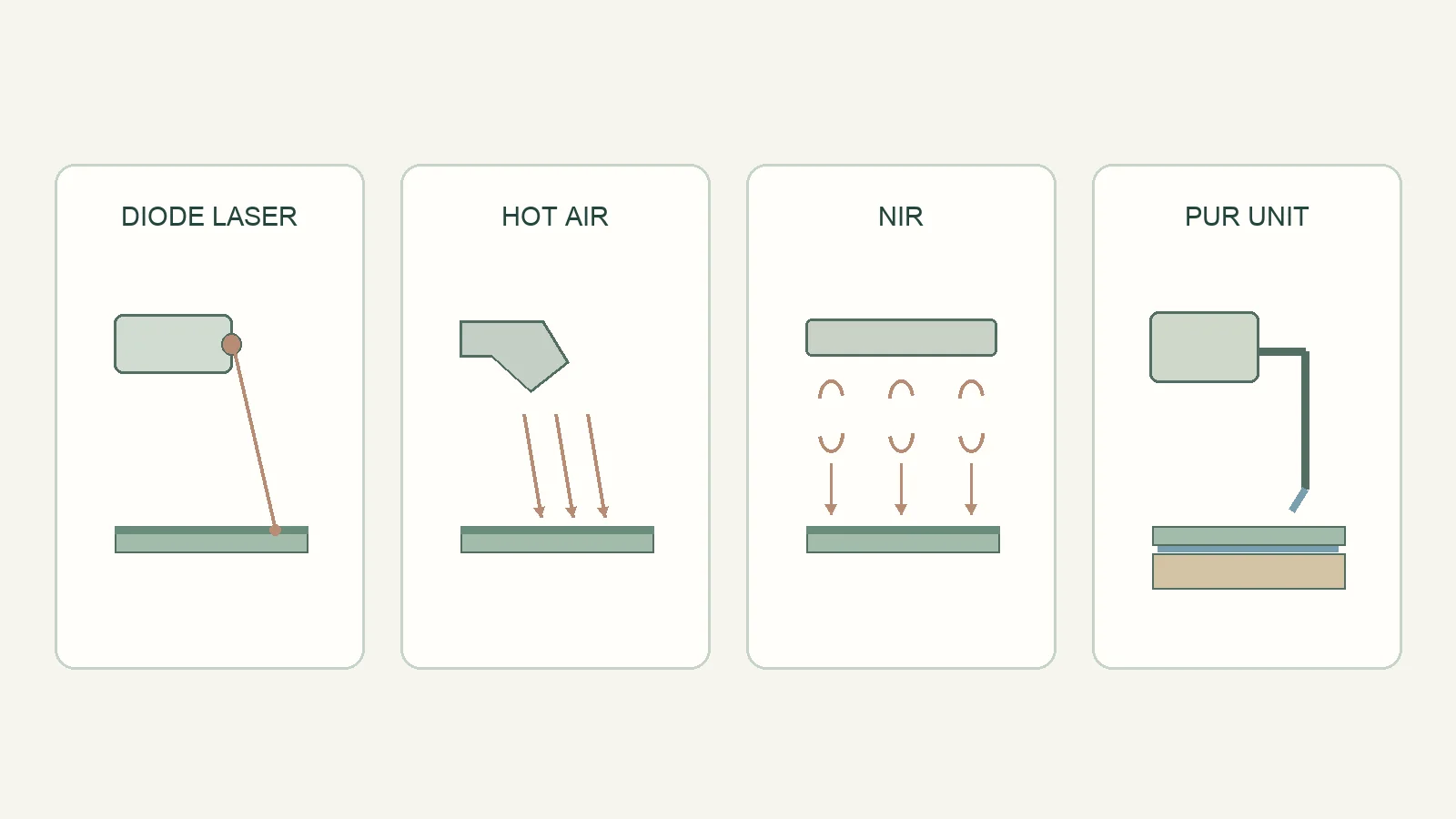
Yes, when its installed activation unit is approved for the proposed functional-layer tape. A PUR pot supplies adhesive; laser processing also needs an activation unit. Identify whether the machine uses a diode laser, hot air or near-infrared radiation, then match the tape layer, color and dimensions to its capability.
“Laser edging” on a catalogue cover can describe a broader family than a literal laser beam. HOLZ-HER’s LUMINA 1598 documentation, modified April 29, 2025, calls LTronic a laser-edging unit while specifying NIR, or near-infrared radiation, as its energy source.
| What the label says | Actual energy source or configuration | What to verify |
|---|---|---|
| Diode laser, such as IMA ZERO | Laser energy melts the functional layer | Approved tape layer, color and dimensional range |
| Hot-air edging | Heated air activates the functional layer | Tape approval for that hot-air unit and its operating window |
| LTronic laser edging | NIR modules | Suitable functional layer and the unit’s edge-height capability |
| Hybrid edgebander | Separate adhesive and activation capabilities | Installed modules and permitted switching procedure |
Functional layers can be co-extruded with the tape or applied as a coating afterward. The same equipment documentation explains that the required energy can vary with edge thickness and color. A new décor therefore needs a compatible activation selection even when its visible material resembles one already in use.
A real hybrid example is the IMA Novimat Compact R3. Its published configuration processes coiled edging with EVA or PUR glue, or with a diode laser, at a stated maximum of 25 m/min. That is a named-machine maximum, not a qualified speed for every tape and operating mode.
A new purchase and a retrofit raise different questions. For a retrofit, identify which activation and pressure modules can be fitted to that exact model. For a new machine, compare the supplied configuration with the tape range you intend to run.
Maintenance can also depend on the installed module. HOLZ-HER’s GluJet description gives a 48-hour cleaning condition for that system. Tie shutdown arrangements to the actual equipment and adhesive combination.
How do PUR settings, curing and cleaning affect output?
Use the selected PUR adhesive’s processing window, moisture-protected equipment and specified cleaning routine to plan output. Cooling gives the bond its initial handling strength; later moisture cross-linking develops the reacted adhesive. Schedule handling and durability assessment at the states specified for the proposed adhesive and component.
Jowat’s July 2024 program, printed page 15, lists 608.00/01 at a processing temperature of 100–120°C. It lists the separate 607.40/41 products at 130–150°C. For the PUR examples in that table, the feed range is 8–40 m/min at 150 g/m². These are adhesive-processing examples, not finished-door heat limits or our face-lamination settings.
For a near-appliance cabinet, assess the finished door under its expected heat exposure and installation position. The processing window tells the operator how the named adhesive is applied.
Printed page 13 describes physical solidification as the adhesive cools, followed by a reaction with water molecules in the substrate and surrounding air. It also specifies moisture-proof containers and dedicated processing equipment. Schedule early handling around the initial bond and performance assessment around the adhesive’s specified state.
Plan each stop as well as the run. Use the equipment’s specified PUR cleaning routine and include the time, cleaner and unused adhesive in the order’s operating cost. For short orders separated by idle periods, compare those demands alongside running speed.
Which tests should you compare before approving the edge?
Compare bonds made with the proposed core, tape and process under matching conditioning and test conditions. Approve the seam’s appearance on a physical reference, then assess bond performance for the expected use. A peel result becomes useful when the specimen, age, method and failure mode are identified alongside the reported force.
ASTM D903-98(2025), active and updated February 21, 2025, covers comparative peel or stripping strength under defined pretreatment, temperature and testing-machine speed. Its public scope supplies no cabinet-door pass value.
| Item | What to specify | Why |
|---|---|---|
| Substrate and core grade | The actual component construction | Establishes what the tape is bonded to |
| Tape and bonding layer | Tape identity plus functional layer or adhesive grade | Makes the two proposed combinations identifiable |
| Activation or glue application | Energy route or adhesive application used | Connects the specimen to the proposed process |
| Conditioning and age | Preparation, storage conditions and time before assessment | Makes results at different stages interpretable |
| Peel or bond method | Method, edition, specimen geometry and test conditions | Supports a meaningful comparison |
| Appearance reference | Agreed face, edge and corner sample | Defines the seam the buyer expects |
| Failure mode | Where separation or material failure occurred | Helps distinguish interface failure from damage elsewhere |
For a humid application, read how the finished edge was exposed and what was inspected afterward. For heat exposure, identify the temperature, duration and construction tested.
A report showing failure in the core describes a different event from separation at the tape interface. Preserve that observation when comparing results. The cabinet-surface durability guide explains why a coating scratch result and a component bond result answer different questions.
Which route fits your job mix and operating budget?
PUR is a practical starting route for varied work on an established line; laser deserves evaluation where seam appearance has value and matching tape volumes support the change. Compare cost per accepted edge meter, including material, energy, changeovers, cleaning, trimming and rework. Use your order mix and usable output as the basis.
Build the comparison around accepted edge length. Count the tape consumed, actual adhesive used where applicable, activation or melting energy, start-up and cleaning work, trimming waste and rejected parts. Divide the cost for that work by the edge length accepted for delivery. A fast run followed by repeated changes can produce a different result from a long, steady order.
The adhesive program above provides a useful unit-conversion example: 150 g/m² × 0.019 m = 2.85 g per edge meter. This converts an area application rate across a 19 mm-wide edge; it is arithmetic, not measured consumption or a quotation. Actual use also needs allowances measured on the proposed process.
Tape availability affects more than the first purchase. Where several color matches are needed, verify which are available with the required functional layer and which your adhesive route supports. The supplier evaluation guide helps distinguish a documented supply proposal from a sample without a dependable production route.
Ask about repair before choosing the operating budget: can a damaged or rejected edge be removed and re-run on the proposed route? Will the matching tape or adhesive remain available? What additional work would that repair require? Add the proposed repair work and material availability to the cost comparison.
Where does a silicone functional panel face fit?
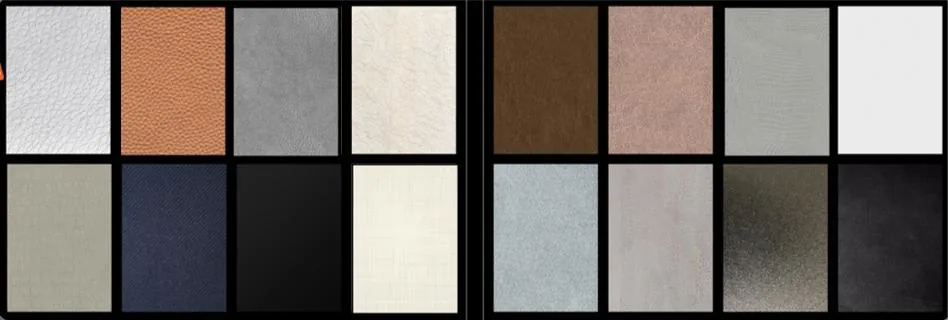
Puremorfilm makes decorative film with a silicone functional surface for flat furniture panels and cabinet-door faces. Our supply route covers PUR flat lamination of the large face. The edge-bonding combination needs separate validation; we have no verified laser, NIR, hot-air or PUR edgebanding route for this film.
Our paint-free surface uses a silicone functional face, distinct from PVC, melamine, PP and PETG decorative faces. The furniture film is PVC-free and uses a No DOP formulation. Its silicone surface is inherently flame-retardant, with higher grades up to UL 94 V-0 available on request.
In the manufacturer’s laboratory tests, coffee, red wine and soy sauce left at 25°C for 24 hours wiped off with no obvious change.
We mainly supply rolls, with a film MOQ of 500 linear metres. On-request laminated panels measure 1220 × 2440 mm, with a separate MOQ of 200 panels. Samples are free. Standard film has no back adhesive; back adhesive is available on request.
Because of its leather-like feel and some elasticity, it is not for floors, stovetop counters, shower floors or other walked-on areas.
How should you approve a PUR or laser route for the job?
Keep PUR where a qualified line already handles varied work; evaluate laser for a seam-led specification with matching tape and activation equipment. For mixed orders, compare a documented hybrid configuration. Approve the actual component through its appearance, relevant bond evidence and accepted output, then choose the route that meets the job at the better total cost.
- Set the seam and color target. Compare face, edge, corner and trimming on physical samples under the intended lighting. Review color matching and metamerism under the intended lighting and from normal viewing positions.
- Validate the real combination. Use the proposed component within the equipment’s supported window, with the selected functional layer or adhesive. Review appearance and the evidence relevant to its end use.
- Choose on accepted output and total cost. Compare equivalent work, including changes, idle periods and the repair questions above. Keep the approved physical sample with the chosen construction.
| Job condition | Starting choice | What settles the decision |
|---|---|---|
| Existing PUR line and many colors | Retain and qualify the PUR route | Required tape matches, seam sample and operating cost |
| High-value seam with steady tape volume | Evaluate laser activation | Matched functional-layer tape, equipment and component evidence |
| Mixed orders on suitable equipment | Evaluate the hybrid configuration | Supported route changes and accepted output for the order mix |
| Humid end use | Evaluate the complete door on either route | Core, edges, corners, back and holes under relevant exposure |
For a decorative panel-face sample, contact us with the panel size, quantity, face target and conditions of use.
Frequently Asked Questions
What Is the Best Edge Banding Adhesive?
There is no single best adhesive: the use, equipment and proposed tape decide the shortlist. A qualified PUR combination is a useful starting point where it meets the component’s exposure and appearance needs; compare its operating demands with the alternatives available on your line.
Is PUR Edge Banding Better Than ABS Edge Banding?
No, they are not direct alternatives: PUR is an adhesive, while ABS is an edge-tape material. Identify the tape and its bonding surface first, then select a compatible adhesive or approved activation route for that construction.
Is PUR Better Than EVA Glue for Edge Banding?
No, not in every case: a qualified EVA combination may meet the job, while PUR suits work requiring its reactive bond when the equipment and maintenance support it.
What Is Laser Edge Banding?
Laser edge banding is a process that uses laser energy to melt a functional layer on the edge tape before pressing it onto the panel. The layer supplies the bond, and cooling gives the joint its initial handling strength.
Are hot-air and laser edgebanding really the better alternative to regular edgebanding?
No, not automatically. Their value depends on the required seam, compatible tape availability and suitable activation equipment. A qualified PUR route may already meet the appearance and production needs of the order.