
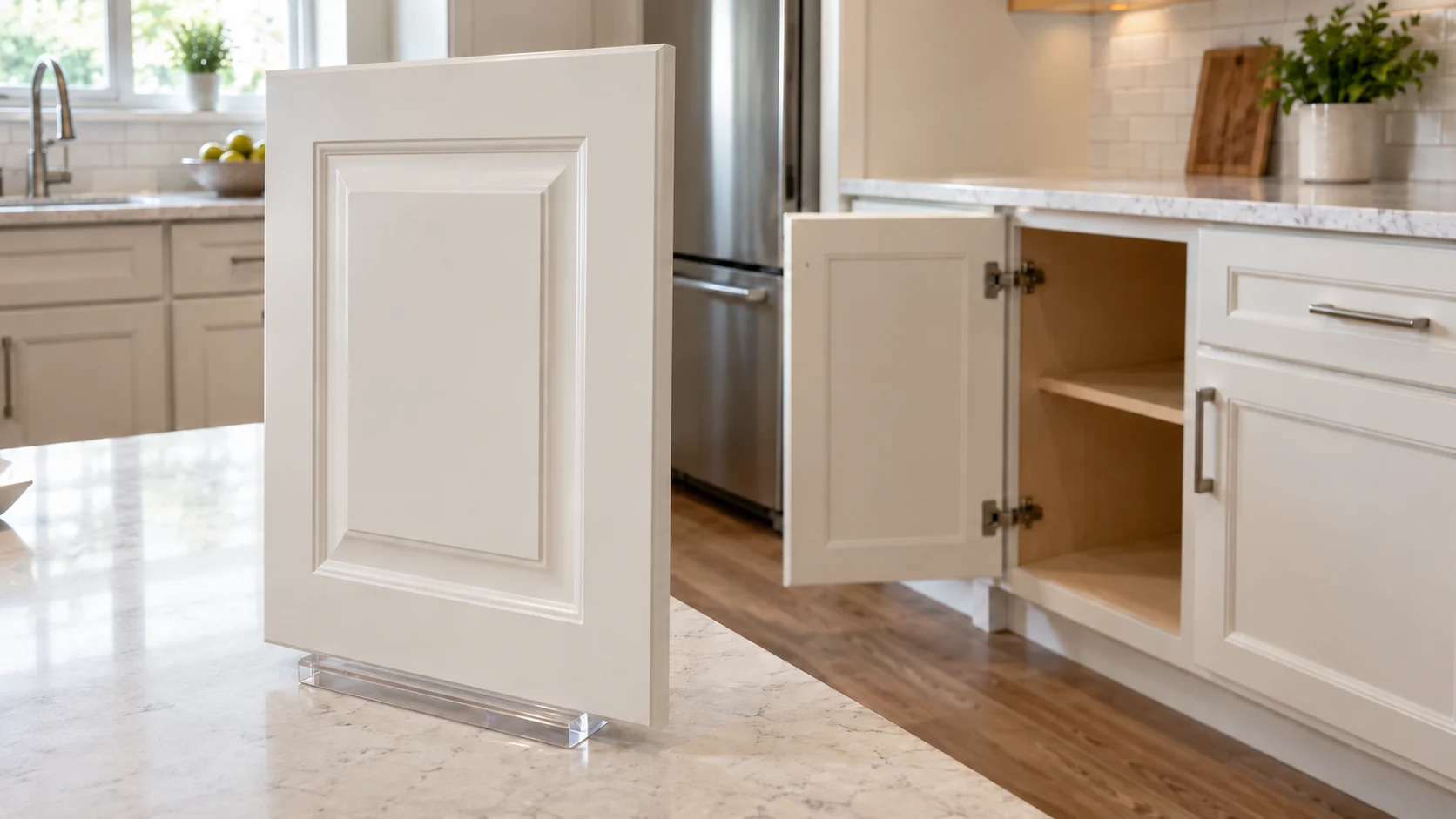
A kitchen display can look like painted cabinetry while its doors are actually covered in a formed plastic film. Thermofoil cabinets usually pair that decorative film with engineered-wood door cores, so judge them by the complete door construction, your kitchen’s heat and moisture, and exactly what work you are paying for.
What are thermofoil cabinets made of?
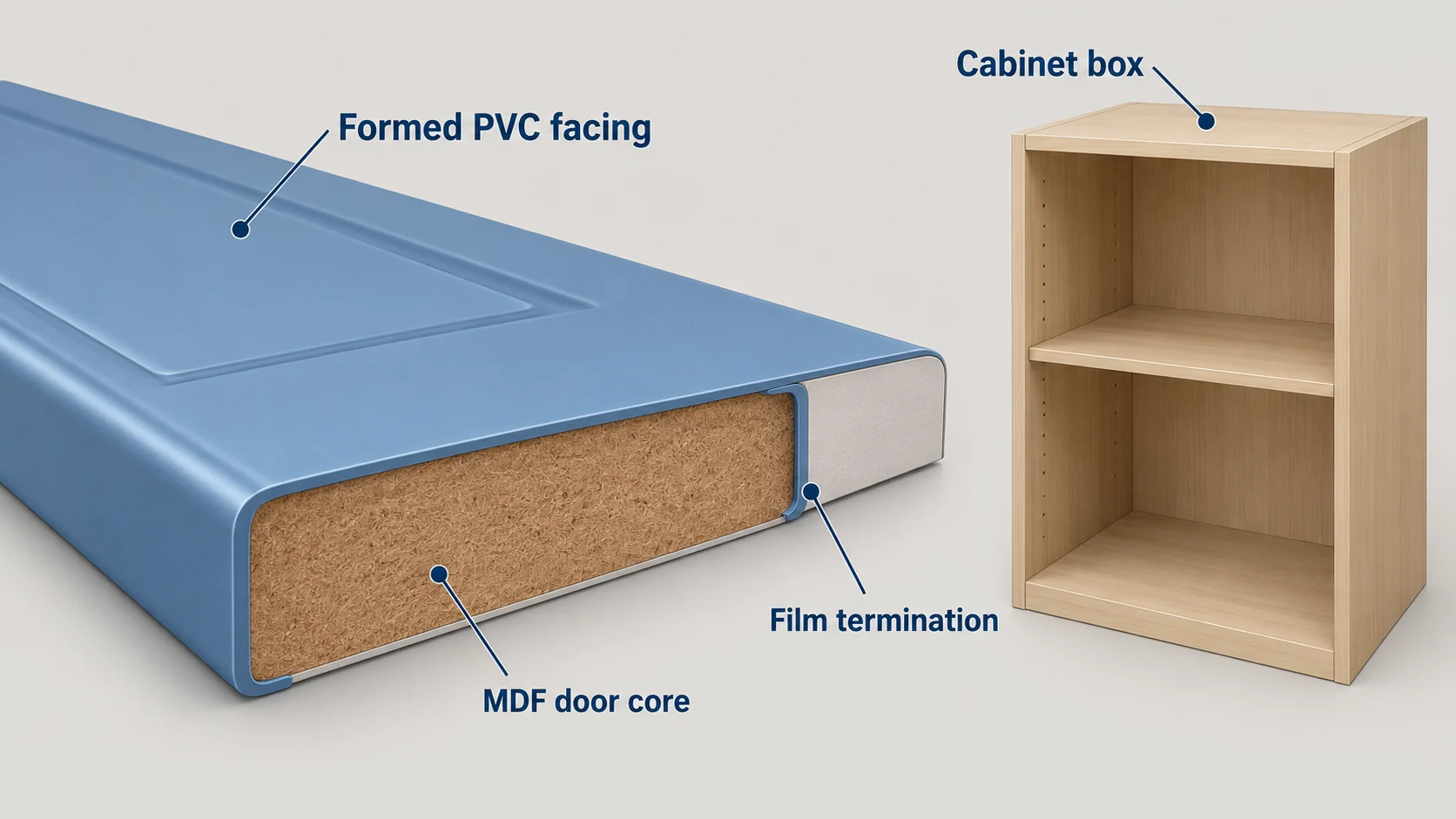
A heat-formed decorative film, usually vinyl, over a shaped door core such as medium-density fiberboard (MDF). The name describes the door finish; the cabinet boxes, shelves and drawer boxes can be made of something else.
The Composite Panel Association calls these films rigid thermoformable foils: three-dimensional laminates formed around contoured parts in a vacuum or membrane press. The category includes PVC and PETG films over MDF or particleboard, so the category name tells you less than the door’s actual material specification. CPA’s 3D laminate description explains the construction.
| Cabinet part | What it does | What to identify when buying |
|---|---|---|
| Decorative film | Provides the visible color, pattern and surface | Film material, finish and care instructions |
| Door core | Holds the door’s shape and routed profile | Core type, grade and finished thickness |
| Door back and edges | Complete the finished component | Back finish, film termination and any exposed core |
| Cabinet box | Supports shelves, doors and hardware | Its own panel construction and existing condition |
MDF is a resin-bonded wood-fiber panel. Its smooth structure machines and takes surfacing well, as the MDF introduction from the same association describes. Read more about the core’s uses and grade choices.
When a listing says “thermofoil cabinets,” ask whether you are getting complete cabinets or replacement fronts only. A door photo won’t show what the box is made of, and a plywood box can still carry an MDF-based door.
For the wider choice of cabinet cores and door faces, compare kitchen cabinet materials.
Which door styles and finishes can you choose?
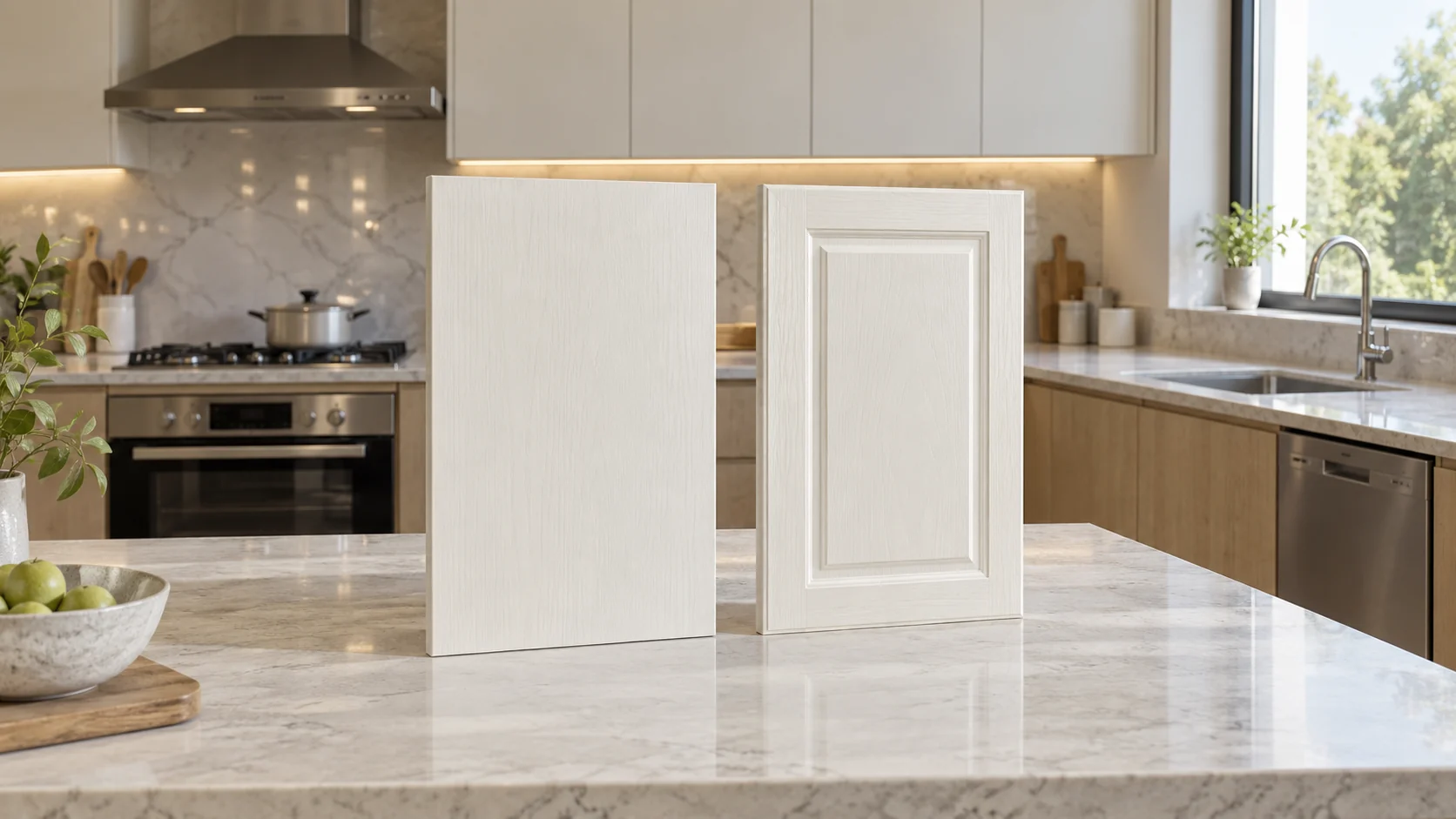
A flat slab for a plain look, or a routed profile wrapped in one continuous formed film. Shaker-style recesses, raised profiles, solid colors and printed woodgrain are the usual options.
The shape usually comes from machining the core under the film. So a Shaker-style thermofoil door is built differently from a wood door made of rails, stiles and a center panel. If construction matters to you, compare cross sections; a style name describes looks, not joinery.
Look at a full door sample from the front, side and back. Check the inside corners of recesses, the outer edge and where the film ends on the back. A small color chip shows color, but not how the finish wraps the profile you will order.
For woodgrain, decide the grain direction on doors and drawer fronts, and ask how neighboring fronts will line up if continuity matters. For solid colors, hold the sample next to your countertop and existing cabinets under your own lighting. Gloss and texture make similar colors look different.
Painted MDF, wood veneer and laminated flat doors are the main alternatives. Our thermofoil versus laminate comparison covers the facings in detail. Pick the profile and finish first, then compare constructions that can deliver it.
What are the pros and cons of thermofoil cabinets?
The pros: a factory-applied color or woodgrain on flat or shaped fronts, and a consistent look across every door. The cons: sensitivity to high heat and standing moisture, and few options for invisible touch-ups or repeated repainting.
You receive an already finished part. On a replacement-door project, that saves you creating the finish at home, though measuring, hinge fit and installation are still yours to solve. A cheap listing that supplies only the door is not comparable with an installed price.
A formed facing also keeps a set of fronts consistent. In an older kitchen, check whether the visible cabinet sides and face frames can match the new fronts; replacing doors alone can leave a mismatch across the room.
Think about repairs as well as looks. A scratch through printed film, a detached facing and a swollen core each need a different fix, and a touch-up pen made for painted wood can stay visible on printed film. If you like to change colors every few years, put a paintable door on your shortlist.
For a new kitchen, specify the box and hardware separately from the door finish. The kitchen cabinet materials guide compares those parts, including box strength and hinge fit.
What should you check around heat and water?
The cabinets beside the oven, under the sink and next to the dishwasher, before you order. The film and the wood-based core behind it fail in different ways, so a washable front still needs sound edges and a layout that keeps hot air, steam and spills away.
Masterpiece’s cabinet-care guidance warns about high heat from self-cleaning ovens and describes protecting nearby cabinetry, including a heat-shield option. Wipe up water promptly, and don’t hang wet towels over sink-base doors. That advice is written for its own cabinets, but those are the spots to check in any kitchen. Read the original cabinet-care guidance.
Check the appliance installation requirements against the cabinet details. A new front will meet the same leak, worn appliance seal or steam vent that damaged the old one. Fix the source first, and get the cabinetmaker’s heat-protection detail for the door you choose.
Around the sink, inspect lower edges, the back face, hinge holes and neighboring panels. A lifted film edge points to the facing or the bond; a thick, soft core usually means replacing that part. Our MDF and water exposure guide explains why core grade and sealing matter.
When you shop, ask to see the finished back and edges, not just the face. Write the door’s heat and moisture limits into the purchase documents, so the kitchen designer and the door supplier work from the same requirements.
Why do white thermofoil cabinets turn yellow?
White thermofoil cabinets can yellow because of surface deposits, heat, sunlight or aging of the finish. Unsuitable cleaners can also damage or discolor the surface. First test the permitted cleaning method on a hidden area: removable grease may clean away, but a permanently changed film usually needs refinishing or replacement.
| What you observe | Likely check | Practical response |
|---|---|---|
| Yellow residue that transfers to a cloth | Cooking grease, smoke or other deposits | Use the door supplier’s approved cleaner and a soft cloth; rinse and dry as instructed. |
| Change concentrated beside an oven or kettle | Heat and steam exposure | Follow appliance clearances and cabinet protection instructions; move portable heat sources. |
| Change strongest on sunlit fronts | Light exposure and finish aging | Reduce direct sunlight; compare with a sheltered part of the same door. |
| A dry patch stays yellow after gentle cleaning | Permanent finish change or chemical damage | Stop escalating chemicals. Ask about a compatible refinishing route or replacement front. |
Cabinet-door care guidance warns about oven heat, direct sunlight and harsh or abrasive cleaners. If the yellowing comes with lifting edges, use the thermofoil cabinets peeling guide before choosing a repair.
How should you clean and care for the finish?
With a soft damp cloth for everyday cleaning: wipe spills promptly and dry any water left around edges and hardware. Move to a cleaner only if your finish’s care instructions allow it.
For its melamine and thermofoil surfaces, Masterpiece rules out abrasives and cleaners containing acetone, acetate or ethyl alcohol, and lists other cleaners for those panels. Your own door supplier should give you the instructions for the product you own.
Test any approved cleaner on a hidden spot first. Use a fresh, soft cloth so grit doesn’t scratch the surface. Work carefully around handles and profiles, then remove the cleaner and moisture as directed. If a mark survives the approved method, identify the stain or call the supplier before reaching for something stronger.
Keep an eye out for changes. If a corner lifts, water sits at an edge or a hinge loosens, check that door before more wiping or use makes it worse. Cleaners remove dirt; a warped door or a loose facing needs a repair decision.
Keep the product label and care sheet with your kitchen records. They tell you which cleaner is approved, and they tell the next owner more than the word “thermofoil” can.
Can existing doors be painted or should you replace them?
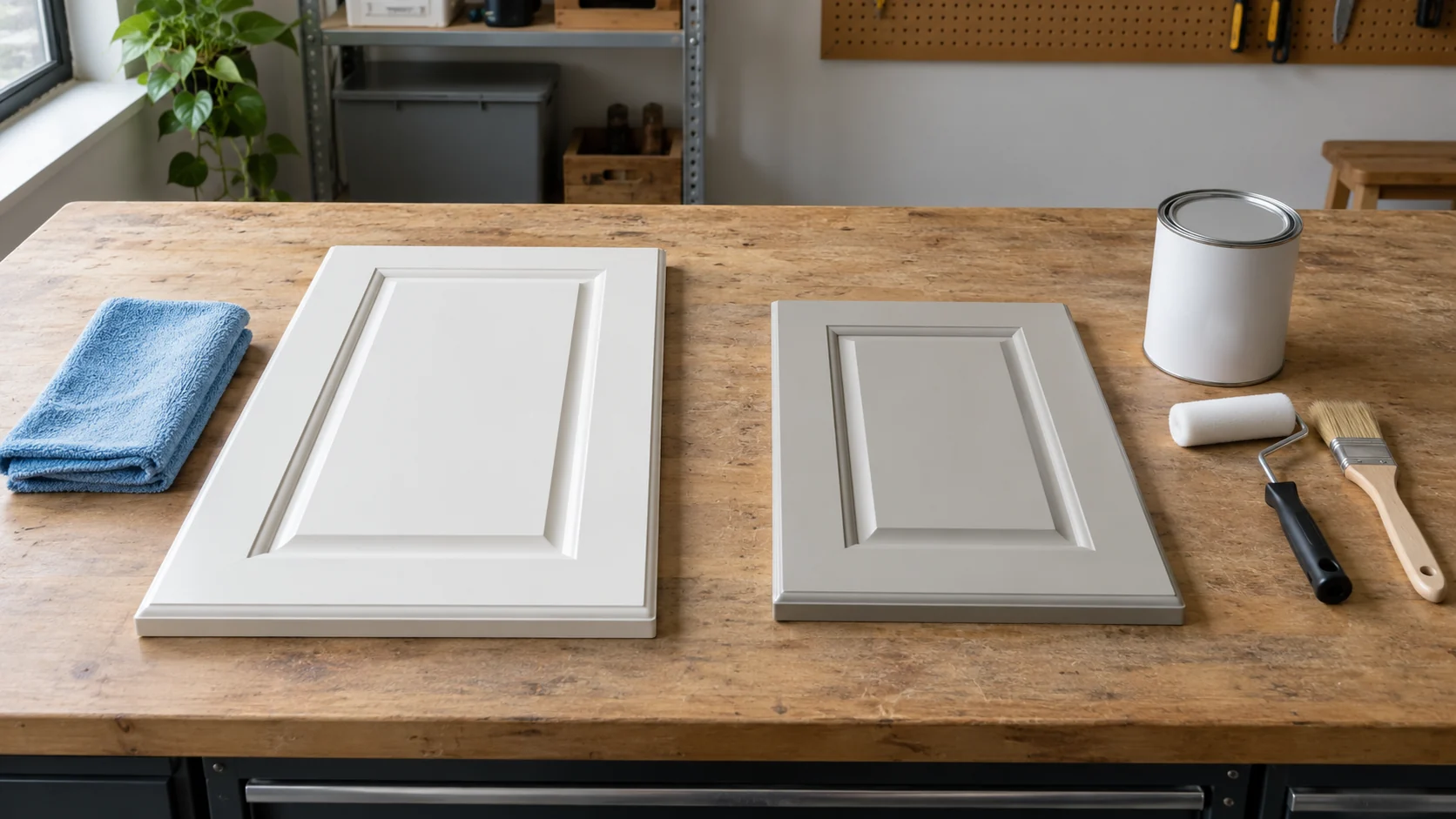
Firmly attached thermofoil in good condition can take a tested paint system. Lifting film or a damaged core needs repair or replacement first.
Benjamin Moore’s INSL-X STIX SXA-110 is a current bonding-primer example. Its technical sheet lists PVC and vinyl among the substrates, requires a clean, dry, sound surface, and calls for testing questionable plastics for adhesion and topcoat compatibility before you coat the whole job. Do that test on a hidden area of your actual door with your chosen topcoat.
For this primer, the sheet lists 3–4 hours to recoat at 77°F (25°C) and 50% RH, and about 3–4 days to reach maximum resistance to scraping off. Being ready to recoat is not the same as being cured, and the cabinet paint on top has its own curing time. STIX SXA-110 technical data, pages 1–2 gives the conditions.
Weigh that preparation and drying time against new fronts, especially when many doors need work or the film is already lifting. If the boxes are sound, replacement doors can fix the visible damage without tearing out the kitchen. Our thermofoil cabinets peeling guide covers condition checks and repair options.
What should a replacement-door or refacing quote include?
The fronts, hardware work, exposed cabinet surfaces and installation, each listed separately. Door replacement supplies new fronts; refacing can also cover face frames and cabinet sides, so two prices can describe very different jobs.
The word thermofoil doesn’t come with a standard refacing price. Send every supplier the same door-and-drawer schedule and compare totals for the work you need. A unit price without sizes, finish, drilling and labor tells you little.
| Item | What to specify | Why it affects the order |
|---|---|---|
| Front schedule | Each door and drawer-front quantity, finished width and height, in inches or millimeters | Defines the components being priced |
| Construction | Core, thickness, profile, face finish and back finish | Prevents appearance-only substitutions |
| Hardware | Hinge make and model, drilling drawing, handle holes and reused parts | Establishes mounting compatibility |
| Visible cabinet surfaces | Face frames, end panels, fillers and their proposed finish | Shows whether the quote includes refacing beyond the fronts |
| Site work | Removal, installation, adjustment and any box repairs | Makes labor and existing damage visible |
| Documentation | Care sheet, warranty terms and applicable composite-wood labels | Records care, coverage and material traceability |
Measure the finished fronts and note where each one goes; for a new layout, let the cabinetmaker work out overlay or inset sizes. Copying opening sizes without allowing for the door arrangement gets you the wrong fronts. Our laminated MDF buying guide explains how to describe a faced panel.
For composite-wood products sold in the United States, ask for TSCA Title VI compliance information. Labels on regulated finished goods carry the fabricator’s name, production date and a compliance statement. Ask for the records that cover the cabinet or part you are buying; EPA’s consumer FAQ, questions 2 and 9 explains which products and labels are covered.
Where does a silicone-faced flat door fit?
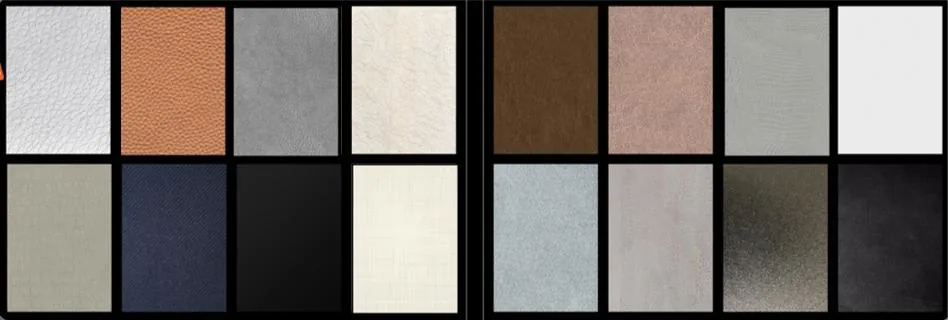
Puremorfilm makes decorative film with a silicone functional surface for flat furniture panels, including slab cabinet doors. It is laminated flat with PUR adhesive, so it suits a flat-front redesign rather than a routed thermofoil profile. The silicone surface is inherently flame-retardant (higher grades up to UL 94 V-0 on request), and the film is formaldehyde-free with a No DOP formulation. For kitchen use, in the manufacturer’s laboratory tests, coffee, red wine and soy sauce left on the surface for 24 hours at 25°C wiped off with no obvious change, and in an SGS test a Mitsubishi Uni 2H pencil at 500 gf and 45° left no obvious scratches on the tested sample.
We supply the film mainly in rolls, with laminated panels on request; the door maker still supplies the finished size, edges and hardware drilling. It is a new paint-free facing whose silicone functional surface differs from PVC, melamine, PP and PETG decorative surfaces. See the furniture decorative film page.
Which cabinet-door route should you choose?
The one that fits your door shape, the state of your existing cabinets and how much finishing work you want to take on.
| Your situation | Practical route |
|---|---|
| You want a factory-finished routed profile | Compare complete thermofoil doors with the specified core, back and care limits |
| You want a different color on sound existing fronts | Evaluate a compatible primer-and-paint system on the actual finish |
| Fronts are damaged but cabinet boxes remain usable | Price replacement fronts and identify any additional refacing work |
| You want a new flat decorative front | Compare finished flat-door constructions and suitable laminated facings |
A rental kitchen with tired but intact white Shaker doors is a painting candidate. A sink base with swollen doors is a replacement job. A full remodel is the time to choose the door shape first.
For a new flat-door project, start with the finished front drawing. For a flat furniture-facing project, contact us with the door design and the material supply form you need.

Frequently Asked Questions
Are thermofoil cabinets any good?
Yes, for factory-finished flat or shaped fronts, as long as the core, cabinet construction and heat and moisture limits suit your kitchen.
How much does it cost to reface thermofoil cabinets?
There is no single price. Front quantities and sizes, finish, hardware work, cabinet-side resurfacing and installation set the cost, so ask each supplier to quote the same itemized schedule.
Is thermofoil better than MDF?
No, they are different parts of a door: thermofoil is the facing, and MDF is a common core. Compare thermofoil-faced MDF with painted MDF or another finished door.
Can thermofoil cabinets be repainted?
Yes, if the film is sound and a compatible bonding primer and paint pass an adhesion test on the actual door. Lifting film or a swollen core needs repair or replacement first.
What are thermofoil cabinets?
Thermofoil cabinets are cabinets whose fronts are covered by a heat-formed film over a shaped core, usually MDF. The term says nothing about the cabinet boxes.