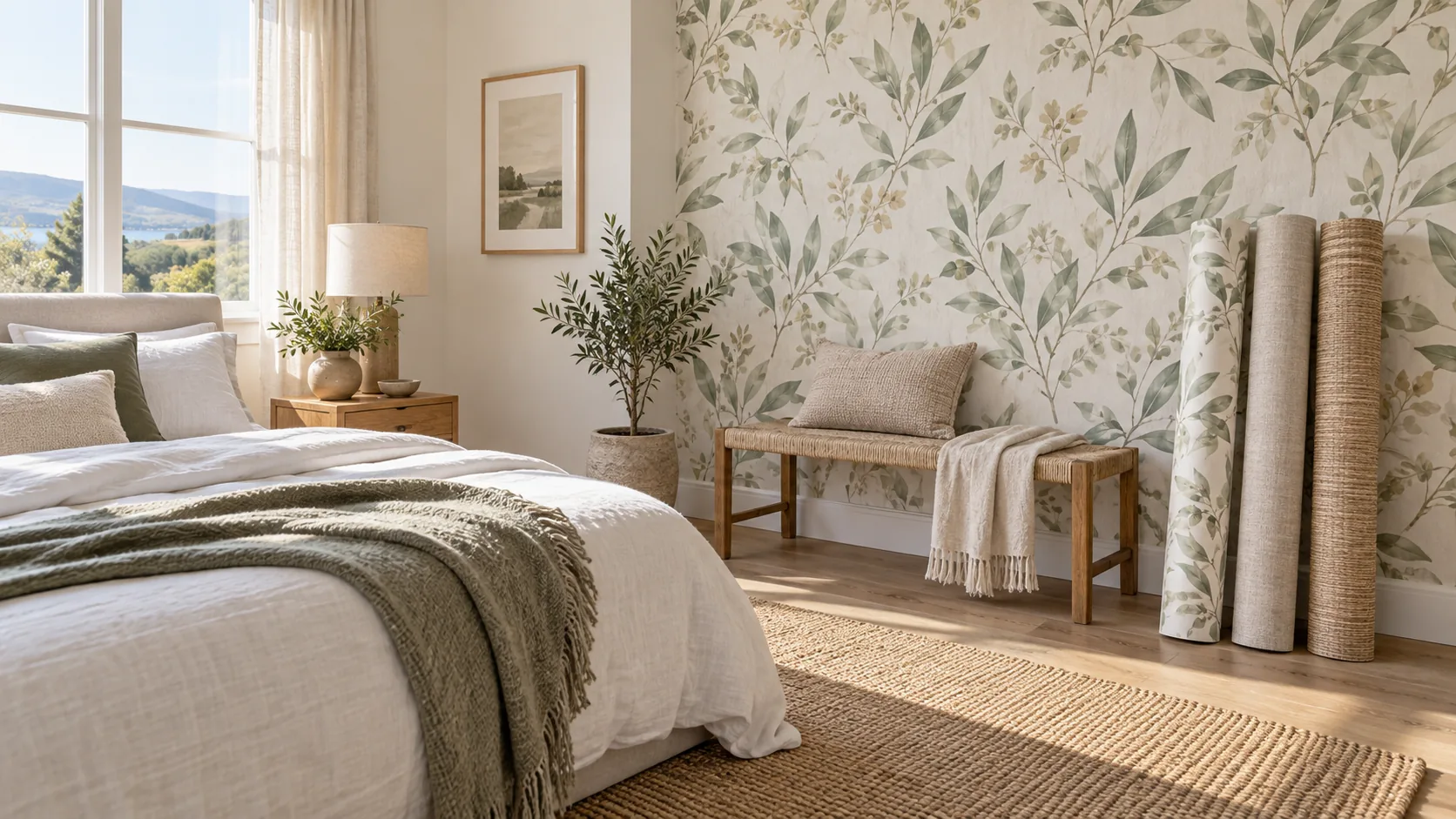
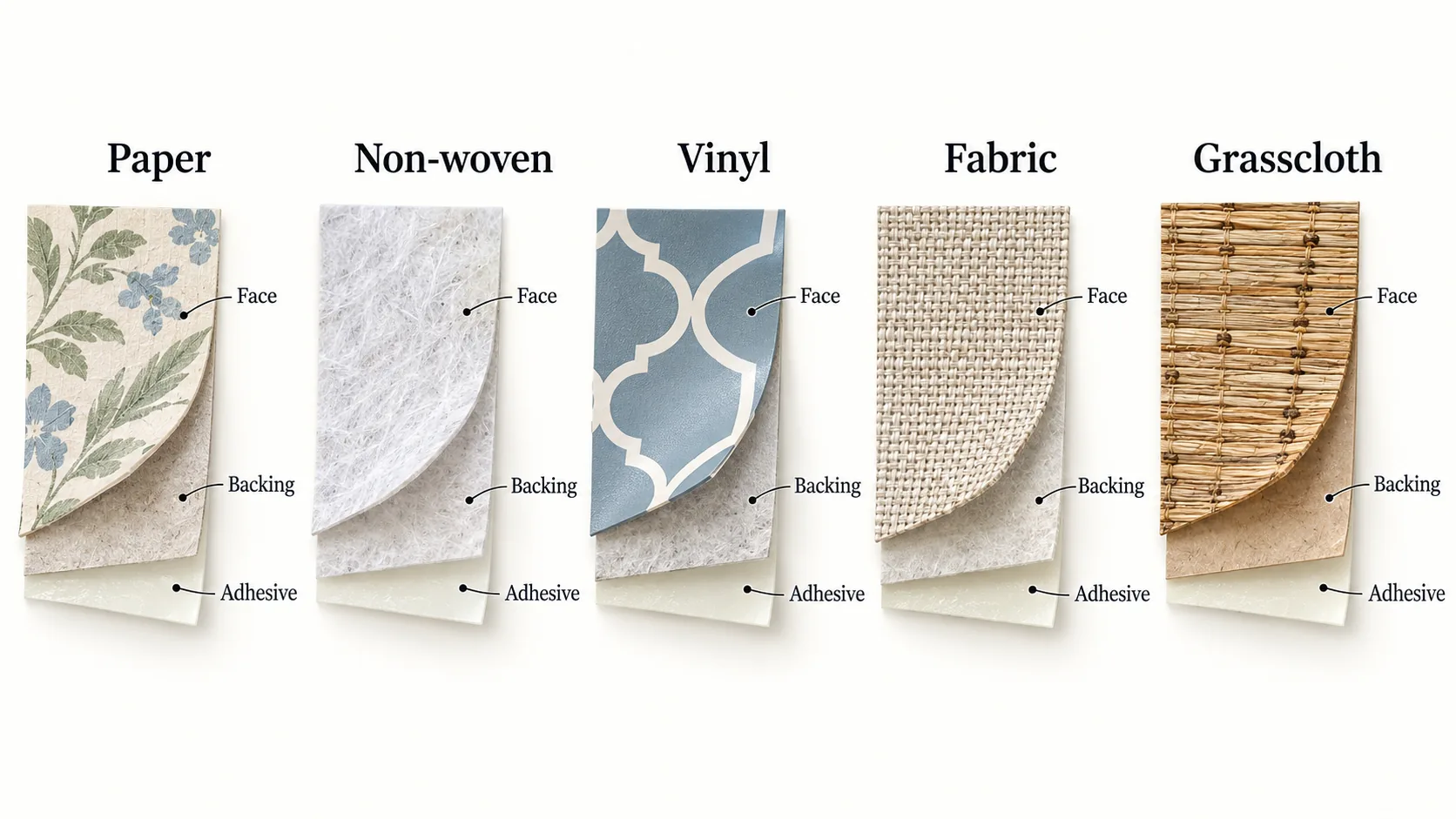
The main types of wallpaper are paper, non-woven, vinyl, fabric and natural-fiber papers such as grasscloth. The face determines the appearance and cleaning options; the backing and adhesive help determine how the covering goes up and comes down. Paper and natural wallcoverings generally suit quieter, low-contact rooms, while washable vinyl and suitable synthetic textiles serve busier walls.
A material name gives you only part of the answer. A vinyl face can have a fabric backing, and a non-woven backing can carry different decorative faces. Read the construction, cleaning label and hanging method together before choosing a roll.
What are the main types of wallpaper?
Paper, non-woven, vinyl, fabric and natural fibers form five useful material families for comparing wallpaper. They overlap where one material forms the face and another forms the backing.
| Family | Decorative face | Common backing or construction | Cleaning consideration | Useful starting point |
|---|---|---|---|---|
| Paper | Printed paper, sometimes with an ink-sealing coat | Paper | Check the individual care label | Bedrooms, dining rooms and low-contact walls |
| Non-woven | Printed or finished fibrous sheet; other faces can also use this backing | Paper and synthetic-fiber mixtures | The actual finish determines washability | A paste-the-wall option for a room you want to decorate yourself |
| Vinyl | Vinyl coating or solid vinyl face | Paper, woven fabric or non-woven | Look for the required washable or scrubbable rating | Busy rooms and suitable ventilated kitchen or powder-room walls |
| Fabric or textile | Woven or other textile surface | Usually a stabilizing backing | Natural and synthetic textiles need different care | Dry decorative walls, or higher-traffic uses with a suitable synthetic product |
| Natural fiber | Woven grass, plant fiber or similar natural texture | Often paper | Many need dry dusting or gentle vacuuming | A dry bedroom or living-room accent wall |
You will also see labels such as metallic, flocked, embossed and paintable. These describe an effect or surface treatment and can occur across different constructions. A grasscloth appearance can likewise be printed or embossed instead of woven from natural fibers.
Unpasted, prepasted and peel-and-stick describe how the adhesive is supplied, which is a separate choice covered further down.
To compare wallpaper with paint, panels and other wall finishes, see the types of wall coverings.
How do the face and backing change how wallpaper behaves?
The face controls what you see and touch, while the backing supports the face and influences hanging and removal. Adhesive is a further part of the installation system.
A fabric-backed vinyl has vinyl exposed to the room. A textile-faced wallcovering has fabric exposed to the room. They can look similar from a distance but ask for different cleaning methods. Natural textiles are usually laminated to a backing to keep them stable and stop adhesive bleeding through to the face.
The backing also affects how a wet strip behaves and how the covering separates during removal. The label may say that the entire strip comes away dry, or that the decorative face peels away and leaves a backing to remove separately. Removability also depends on the wall preparation and adhesive used.
Trust the cleaning label over a guess based on texture. In the Wallcoverings Association’s wallcovering characteristics, washable means a covering takes occasional sponging with a detergent solution; scrubbable means it takes a brush. A washable label gives no permission to attack the surface with a scouring pad.
On a stair wall brushed by hands, prioritize the care rating before falling in love with a delicate weave. In a bedroom behind a headboard, the decorative face can carry more weight in the decision.
When is paper wallpaper a good choice?
Paper wallpaper suits dry, low-contact rooms where the printed design matters more than frequent cleaning. Bedrooms, dining rooms and studies are natural places to start.
Paper wallpaper is decoration printed on a paper substrate. Some products have a coating to seal the inks, so the appearance of paper alone cannot tell you whether the surface tolerates a damp wipe.
A detailed print can give a quiet wall its color and pattern without needing a heavy raised texture. Put that sample beside the curtains, floor and furniture finish to see whether the pattern works at room scale. A small motif that looks restrained on the roll can become busy across the whole wall.
A narrow entryway where bags scrape the wall asks more of the covering. So does a child’s drawing corner. For those locations, move toward a surface with a cleaning rating suited to the contact, or keep the delicate paper above the most exposed area.
If you are still choosing between a patterned wall and a painted one, our wallpaper versus paint comparison covers that broader decision. The material choice within wallpaper comes next.
What is non-woven wallpaper, and why is it easier to hang?
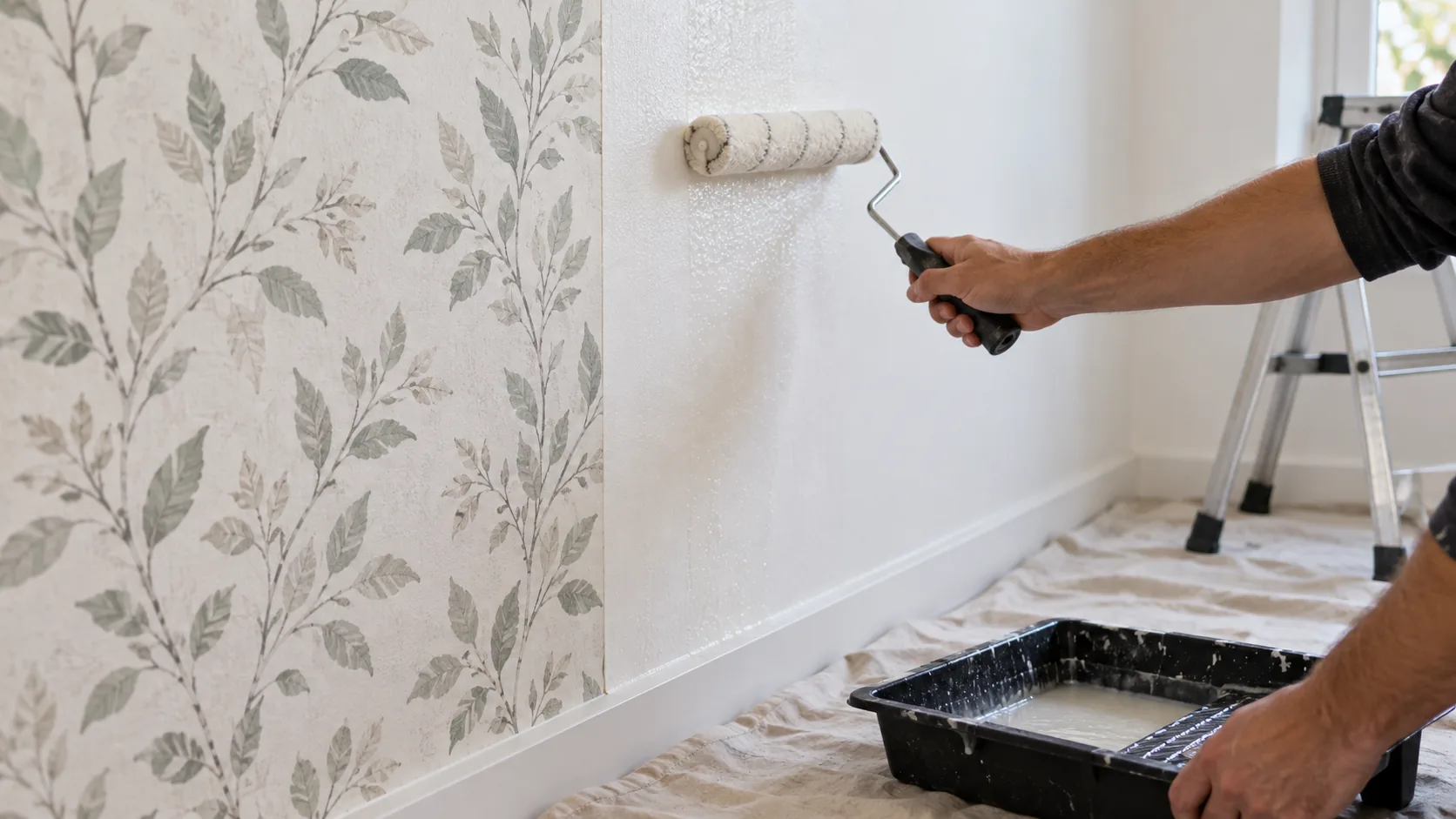
Non-woven wallpaper uses a fibrous construction with good wet strength, and many versions let you paste the wall and hang a dry strip. That saves handling a long, wet sheet on a pasting table.
Boråstapeter’s wallpapering FAQ describes its non-woven material as paper with added polyester fibers, which improves wet strength and resistance to swelling. The manufacturer connects that construction to applying adhesive directly to the wall and hanging the paper edge to edge.
For a bedroom feature wall, that can make positioning the strip more manageable. You apply the adhesive where the strip will go, bring the dry length to the wall and smooth it into place according to its instructions. You still have to line up the pattern.
Non-woven is a material or backing description, while paste-the-wall is an installation method. Read both labels, because the face may be plain, coated, embossed or another material, and that face sets the cleaning rating. For this manufacturer’s paper, the added polyester rules out an all-natural or plastic-free description.
What should you know about vinyl wallpaper?
Vinyl is a useful choice for walls that need frequent wiping, provided the selected product carries the right cleaning rating. It is a face material that can be combined with several backings.
Vinyl-coated paper and solid-sheet vinyl differ in construction: one has a coating over paper, while the other has a solid decorative surface laminated to a backing. That distinction affects the finished covering, so avoid judging all vinyl from one thin coated sample.
For example, Schumacher’s care guide identifies extra-washable vinyl wallcoverings for well-ventilated kitchens and powder rooms where condensation can occur. Keep decorative wallpaper outside direct shower spray and persistent splashing.
Our vinyl wallpaper guide covers the subtypes, layers, hanging and removal in detail. If the terminology is confusing, PVC and vinyl explains the material names. Here, concentrate on whether the sample’s face, care label and backing suit the intended wall.
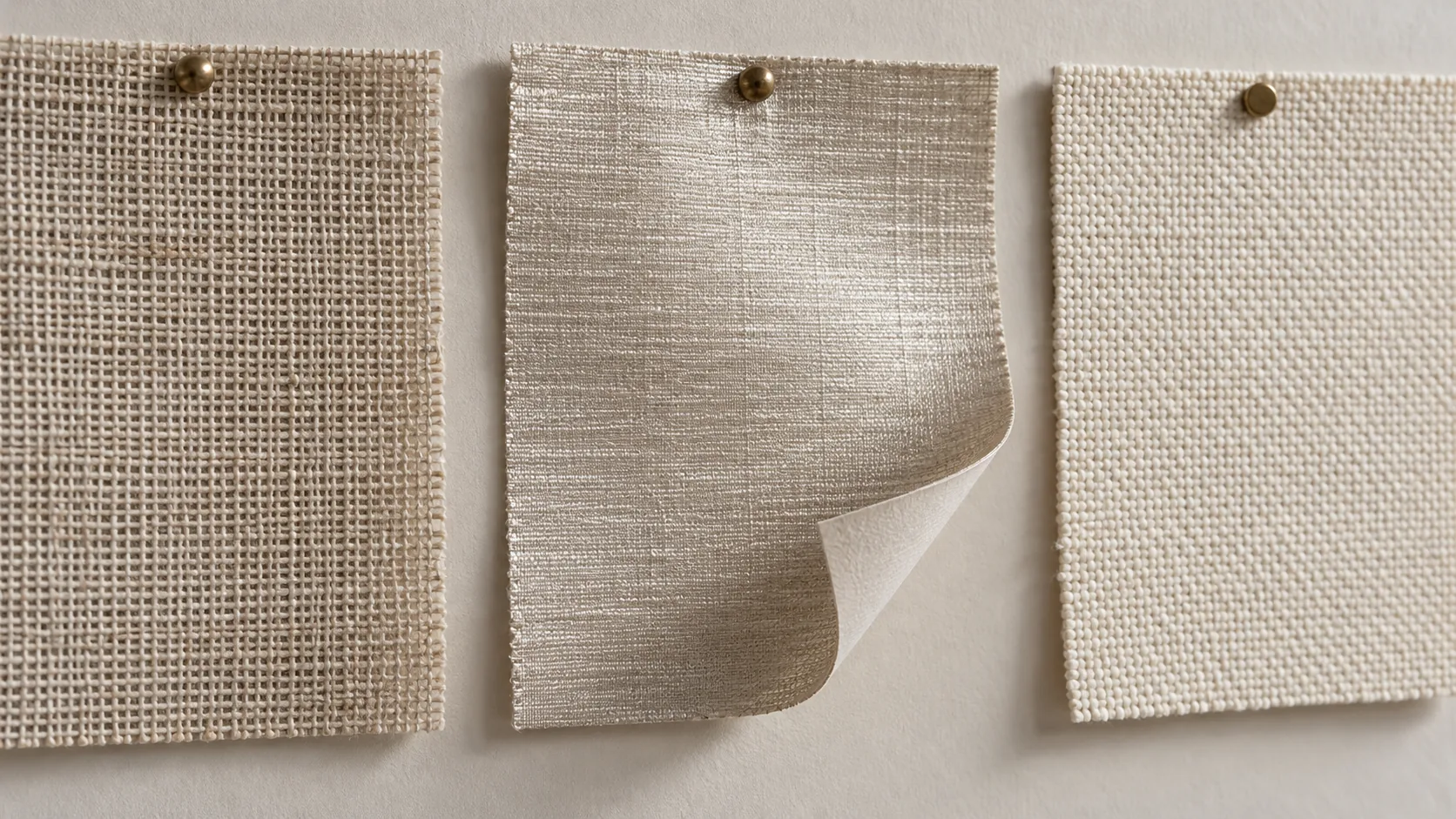
Are fabric and textile wallpapers practical?
Natural textile faces work best on dry walls with limited contact, while a suitably rated synthetic textile can serve a busier space. Decide whether you want the feel of real cloth or a cloth-like pattern on a more washable face.
Linen, silk and cotton can provide weave, irregularity and changing highlights that a flat print does not reproduce in the same way. The stabilizing backing helps the fabric hang as a wallcovering, but the exposed fibers still need their own care. Gentle dry dusting is a sensible starting point for delicate natural textiles; the product’s specific instructions settle any spot treatment.
Synthetic textiles are among the most durable, easy-to-clean wallcoverings for high-traffic rooms. Pick one by its stated performance and cleaning instructions, not by the word fabric.
In a dining room above a sideboard, cloth can add visible texture without being constantly handled. Beside a breakfast table where chairs rub the wall and food splashes are likely, a washable textile-look vinyl may be easier to live with. Turn the sample over and read the face description so you know which of those two surfaces you are buying.
Is grasscloth wallpaper worth it?
Natural grasscloth is worth considering for a dry accent wall when you welcome visible texture, shading and seams. A washable faux-grasscloth surface is a more practical direction where hands, grease or splashes are likely.
Natural grasscloth or a grasscloth look?
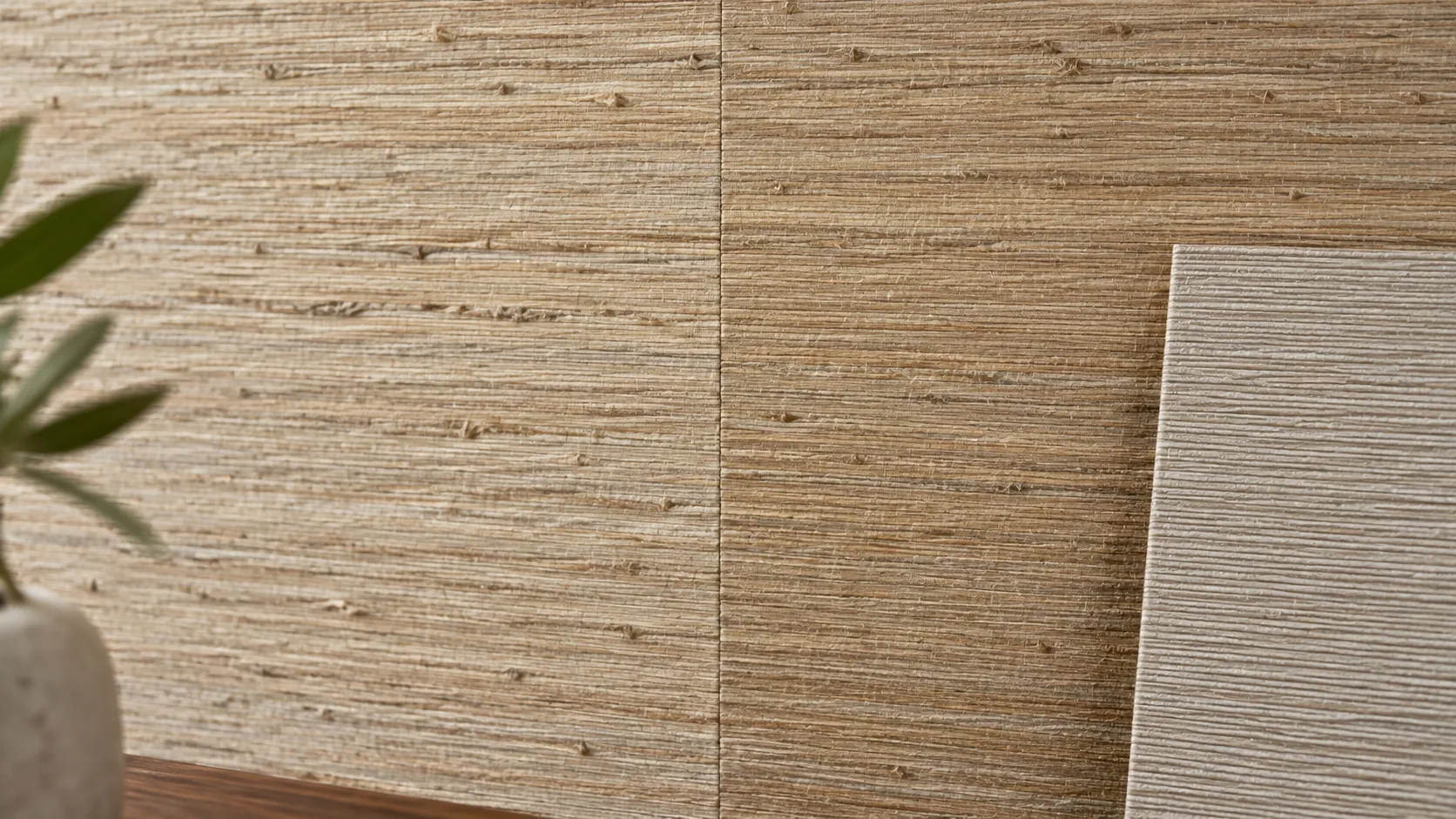
Natural grasscloth uses woven plant fibers attached to a backing. Jute, sisal, raffia and sea grass are examples in Brewster’s grasscloth introduction. The weave and fiber irregularity are part of its appearance.
Faux grasscloth reproduces that look through its decorative surface. It is often vinyl, and some faux-grasscloth products use a non-woven construction. Look at the face material and care label instead of assuming that every grass-like sample contains natural grass.
Why do the seams and colors vary?
Natural fibers vary in thickness, shade and texture, so adjacent strips form a visible paneled effect. With no printed pattern to match, the seams will show. That natural shading is part of the material’s appeal.
View several sample lengths together if a uniform wall is important to you. Natural shading is expected; lifting edges, open gaps and paste stains are separate defects. A continuous-looking wall may be easier to achieve with an appropriate printed or embossed alternative.
How much cleaning can grasscloth take?
Keep routine care dry: lightly dust or gently vacuum natural grasscloth. The original care guidance warns that moisture from cleaning products can damage it, while vinyl faux grasscloth can have a different cleaning routine.
A dry bedroom or living-room wall allows the natural material to do its job. Near a sink, cooking grease or shower steam, choose a suitable washable imitation or another finish. For an imitation, the actual surface rating determines whether you can wipe it with mild soapy water.
Should you use unpasted, prepasted or peel-and-stick wallpaper?
Paste-the-wall non-woven can simplify a first project, prepasted paper removes separate paste mixing, and peel-and-stick can suit a temporary accent wall on a sound, smooth surface. Delicate natural coverings and difficult rooms often benefit from professional hanging.
| Label | Where the adhesive comes from | What you do |
|---|---|---|
| Unpasted | Separately supplied adhesive | Apply the compatible paste to the paper or wall as specified |
| Prepasted | A dry adhesive already on the backing | Activate it with water and allow any specified resting time |
| Paste-the-wall | Separately supplied adhesive | Paste the wall and hang the compatible covering dry |
| Peel-and-stick | Pressure-sensitive adhesive under a release liner | Peel away the liner and position the covering on the prepared wall |
A prepasted roll needs water to activate its glue; a self-adhesive one needs no water and bonds once its release liner comes off. Booking means folding pasted surfaces together for a stated resting period; it belongs to the applicable hanging instructions, not every roll.
Peel-and-stick still needs preparation. As a product-specific example, NuWallpaper’s hanging instructions call for a smooth, dry, clean, firm wall, at least 48 hours of room acclimation and at least 4 weeks for newly painted surfaces to cure, longer if the paint maker requires it. Those timings make wall preparation and sound, smooth paint part of planning a removable-wallpaper project.
For a rental, test the intended wall and removal behavior before committing to the whole room. For a permanent installation, pattern alignment, wall preparation and the surface’s cleaning limits deserve as much attention as the adhesive label.
Is a film-faced wall panel an alternative to wallpaper?
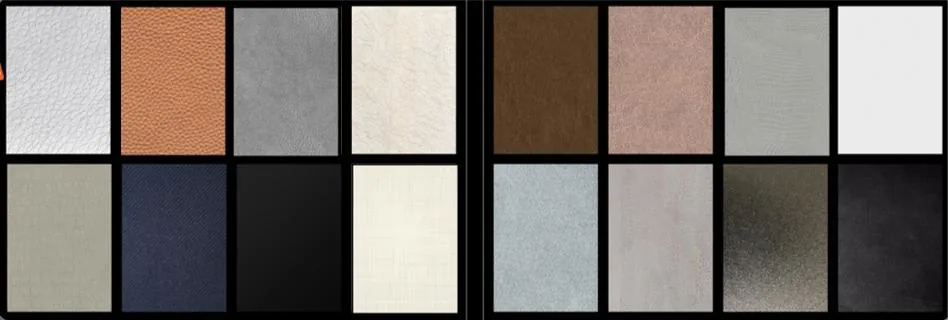
Yes, if you would rather put up panels than hang paper. Puremorfilm makes decorative film with a silicone functional surface that panel makers laminate flat onto boards with PUR adhesive; we supply it as film rolls, and it is not a wallpaper you hang yourself.
The silicone surface is inherently flame-retardant, with higher grades up to UL 94 V-0 available on request. In the manufacturer’s laboratory tests, coffee, red wine and soy sauce left on the film for 24 hours at 25°C wiped off with no obvious change. The wall film contains no PVC, is formaldehyde-free and uses a No DOP formulation.
This new paint-free material uses a silicone face, distinct from PVC, melamine, PP and PETG decorative faces. See the decorative wall film route for factory lamination.
Which type of wallpaper should you choose for each room?
Choose by the wall’s contact, moisture and cleaning needs, then narrow the pattern and hanging method. The covering behind a bedroom headboard has a different job from the wall beside a kitchen sink.
| Room or use | A sensible starting choice | What to watch |
|---|---|---|
| Bedroom, dining room or study | Paper, natural textile or natural grasscloth | Keep delicate faces away from frequent handling |
| Living-room accent wall | Any suitable material; natural grasscloth adds a woven paneled effect | Decide whether visible joins and shade changes suit the design |
| Entryway or children’s activity area | Scrubbable vinyl or a suitably rated washable imitation | Check the actual cleaning rating |
| Ventilated kitchen or powder room | Extra-washable vinyl suited to that location | Avoid direct water and cooking grease on delicate faces |
| Direct shower or persistent splash zone | A suitable wet-area panel or tile system | Choose the complete water-management system |
| Heavily used commercial corridor | A wallcovering specified for that traffic, such as Type II or III vinyl | Match the use category and project requirements |
Our bathroom wall panels versus tiles comparison covers wetter locations, and the wall panel materials guide explains the broader panel options.
If a panel surface fits your project, bring the room type, wall location and desired color or texture when you contact us about a factory-laminated film.
Frequently Asked Questions
Which type of wallpaper is best?
Paste-the-wall non-woven is a useful starting point for straightforward hanging; scrubbable vinyl suits frequent cleaning. Paper, natural fabric and grasscloth suit quieter walls where texture or print takes priority.
What is type 3 wallpaper?
Type III wallpaper is a heavy-duty commercial use category for the most heavily trafficked locations needing added wall protection. It classifies intended service; paper, vinyl and fabric describe materials.
How many types of wallpaper do we have?
Five useful material families are paper, non-woven, vinyl, fabric and natural fibers such as grasscloth. Counting adhesive methods or surface effects produces a different list, so there is no single fixed total.
What is the difference between paste-the-wall, prepasted and unpasted wallpaper?
Paste-the-wall identifies where separate adhesive is applied; prepasted has water-activated adhesive on the backing; unpasted requires separately supplied paste. The roll instructions determine whether unpasted material is pasted on its back or hung onto a pasted wall.
Can you use grasscloth wallpaper in a bathroom?
No, natural grasscloth is a poor choice for a bathroom with a shower or tub. A suitably washable vinyl grasscloth look can suit a ventilated powder room, with the product’s own location and cleaning instructions.