
Soft touch laminate is a decorative furniture surface selected for a velvety feel; super matte describes low gloss, and anti fingerprint describes resistance to visible finger marks. For cabinet doors and wall panels, choose a grade that demonstrates the properties you need, because a soft feel alone establishes neither scratch resistance nor fingerprint performance.
How does soft touch laminate compare with other matte surfaces?
Choose a documented soft-touch furniture surface when touch is part of the design; choose a conventional matte laminate when the required appearance and published performance already meet the job. A matte finish can feel relatively hard or textured, while a soft-touch surface can combine low sheen with a smoother, velvety sensation.
The word laminate also needs a construction description. A decorative sheet bonded to MDF, a lacquered furniture board and a decorative film are different products, even when the finished doors look similar. The comparison below separates those routes. The named reference is one specific material, rather than a specification for every soft-touch surface. Our film column describes a silicone functional face on a PET support, a different construction from paper-based laminate.
| Selection dimension | Conventional matte HPL | Soft-touch lacquered board or laminate | FENIX NTM, a named reference | Our silicone decorative film |
|---|---|---|---|---|
| Construction | Resin-impregnated paper laminate bonded to a supporting board | A lacquered face on a board or a separate decorative laminate; verify which is quoted | Paper and thermosetting resin construction with an electron-beam-cured acrylic surface | Silicone functional face on a PET support film for PUR flat lamination |
| Touch | Select for the stated texture; matte alone does not establish a velvety feel | Prefer when the specified finish provides the tactile effect you want | Manufacturer describes a soft-touch face | A route for evaluating a leather-like, elastic feel on a physical sample |
| Visual sheen | Useful for a subdued reflection without a tactile requirement | Super-matte versions combine low sheen with touch; the finish code controls the offer | Manufacturer describes an extremely matte surface | Select the required sheen from a physical finish sample |
| Visible fingerprints | No anti-fingerprint result follows from the matte label alone | Prefer an explicitly documented anti-fingerprint finish where frequent handling matters | Anti-fingerprint is a stated product property | Judge the handled sample; the silicone name alone establishes no fingerprint result |
| Scratch response | Use the grade’s test results; ordinary matte is not a durability class | Soft feel provides no valid ranking against HPL without comparable tests | Superficial micro-scratches can be thermally healed according to the manufacturer’s method; this is not repair of deep damage | The film-sample pencil test below supports only its stated conditions |
| Shaped parts | A designated postforming grade may suit specified radii | Forming depends on the exact board or laminate grade | Official range information states that a postforming grade is not available | PUR flat lamination for flat panels; not proposed here for routed, vacuum-formed doors |
The construction and application distinctions are supported by an official laminate range description and a matt lacquer-surface laminate specification. They describe particular products, not universal results for each column. When choosing an overall cabinet sheen, the separate matte versus gloss cabinet guide addresses that broader visual decision.
Are super matte, soft touch and anti fingerprint the same thing?
No. Super matte describes reflected appearance, soft touch describes tactile response, and anti fingerprint describes a surface’s response to handling marks. You can specify all three, but one label cannot stand in for the other two.
A product described as super matte or ultra matte should be compared with a gloss reading and its measurement geometry, where that method suits the surface. ISO 2813 covers gloss measurement at 20°, 60° and 85° for non-textured coatings on plane, opaque substrates. Values measured at different angles are not interchangeable. Textured or translucent samples also need an appropriate measurement method.
Gloss describes the directed highlight rather than the total light reflected from the surface. A pale, low-gloss panel can still look bright. Use light reflectance value for the separate question of reflected light and visual contrast; use the gloss reading to discuss sheen.
Touch needs a physical sample. Compare the smoothness, drag and elastic feel with your fingers rather than inferring them from a photograph. A coating may create a velvety sensation on a rigid laminate; the sensation does not mean the entire panel is flexible or cushioned.
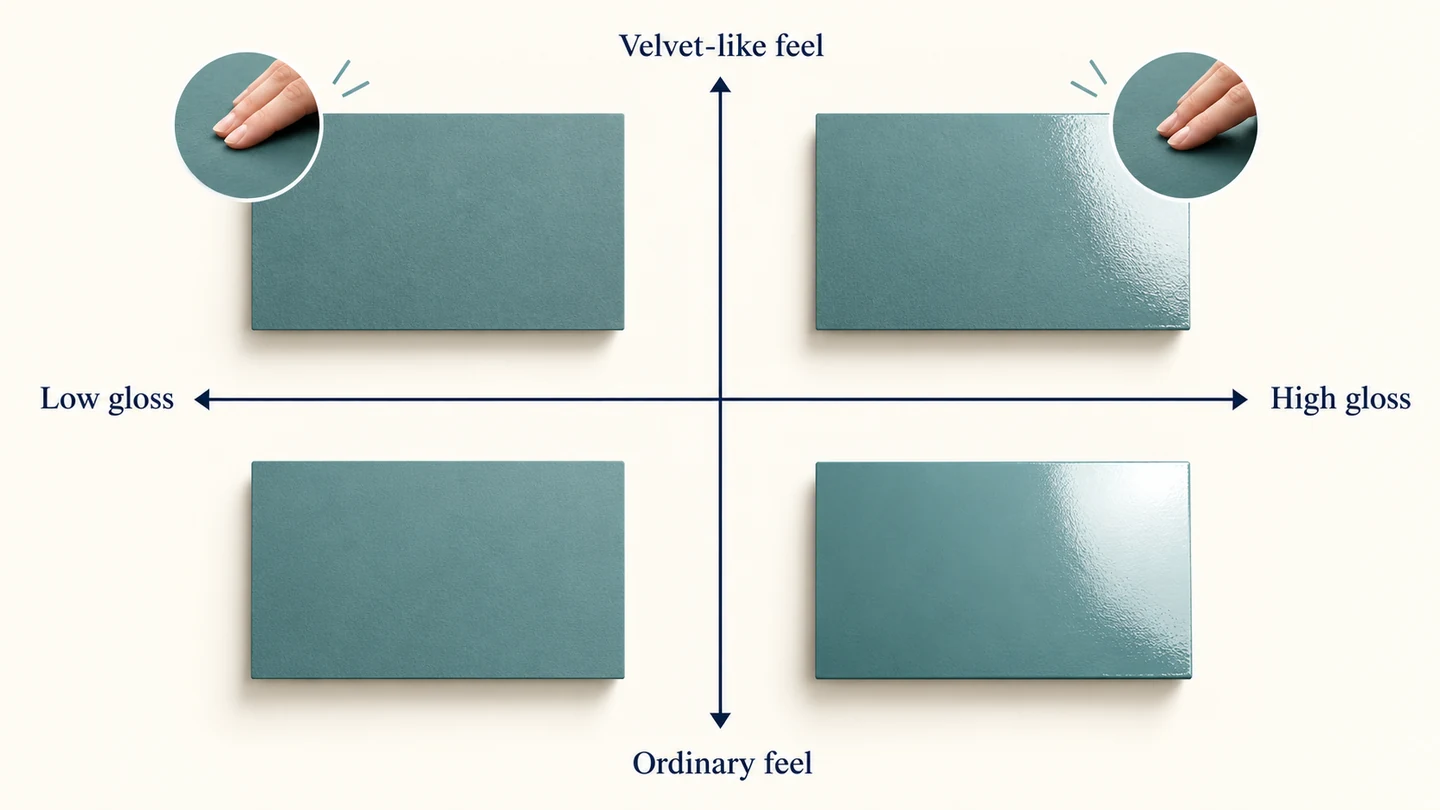
Conceptual illustration: appearance and tactile feel are separate selection axes, without measured product rankings.
Will an anti fingerprint laminate stay free of marks?
No. Treat an anti fingerprint laminate as a surface designed to reduce the visibility of finger marks, then assess the proposed finish after handling and cleaning. The description does not establish immunity to skin oils, stains, scratches or cleaning residue.
For an approval comparison, use the proposed color and finish under the intended lighting. Handle each sample, inspect from the normal viewing position and at an angle, clean it by its supplied instructions, and inspect again. This practical comparison answers whether the remaining marks are acceptable to you; it does not create a standardized laboratory rating.
Keep fingerprint appearance and stain removal separate in the record. A face can conceal a fresh mark yet retain residue after inadequate cleaning. Conversely, a visible mark may wipe away readily. On a frequently opened cabinet front, both the untreated appearance and the cleaned appearance affect the decision.
The care instructions for specialist matte materials also distinguish cleaning residue from permanent surface change. An official surface care guide instructs users to rinse and dry after cleaning and warns that abrasion can create a glossy spot. Its cleaning permissions apply to the identified material, so do not transfer a solvent or repair method to another soft-touch surface.
Does a soft-touch face resist scratches and abrasion?
Soft touch alone predicts neither scratch resistance nor abrasion resistance. Compare the actual test method and conditions for the proposed face, and select a surface approved for the intended level of contact.
A single scratch, repeated rubbing and a fingerprint are different events. A pencil-hardness result addresses the specified pencil contact; an abrasion result addresses repeated wear under its stated wheel, load and cycle count. Neither establishes that a surface is scratch-proof. Thermal repairability is another separate feature and requires explicit instructions for the particular material.
| Performance question | Evidence that answers it | Selection consequence |
|---|---|---|
| Will a given contact leave a scratch? | Scratch method, tool or pencil, load, sample and observed result | Compare results only when the conditions are comparable |
| How does repeated rubbing change the face? | Abrasion method, wheel or abrasive, load, cycles and assessment | Use the result for the stated wear mechanism, without converting it into years of service |
| Will finger marks remain conspicuous? | Named anti-fingerprint evidence plus handled samples in the proposed finish | Judge visible marking separately from scratch results |
| Can damage be repaired? | Written repair method for that exact surface and type of damage | Use thermal or abrasive treatment only when the material instructions permit it |
For a heavily used horizontal work surface, start with a grade expressly intended for that duty. A pleasant cabinet-door sample cannot establish worktop performance. Compact laminate and bonded HPL also have different support requirements; the tactile face does not settle the structural choice.
Which construction suits flat fronts, edges and routed doors?
For flat cabinet fronts and wall panels, select a surface with a documented flat-bonding route and a separate edge detail; for routed doors, select a material and process specifically qualified for the shape. Soft touch names a face property, rather than a forming process.
A decorative sheet or film may need a supporting board. The board controls the component’s stiffness and fixing arrangement, while the face controls the exposed surface. Where water can reach an edge or joint, the complete panel construction matters. The official care guide warns against flooding laminate seams because water can penetrate and swell the substrate.
A front-face sample also leaves the edge unresolved. Decide whether the component uses a separate edge band, an approved forming route or a framed assembly. Inspect a finished corner to see the seam, feel the transition and check whether its appearance matches the face. A matching color name does not describe a finished joint.
Use the profile wrapping and flat lamination comparison when choosing the production route. For film-faced flat boards, the PUR adhesive guide discusses the separate bond-selection task. This article does not assign a generic temperature, pressure or line speed to every soft-touch material.
How should you clean and approve a soft-touch finish?
Use the exact material’s care instructions, then approve the face after the planned cleaning routine as well as before it. A low-gloss appearance can be changed by the wrong abrasive or by residue, so cleaning behavior belongs in the finish decision.
For general laminate care, the official guidance cited above starts with a damp nonabrasive cloth and mild detergent, followed by rinsing and drying. Specialist surfaces can have different permissions. A solvent, melamine eraser or heat treatment allowed for one material should be used on another only when its own instructions allow it.
On the sample panel, compare a cleaned area with an untouched reference under the same light. Record any persistent mark or change in sheen and the cleaning product used. You can repeat this comparison with the actual spill or soil relevant to your application, following the supplier’s permitted procedure. Keep practical observations distinct from formal test results.
Your approval sample should include the selected face, substrate, adhesive route and edge finish. Use the patterns and finishes page to discuss a decorative-film sample’s appearance, rather than treating a screen image as a final color or touch approval. Preserve one approved physical sample with the specification so later production has a defined reference.
Where does a silicone decorative film fit?
Our silicone decorative film is a separate surface route for flat furniture fronts, cabinet doors and wall panels when you want to evaluate a silicone functional face. Puremorfilm manufactures the film in China with a silicone face on a PET support film; the PET support and silicone contact surface have different roles.
We supply rolls without self-adhesive backing for PUR flat lamination, or silicone laminated panels quoted per project. The film is intended for vertical and low-wear surfaces. We do not recommend the film for floors, countertops, stovetops or other walked-on surfaces. Its face should be evaluated against your required touch and appearance, rather than treated as a substitute for every soft-touch laminate grade.
An SGS-tested film sample showed no obvious scratches with a 2H pencil at 500 gf and 45°, using three lines longer than 20 mm. Use that result for a scratch assessment alongside physical checks of feel and gloss; pencil hardness does not measure fingerprints.
For furniture and wall decorative-film rolls, the minimum order is 500 m per pattern. Laminated panels are 1220 × 2440 mm, with a minimum of 200 sheets per pattern, quoted per project. These supply details do not establish a standard film width, thickness or lead time.
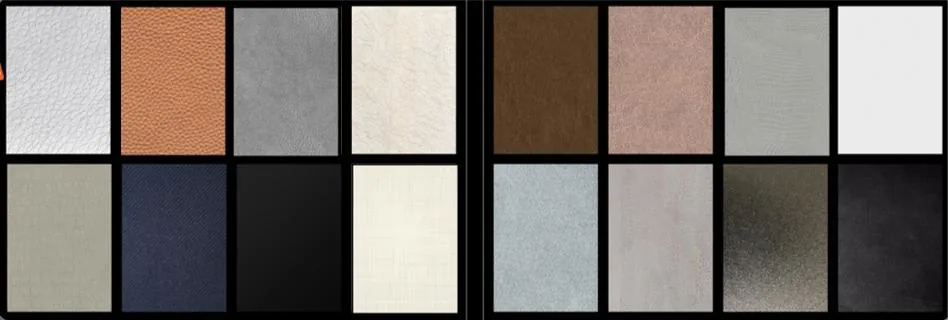
Decorative film color and texture swatches; assess the required feel on a physical sample.
Compare the structure and suitable uses before choosing a face for your panel.
How should you choose a soft touch laminate for your project?
Choose a soft touch laminate when the tactile effect contributes to the component and its documented surface performance matches the application. Specify low gloss and reduced fingerprint visibility separately when you need both, then approve the finished panel rather than a finish name.
| Batch application | Main surface question | Choice and condition |
|---|---|---|
| Frequently handled cabinet fronts | Will the chosen face remain acceptable after handling and cleaning? | Prefer documented anti-fingerprint performance alongside the required feel; inspect the finished edge |
| Low-wear decorative wall panels | Does the installed finish provide the intended sheen and texture? | A matte or tactile decorative surface can fit; select the complete wall-panel construction for the project |
| Worktops and repeatedly rubbed horizontal areas | Is the exact grade intended for the wear and cleaning duty? | Choose a documented worktop-grade material; our silicone decorative film is excluded from countertops |
If your project uses flat furniture or wall panels, ask Puremorfilm about film rolls or panels quoted per project. Bring the intended use and the required appearance and touch so the sample discussion starts with the surface you need.
Frequently Asked Questions
Is soft touch laminate suitable for cabinet doors?
Yes. Grades intended for furniture fronts can suit cabinet doors when their surface performance, bonding route and edge construction match the application. Choose a specific grade rather than approving the words soft touch alone.
Is every super matte surface anti fingerprint?
No. Super matte describes sheen. Reduced visibility of finger marks needs its own product evidence and sample assessment in the proposed finish.
Is soft touch laminate scratch-proof?
No. A soft feel does not establish scratch resistance, and a scratch-resistant surface can still be damaged. Compare the stated method and conditions for the exact material.
Can all soft-touch films be vacuum-formed over routed doors?
No. Forming capability belongs to the exact film and process. Our silicone decorative film uses PUR flat lamination and is offered for flat furniture and wall-panel surfaces.
What is the minimum order for your furniture decorative film?
500 m per pattern is the minimum for our furniture and wall decorative-film rolls. Panels are 1220 × 2440 mm, with a minimum of 200 sheets per pattern, quoted per project.