
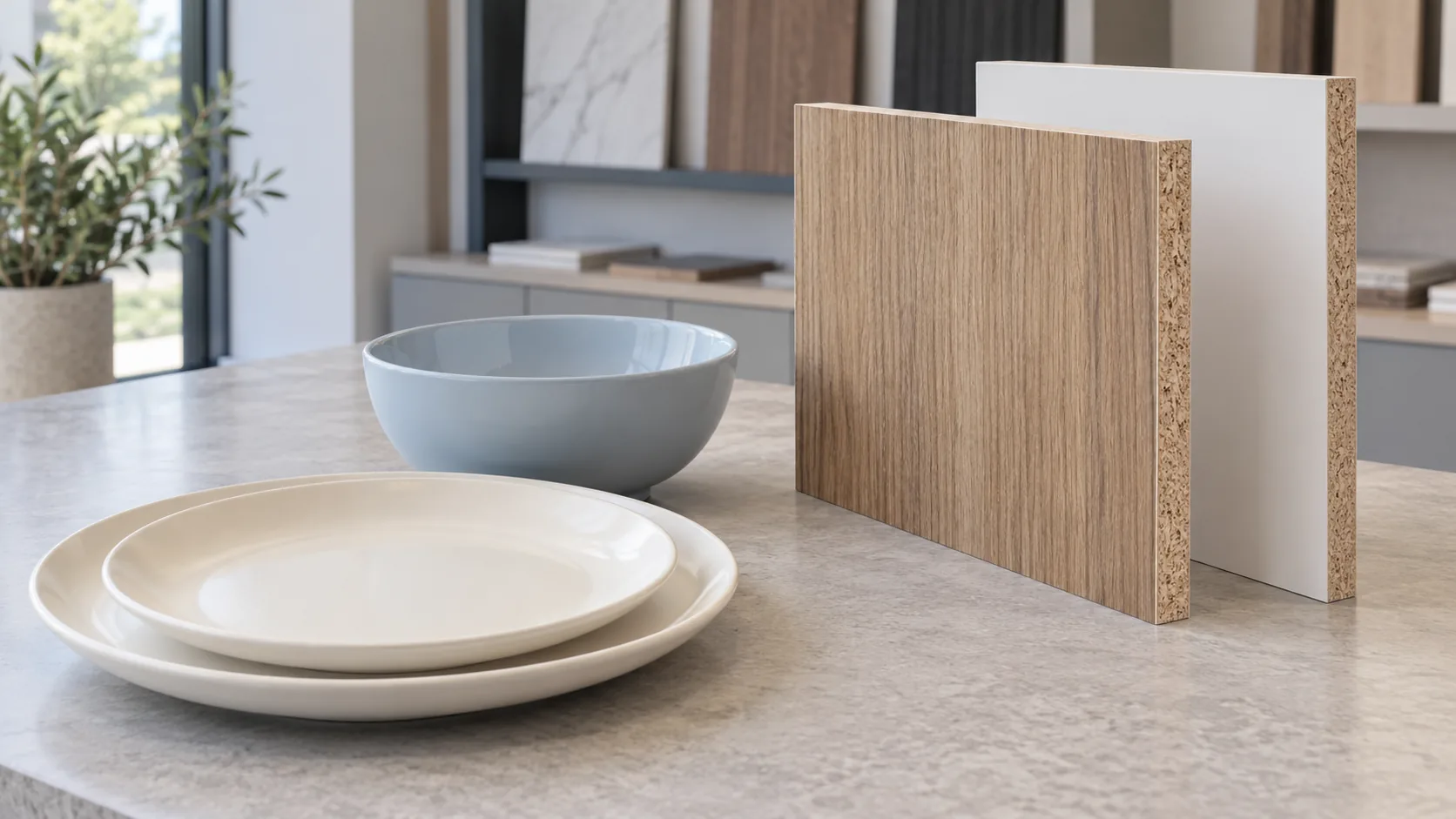
What is melamine? Melamine definition: melamine (C3H6N6) is a white, nitrogen-rich industrial chemical used mainly to make hard melamine-formaldehyde resins. On a plate label or cabinet quote, the same word usually means molded plastic dinnerware or a resin-faced furniture board.
What is melamine in chemistry and finished products?
Melamine is a nitrogen-containing chemical that manufacturers turn into resin, dinnerware and the decorative faces of furniture boards. Because one name covers a raw ingredient, a plastic and a finished assembly, read the full product description before you compare uses.
The ChEBI record gives melamine the formula C3H6N6 and a triazine ring structure. What matters to a buyer is the gap between that molecule and the materials made when it reacts with other ingredients: a bag of feedstock and a finished plate sit at different stages of manufacture.
| Wording you encounter | What the seller usually means | What to identify next |
|---|---|---|
| Melamine chemical | An industrial raw material | Chemical identity and intended industrial use |
| Melamine resin or MF resin | A polymer made using melamine and formaldehyde | Resin formulation and application |
| Melamine dinnerware | Molded resin tableware | Food-contact use and heating restrictions |
| Melamine board or TFL | A decorative paper face fused to a wood-based panel | Core board, face finish and edge treatment |
A cabinet sold as “white melamine” almost always means its faced panels; a bowl sold as “melamine” is a molded plastic article. Neither label tells the whole story: the cabinet still needs a core specification, and the bowl still needs use instructions.
So start with the object in front of you. Then read the guidance for that category, whether tableware, furniture panels or industrial chemicals, and don’t carry advice from one to another.
For furniture surfaces, the decorative laminate overview compares melamine-faced boards with HPL, thermofoil and decorative films.
How does melamine become a resin?
Manufacturers react melamine with formaldehyde and cure it into a cross-linked network. The resulting thermosetting plastic is melamine-formaldehyde resin, or MF resin.
Curing bonds the resin into a network that holds its shape. Unlike a typical thermoplastic, you can’t melt it down and remold it. That is why a molded dinner plate and a hard decorative paper face can share the same resin chemistry and still look nothing alike.
A 2014 research paper on MF resins describes this reaction and how formulation and reaction conditions change the resin.
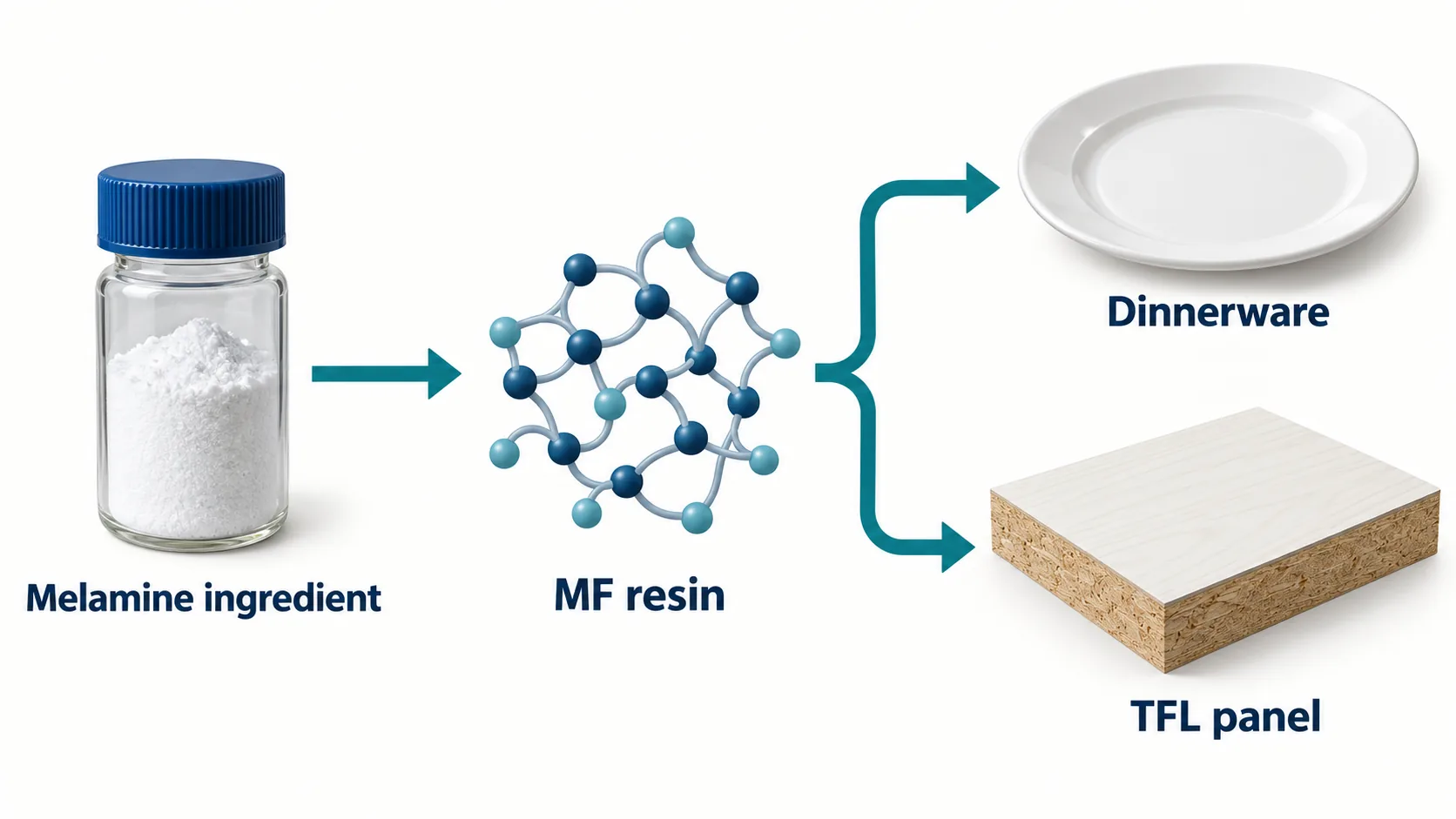
Finished tableware can contain fillers as well as resin, and a decorative panel combines its resin-treated face with paper and a wood-based core. What you buy are the properties of the assembled product, not of melamine on its own.
The chemistry also explains why two statements answer different questions: “uses formaldehyde in manufacture” describes ingredients, while “meets an applicable emission or migration requirement” needs evidence for a finished material in a stated use. The material name can’t stand in for that evidence.
Where do you encounter melamine in everyday products?
Molded tableware, decorative panel faces and other resin products such as coatings. In each one, melamine either forms the article, creates a decorative surface or helps bind a coating.
For dinnerware, a mold shapes the resin-based material. In a furniture panel, a decorative face covers a supporting board. In industry, the useful question is which resin or coating system contains melamine and what that system does.
The FDA’s industrial-use overview lists uses including certain utensils, plates, plastic products, paper products and industrial coatings. Melamine is not approved for direct addition to human food or animal feed sold in the United States.
That gap is what the food-contamination stories were about. An ingredient used to make an approved food-contact article serves a different purpose from a chemical deliberately added to food, so judge the actual article and its instructions.
Looks can mislead too. A wood-look furniture face may be printed, while a wood veneer is real wood. A molded plate may look like pottery but won’t share stoneware’s heating instructions. Choose by material and intended use, then use appearance to pick the design.
For a furniture project, start with the full list of kitchen cabinet materials; the visible face doesn’t tell you what the cabinet is built from.
Is melamine dinnerware safe for serving and microwaving?
Safe for serving, not for microwaving. You can serve food on melamine dinnerware, but don’t heat food or drinks on it in a microwave; reheat in a dish expressly labeled microwave-safe.
Residual melamine can migrate from the plastic, and high heat with acidic foods can increase that migration. Hot, acidic dishes such as tomato soup are where that matters most.
Germany takes a more cautious line on hot food. Its BfR FAQ, updated July 17, 2026, recommends avoiding hot food as well as microwave heating, expects no health effects with cold or lukewarm food and advises replacing damaged articles. It is German risk guidance; the United States does not ban melamine tableware.
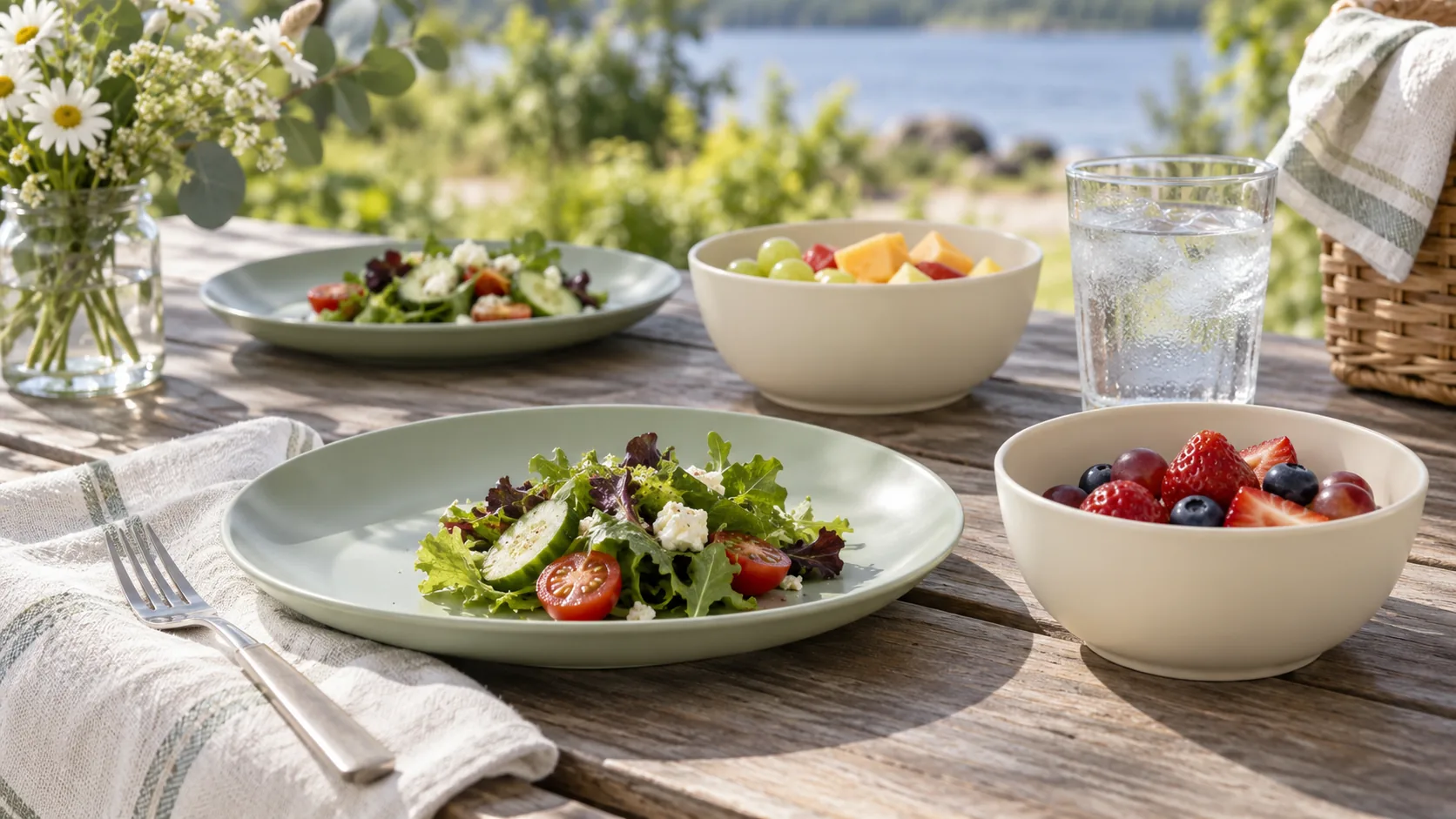
For everyday buying, find the material on the packaging and check what the product is allowed to do. If you reheat leftovers often, keep a microwave-safe dish for that job. For picnics and cold food, check the pieces for damage and follow the care instructions.
What is melamine board, and how does it work in furniture?
Melamine board is usually a wood-based panel faced with thermally fused laminate, or TFL, not a solid slab of melamine plastic. The decorative face and the structural core do different jobs.
The Composite Panel Association defines TFL as a decorative surface fused directly to a substrate, mainly MDF or particleboard. The face gives the visible finish; the core gives the panel its body and decides how the part can be built into furniture.
Look at an unfinished edge and you’ll see this. Instead of solid plastic, there is a wood-based core under a thin decorative face. Edge treatment covers the cut perimeter and the face covers the broad surface, so a quote that only gives a color and “melamine” leaves the core and edges undefined.
In TFL, resin-impregnated décor paper is fused to the substrate under heat and pressure, and press plates add texture and set the gloss. You’ll find it in cabinets, office furniture, closet systems and store fixtures, and the panels usually need a decorative edge treatment.
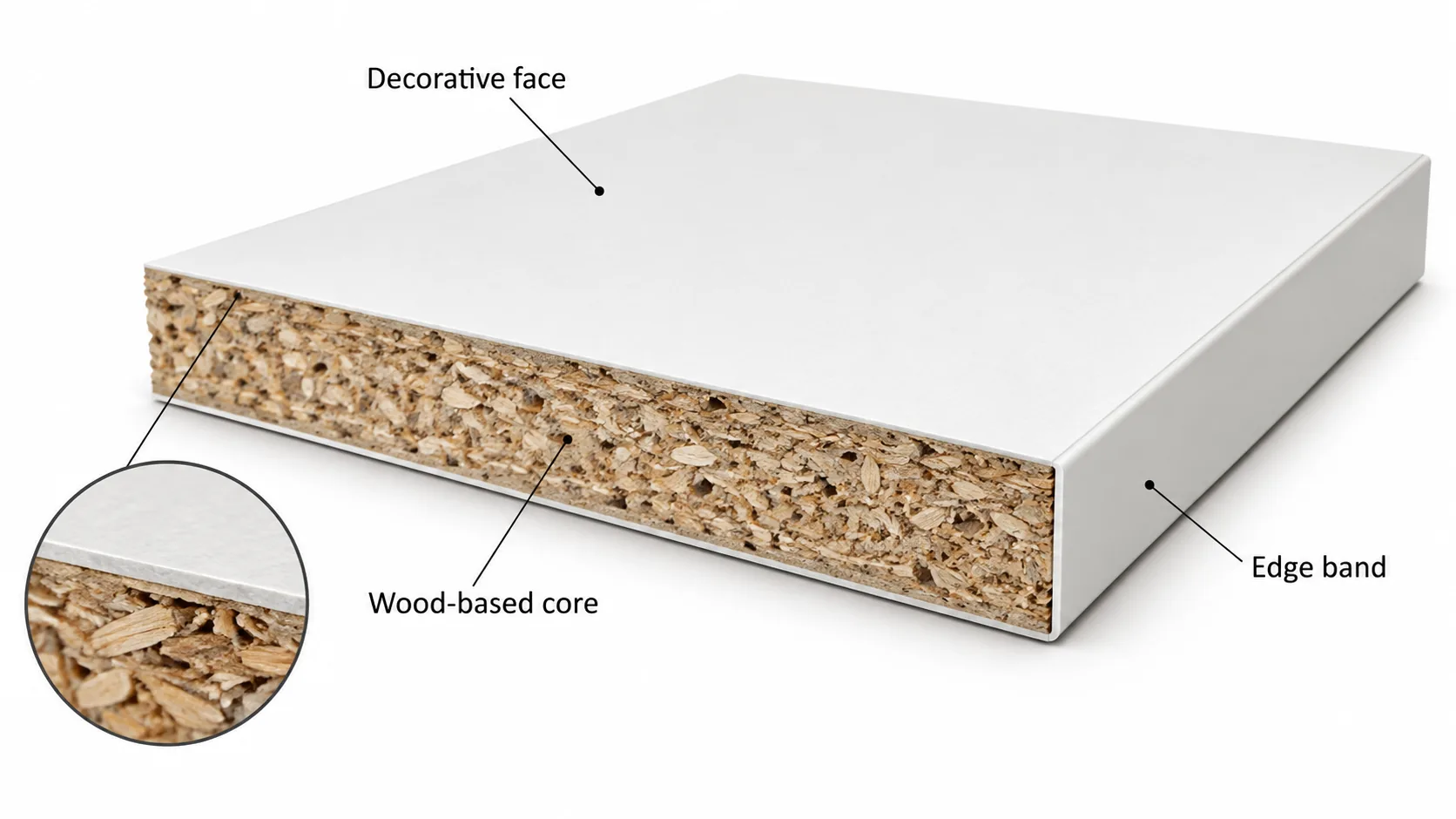
When a supplier proposes melamine-faced MDF, keep both parts in the order. The MDF core grade and the decorative face are separate lines on the specification. If the quote says “laminated MDF” instead, our laminated MDF explanation helps you work out which facing system is meant.
What are the practical pros and cons of melamine board?
Weigh the finished face against the work left at the edges:
- Ready-finished face: the resin-treated paper is fused to the core, so the panel arrives ready for machining.
- Choice of appearance: décor prints, press textures and gloss levels give you color and surface options.
- Edge work remains: cut panels typically need decorative edge treatment.
- Moisture-sensitive core: MDF and particleboard can swell in high humidity or water, and the expansion may remain after drying. Our MDF water-resistance guide covers the core and exposed edges.
For an existing cabinet, identify the finish before you pick a cleaner. Our laminate cabinet cleaning guide covers cabinet care, which has nothing in common with caring for dinner plates.
How is melamine related to MDF, laminate and wood veneer?
They describe different layers. Melamine can describe a decorative face, MDF a core board, laminate a family of layered materials and wood veneer a thin real-wood facing. One product can combine a core with a facing, so the terms often show up together in one specification.
MDF is a panel made from wood fibers and resin. The board under a melamine face could be MDF, while a panel that looks the same could use particleboard; naming the face doesn’t choose the core.
| Term | What it describes | How it relates to melamine furniture |
|---|---|---|
| MDF | A wood-fiber core panel | Can support a decorative TFL face |
| Particleboard | A wood-particle core panel | Another common substrate for TFL |
| TFL, often called melamine | Décor paper fused directly to a panel | Identifies the facing route |
| HPL | A laminate sheet made before bonding to a substrate | Another facing route within the laminate family |
| Wood veneer | Thin real wood attached to a substrate | A different visible face with real wood grain |
HPL presses several resin-treated paper layers into a sheet that is then bonded to a panel, while TFL fuses its décor paper straight onto the core. Our melamine vs laminate comparison goes deeper into the TFL/HPL choice.
Veneer is a real-wood facing. A printed wood pattern and a real veneer can look alike in a photo and still suit different design briefs.
Ask for a sample that shows the face and the cross-section; it clears up a confusing description before you compare quotes. Then judge the specified assembly against your needs instead of ranking vague labels like “melamine” and “wood.”
What should you check before buying melamine products?
The product category first, then the evidence that fits it: food-contact and heating instructions for dinnerware, or core, facing, edges and panel documentation for furniture. That keeps a tableware claim out of a board specification.
For US furniture made with regulated composite wood, the EPA stakeholder guidance names hardwood plywood, MDF and particleboard as covered products and explains the labeling for panels and finished goods under TSCA Title VI. Check the label and the supplier’s records; “melamine” on a sales sheet doesn’t answer the compliance question.
| Item | What to specify | Why it helps |
|---|---|---|
| Product identity | Molded dinnerware, TFL panel or another stated resin product | Establishes which guidance applies |
| Intended use | Cold food service, cabinet component or another defined application | Makes the buying task explicit |
| Dinnerware instructions | Material, food-contact documentation, heating and care limits | Connects permission to the actual article |
| Furniture construction | Core type, panel dimensions, face and reverse-face finish, edge treatment | Defines the assembly you are ordering |
| Relevant documentation | Applicable food-contact records or composite-wood label and records | Matches evidence to the product category |
| Approved appearance | Physical sample, color, texture and gloss reference | Gives both parties a visible acceptance reference |
For a furniture quote, ask for a sample with the proposed core and edge treatment. A face-only swatch helps you choose the décor, but a full sample shows how the board is built. If the reverse face differs, note which side gets which finish.
For dinnerware, keep the packaging and use instructions. A word like “durable” on the box doesn’t mean the plate can go in the microwave, so if you need to heat food, buy a dish made for it.
Which surface should you choose for a furniture project?
A complete faced-board specification for ready-finished panels, or an organosilicon decorative face if you want a different paint-free surface. Either way, the decision is about the functional face and the finished panel.
- With TFL board, identify the core, decoration, reverse face and edge treatment in the order.
- An HPL order needs the laminate sheet and its intended panel assembly.
- To get real wood grain, evaluate a veneer sample and its specified finish.
Puremorfilm’s paint-free material uses a silicone functional surface, a different surface from PVC, melamine, PP and PETG decorative faces. The film is formaldehyde-free and flat-laminated to board with PUR adhesive; we mainly supply rolls, with film-faced panels on request. The silicone surface is inherently flame-retardant, with higher grades up to UL 94 V-0 available on request. The film uses a No DOP formulation, and in the manufacturer’s laboratory tests, coffee and red wine left for 24 hours at 25°C wiped off with no obvious change.
See our furniture decorative film when you compare facing routes, and judge each finished assembly on evidence for its own construction and use.
The film has a leather-like feel and some elasticity, so floors, cooktop countertops, shower floors and other walked-on areas are outside its scope. For furniture-facing projects, contact us with the panel application, the texture you want and your preferred supply form.
Frequently Asked Questions
Is melamine just plastic?
No. Melamine is a chemical ingredient, and melamine-formaldehyde resin is the plastic made with it. A product sold as melamine may be molded resin dinnerware or a decorative face on a wood-based panel.
Is melamine safe to eat with?
Yes, for serving food. Follow the article’s instructions and don’t heat it in a microwave; Germany’s BfR also advises against hot food.
Is melamine banned in the US?
No. It has permitted industrial uses in the United States, including some tableware manufacturing. Adding it directly to human food or animal feed sold in the US is not approved.
Which is better, plastic or melamine?
Neither, in general, because melamine resin is itself a plastic. Melamine suits cold or room-temperature food; for reheating, use a container labeled microwave-safe.
Can melamine dinnerware go in the microwave?
No. Use ceramic or other cookware labeled microwave-safe.
What is melamine wood?
Melamine wood is not a type of wood. It is the everyday name for melamine board: particleboard or MDF faced with a decor paper soaked in melamine resin, which gives it a solid color or a printed wood look. People also call it melamine-faced board, TFL or, loosely, melamine veneer, although it contains no real wood veneer.
What are melamine cabinets?
Melamine cabinets are cabinets whose boxes, shelves and often doors are made from melamine-faced board. They are affordable, easy to clean and widely used for kitchen boxes, closets and office storage. Their weak points are chipped edges and water reaching the core through cut edges or holes, so look for well-bonded edge banding.