
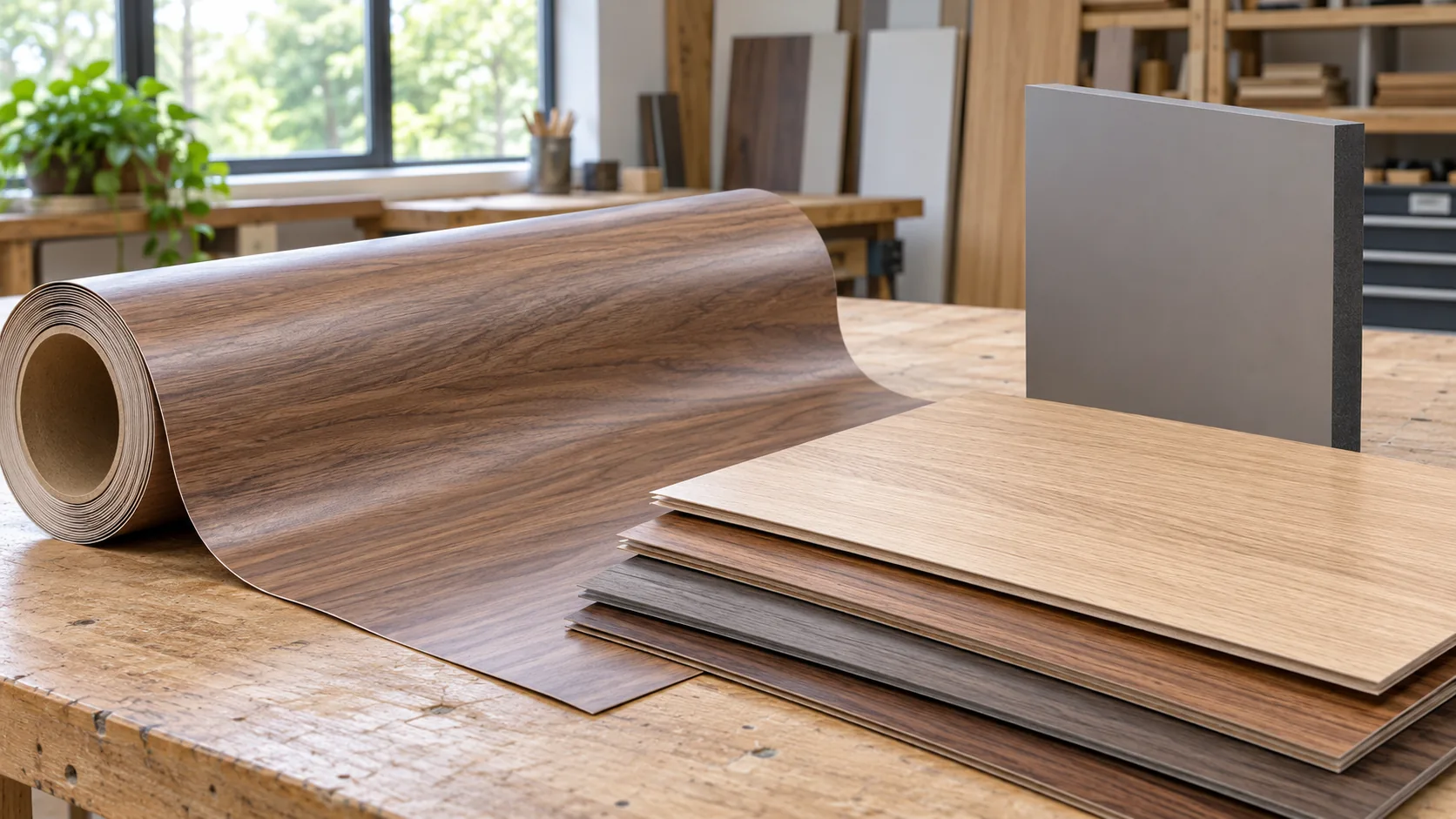
CPL and HPL use resin-impregnated papers, but the familiar comparison concerns how they are pressed: CPL moves through a continuous double-belt press, while traditional HPL comes from batch presses. For a CPL vs HPL choice, start with the finished grade and thickness. Continuous presses can also produce HPL meeting EN 438; the industry association’s process description covers material up to 1.2 mm thick.
What is the difference between CPL and HPL?
CPL names a continuous pressing route; HPL names a high-pressure laminate family that includes both thin facings and compact panels. The two labels overlap, so the useful comparison is between the actual sheets available for your component.
| Point to compare | CPL | HPL |
|---|---|---|
| Full name | Continuous pressed or continuous pressure laminate | High-pressure laminate |
| Press route | Paper webs pass continuously between steel belts | Traditionally a multi-daylight batch press; continuous production is also possible |
| Basic construction | Resin-impregnated decorative and backing papers | Resin-impregnated decorative and core papers |
| Supply form | Thin sheets, strips or coiled material, according to grade | Thin sheets for bonding, or thicker compact panels |
| Role in the finished part | A facing bonded to a suitable core | A facing on a core, or a compact element designed for its application |
| Curved details | Flexible grades suit wrapping and edge applications | Postforming grades suit heat-formed curves |
| Performance evidence | The declared grade, thickness and test results | The declared grade, thickness and test results |
U.S. industry HPL overviews treat continuous-pressed and flexible CPL as part of the same laminate family. So a label such as “CPL door” tells you less than a description of its facing, core and edge.
On a flat wardrobe front, either route can supply the decorative face. A rounded door profile introduces another requirement: the facing has to form around that shape. Keep the geometry of the finished component in view as you compare the samples.
What are CPL and HPL made of?
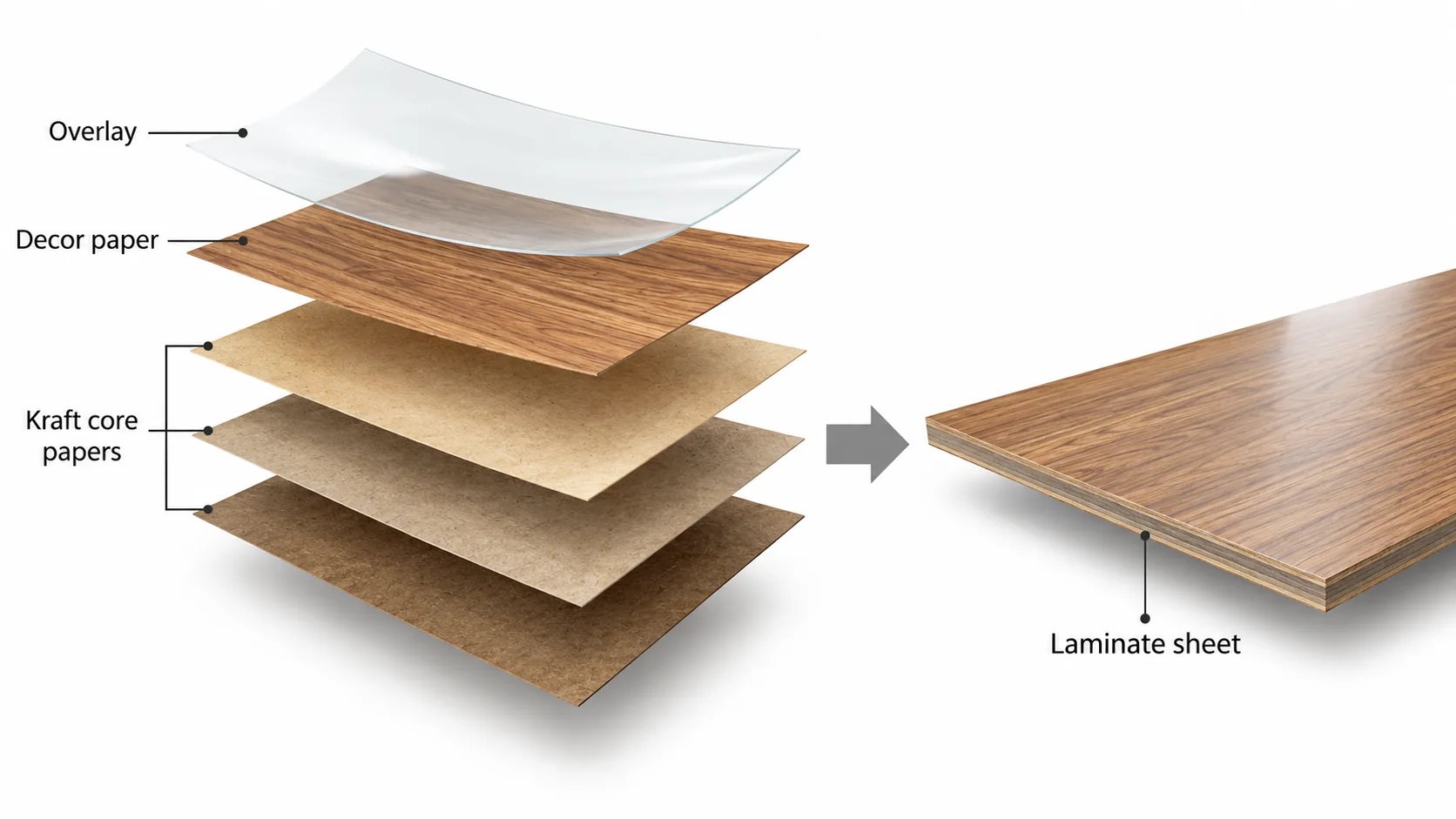
Both use papers impregnated with thermosetting resins, typically a kraft-paper core under a decorative face and, where specified, a protective overlay. The paper supplies reinforcement; the cured resin binds the layers into a dense laminate.
In a conventional construction, the kraft papers carry phenolic resin and the decorative paper carries melamine resin. The printed paper supplies the pattern. An overlay above it can protect that pattern while preserving its appearance. Core, décor and overlay are the three layers a laminate press joins.
Melamine is the resin chemistry in this context, while “melamine board” usually describes a ready-faced wood-based panel. Our explanation of melamine separates those uses of the word. They are easy to mix up when a drawing lists a material name without showing the panel build.
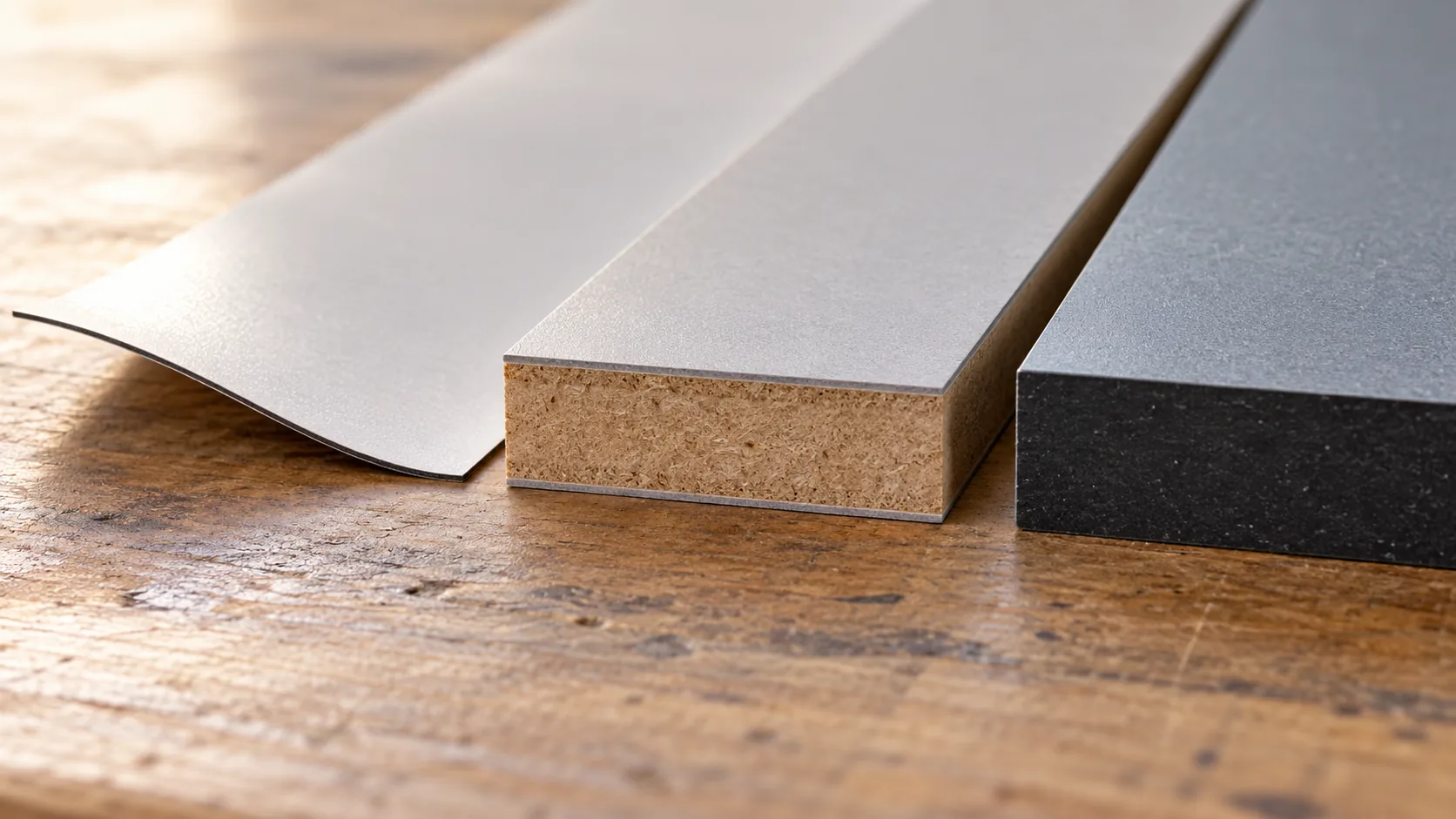
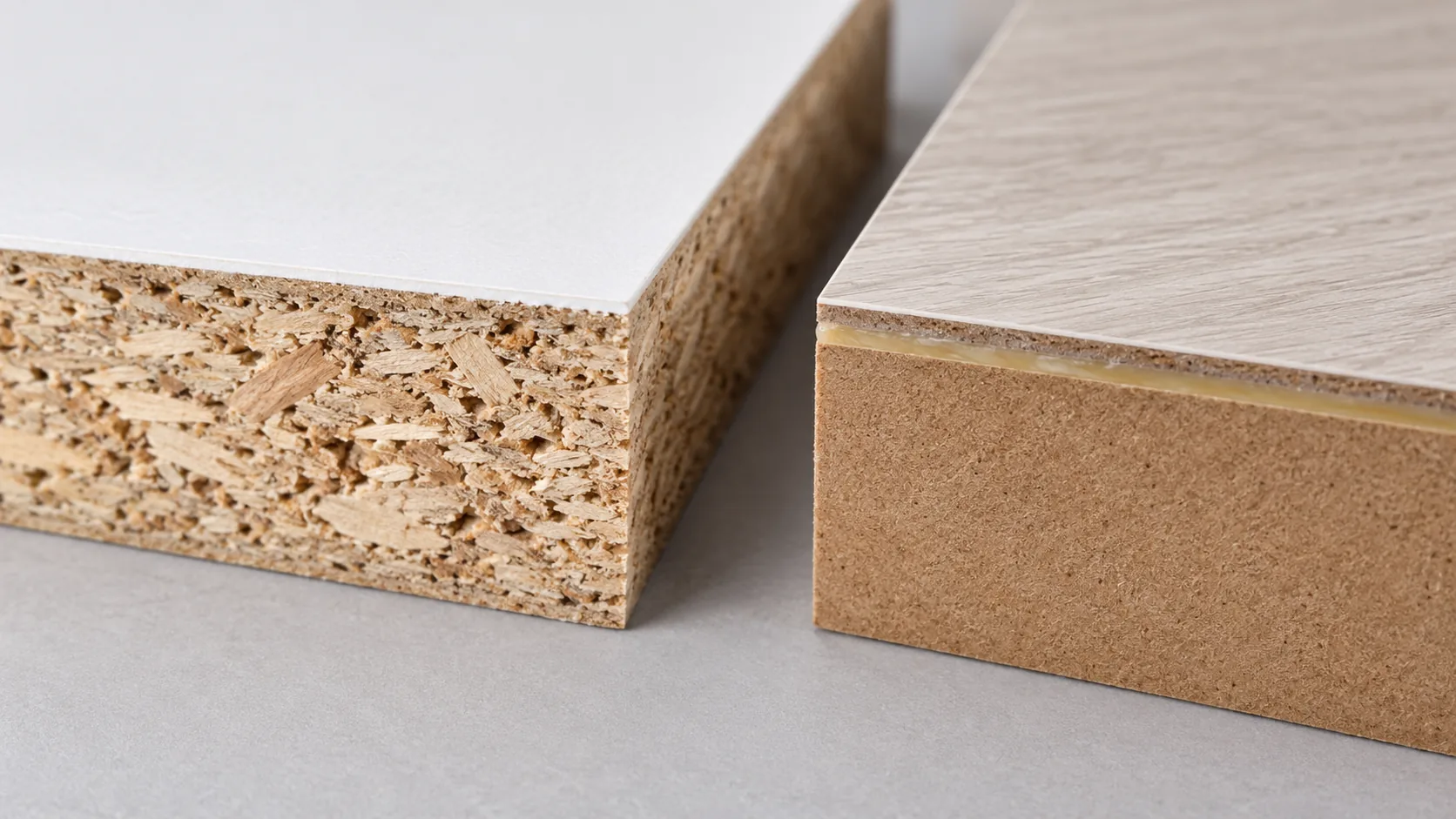
Look at the cut edge as well as the front of a sample. It shows whether you are holding a separate laminate, a faced core or a compact panel. Two matching woodgrain surfaces can conceal quite different constructions underneath.
How are CPL and HPL manufactured?
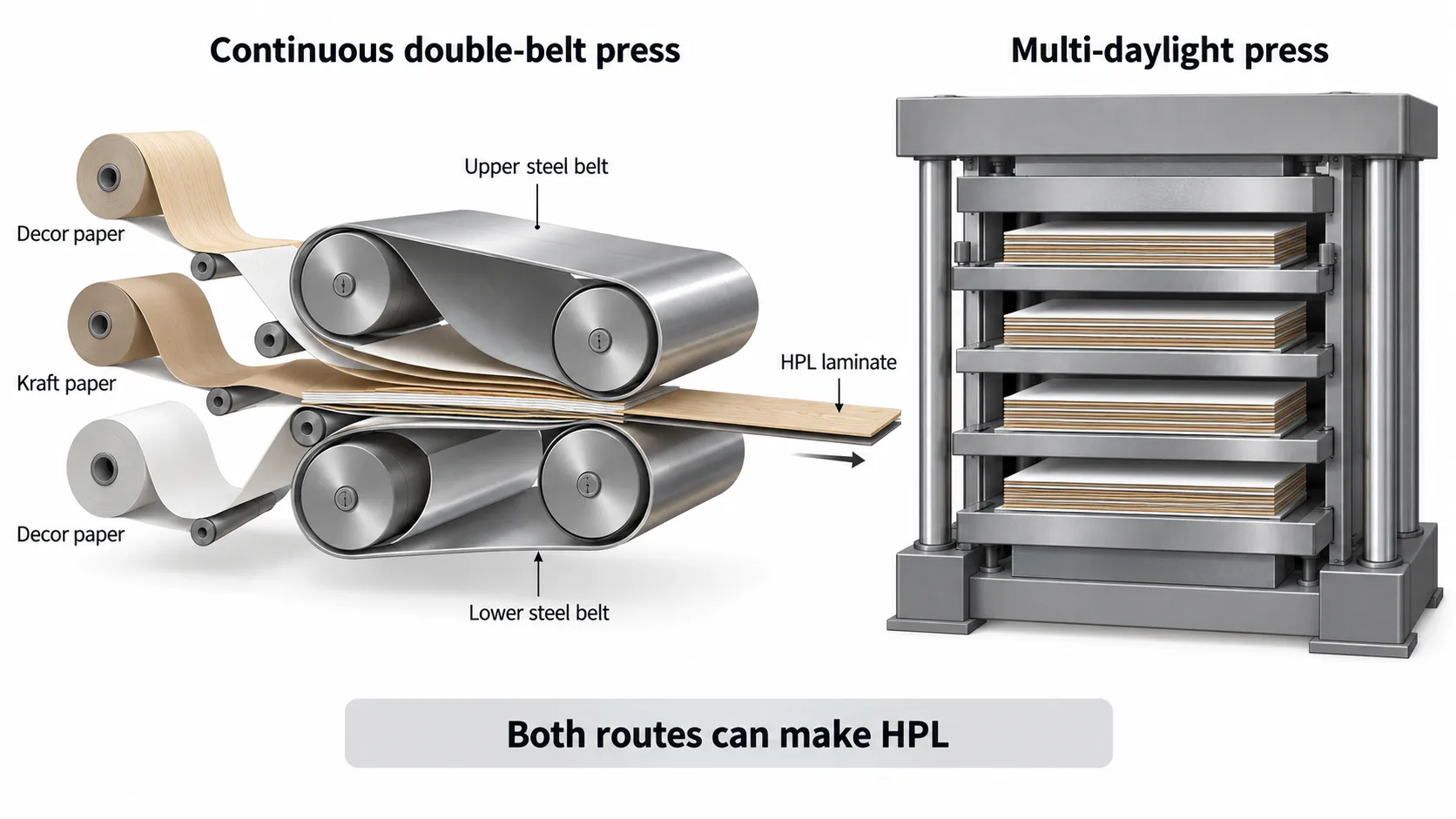
Continuous pressing feeds impregnated paper webs between moving steel belts; batch pressing closes a stack of sheet assemblies inside a multi-daylight press. Both routes consolidate the paper and cure its resins.
Batch pressing runs above 5 MPa and above 120°C, according to ICDLI, the decorative laminates industry association. The full cycle, including cooling under pressure, takes about 100 minutes, depending on the press charge and maximum temperature. These figures describe making the laminate itself, not bonding it to a furniture core.
The continuous process in that account produces laminate up to 1.2 mm thick at 8–30 m/min, varying with thickness and line length.
Continuous production also changes how material reaches a fabricator: long webs can be cut to the lengths a job needs, and press makers market the route for economical production of large quantities. That suits repeated components cut from long runs.
Is CPL lower quality than HPL?
CPL can meet the same EN 438 minimum requirements as batch-produced HPL. Quality follows the actual laminate grade and construction, so a press name is a poor substitute for a test result.
ICDLI states that both production routes can make HPL meeting the standard’s optical and mechanical minimum requirements. In the U.S., the Composite Panel Association describes CPL properties as similar to standard HPL. The tests that matter are abrasion, scratching, impact, heat, moisture, staining, chemicals and light, and impact resistance depends partly on thickness.
For example, a thick compact sheet and a thin facing on MDF are different test objects. When a supplier presents an impact result, check the specimen construction and method before treating it as evidence about your door. Our cabinet surface durability test guide explains why scratching, wear, spills and edge damage answer different questions.
For a busy cabinet front, compare the required surface grade and the completed component. A durable face still relies on a sound core, bond and protected edges.
How do thickness and compact laminate change the choice?
Thin laminate needs a supporting core; compact laminate can serve as a separate panel or a bonded component. The thickness category helps identify what you are buying.
| EN 438 part | Scope relevant to this choice |
|---|---|
| Part 3 | Laminates less than 2 mm thick intended for bonding to supporting substrates |
| Part 4 | Compact laminates at least 2 mm thick for interior use |
| Part 5 | Flooring-grade laminates intended for bonding to supporting substrates |
| Part 6 | Exterior-grade compact laminates |
| Part 7 | Compact and composite panels for internal and external wall and ceiling finishes |
These scopes come from BSI’s EN 438 series listing, with separate current overviews for thin laminates and interior compact laminates. A category boundary describes a product class, not the unsupported span of a shelf or partition.
A thin sheet bonded to MDF gets its panel stiffness from that assembly. A compact panel can serve a different construction role, but its chosen thickness, fixings and support spacing must suit the design. The C in CPL stands for continuous, not compact.
The continuous process described earlier concerns thin stock. Batch production also supplies compact products. Keep those product forms distinct when reviewing samples: a loosely curved facing strip, a laminate-faced board and a solid compact edge show different things.
Which is better for doors, cabinet fronts and worktops?
Thin CPL or HPL can suit flat doors and cabinet fronts; forming details call for a formable grade, while worktops need a surface and construction selected for horizontal use. Choose the component first, then the appropriate laminate.
For a flat wardrobe or cabinet door, assess the face together with its core and edging. A finish sample tells you about color and texture; a completed door sample also reveals the edge line, corner treatment and face-to-edge match. The comparison of thermofoil and flat laminate doors covers another construction distinction that often appears in the same cabinet discussion.
For wrapped profiles, start with flexible CPL, which is made for profile wrapping and edgebanding. HPL also comes in postforming grades that heat can bend into concave or convex curves. Specify the shape and the forming capability together.
For a kitchen worktop, start with a horizontal-use grade and the full worktop build, including joints, cutouts and edges. Compact is another option where its construction suits the design. Compact laminate can be bonded or used as a self-supporting element, depending on the construction. Hymmen’s application overview includes worktops, furniture and doors across decorative laminate products.
How do CPL and HPL compare with TFL or melamine board?
TFL bonds resin-impregnated decorative paper directly to a wood-based core; CPL and HPL first become separate laminate products that a fabricator bonds to a core. That manufacturing difference changes what the panel shop buys and processes.
In TFL, heat and pressure fuse the decorative paper to its substrate, producing a faced panel ready for machining. A separate HPL construction adds the sheet and its bonding operation. TFL therefore combines tasks that a laminate lay-up handles separately.
This makes TFL worth considering for cabinet boxes, shelving and other parts where its declared grade meets the job. A thicker facing adds a different layer construction; wear performance still follows the actual surface grade and test. The melamine versus laminate comparison takes that choice further, while the laminated MDF explanation separates facing selection from core selection.
For U.S. cabinet-budget context, Angi’s guide updated July 9, 2026 gives $4,000–$9,000 for melamine cabinets. HomeAdvisor’s guide updated June 17, 2026 gives $4,000–$15,000 for the broader laminate-cabinet category. Those overlapping whole-cabinet budgets cover varied constructions and project costs; they do not isolate a same-specification HPL/TFL facing premium.
What should you specify when ordering CPL or HPL?
Specify the surface grade, sheet thickness, finish, forming requirement and finished-panel build.
| Specification | What to record | Why it affects the choice |
|---|---|---|
| Standard and grade | Relevant EN 438 part, product type and intended application | Connects the declaration to the job |
| Thickness and construction | Nominal sheet thickness, core or support arrangement | Defines the supporting panel build |
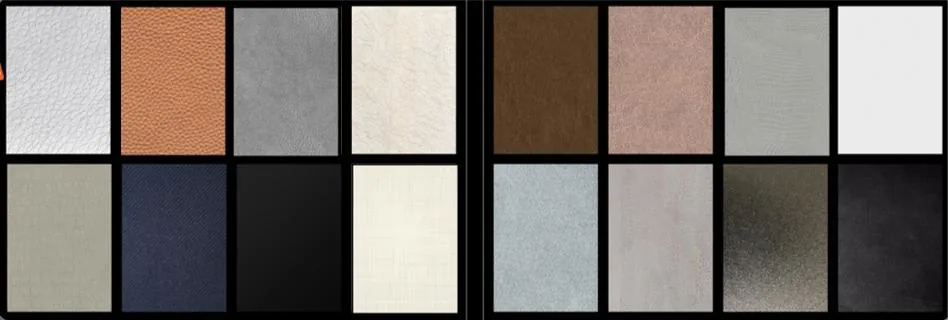
| Surface | Décor reference, texture and gloss | Makes visual comparison meaningful |
| Forming | Flat, wrapping or postforming requirement and component shape | Identifies a suitable material grade |
| Balanced back | Face and back construction, with sheet direction | Helps manage stresses in a bonded panel |
| Core and bond | Core material and compatible adhesive system | Defines the complete lay-up |
| Edges and joints | Edge material, joint detail and cutout protection | Addresses visible lines and moisture entry points |
| Evidence | Test method, grade, specimen build and reported result | Allows comparison on a common basis |
A symmetrical build with the same laminate direction on front and back helps keep a bonded panel flat, and a finished edge protects the substrate. These details become visible when a door bows or a cut edge takes up moisture.
Plan the panel lamination adhesive, the MDF lamination sequence and the edge-banding approach as parts of the same component.
Where does a silicone-faced decorative film fit?
On flat furniture panels, cabinet fronts and wall panels, as an alternative to a thin laminate facing. Puremorfilm makes decorative film with a silicone functional surface that goes onto the board at the same lamination stage.
The silicone surface is inherently flame-retardant; higher grades up to UL 94 V-0 are available on request. In the manufacturer’s laboratory tests, coffee, red wine and soy sauce left at 25°C for 24 hours wiped off without obvious change. Our film has a No DOP formulation and is PVC-free and formaldehyde-free.
An SGS-tested film sample showed only slight matting, with no substrate exposure or coating peeling, after 2000 revolutions under ASTM D4060-25 using CS-10 wheels, 1000 g per wheel and 60 rpm.
We mainly supply film rolls for PUR flat lamination, with film-faced panels available on request. Our paint-free material uses a silicone functional surface, distinct from PVC, melamine, PP and PETG decorative faces. The relevant uses are flat facings; structural compact duties, floors, cooktops and shower floors need other materials. See the furniture decorative film page for this supply route.
Should you choose CPL or HPL?
Choose the facing and grade that fit the component: formable material for curved details, suitable thin laminate for a faced panel, and a purpose-selected compact product for compact construction.
| Your component | Starting point |
|---|---|
| Wrapped edge or shaped door detail | Flexible CPL, or a suitable postforming HPL grade |
| Flat door, cabinet front or furniture panel | Thin CPL or HPL with the required performance and finish |
| Worktop or demanding horizontal surface | A horizontal-use HPL grade and a suitable complete construction |
| Compact partition or exterior panel | Compact laminate of the correct application grade and support design |
| Budget-conscious cabinet box or shelf | TFL where its grade and edge treatment suit the use |
Bring the decision down to a completed sample: face, core, bond, back and edge. We can provide a sample for a flat-facing comparison. For a cabinet or wall-panel project, bring your substrate, finish reference, intended use and required test method when you contact us.
Frequently Asked Questions
What are the downsides of HPL sheets?
Thin HPL needs a supporting core, a balanced bonded construction and finished edges. Curves require a suitable postforming grade. A cut edge may also reveal the laminate core, which becomes part of the design or needs an edge treatment. These are construction choices to settle before selecting the décor.
Which is more expensive, HPL or TFL?
The published U.S. cabinet budgets do not establish a same-panel HPL/TFL price ranking. HPL adds a separate laminate sheet and a bonding step that a ready-faced TFL panel does not need. Those whole-cabinet budgets are $4,000–$9,000 for melamine and $4,000–$15,000 for the broader laminate category. Their overlap reflects varied cabinet constructions and project scope, rather than a measured HPL/TFL facing surcharge.
What do HPL and CPL mean?
HPL means high-pressure laminate; CPL means continuous pressed or continuous pressure laminate. The first describes a laminate family; the second names its continuous manufacturing route. A continuously produced laminate can also meet the requirements for HPL.
Is HPL the same as plastic laminate?
Yes, in most U.S. usage: HPL is the direct descendant of the original plastic laminate. The more precise term is useful when you need a particular grade. TFL describes paper fused directly to a board, while CPL describes continuous pressing of a separate laminate.
What is the difference between CPL and melamine?
CPL is a separate paper-and-resin laminate facing; melamine board, or TFL, has decorative paper fused directly onto its core. Melamine resin can occur in both constructions, so the resin name and the finished panel name answer different questions.