
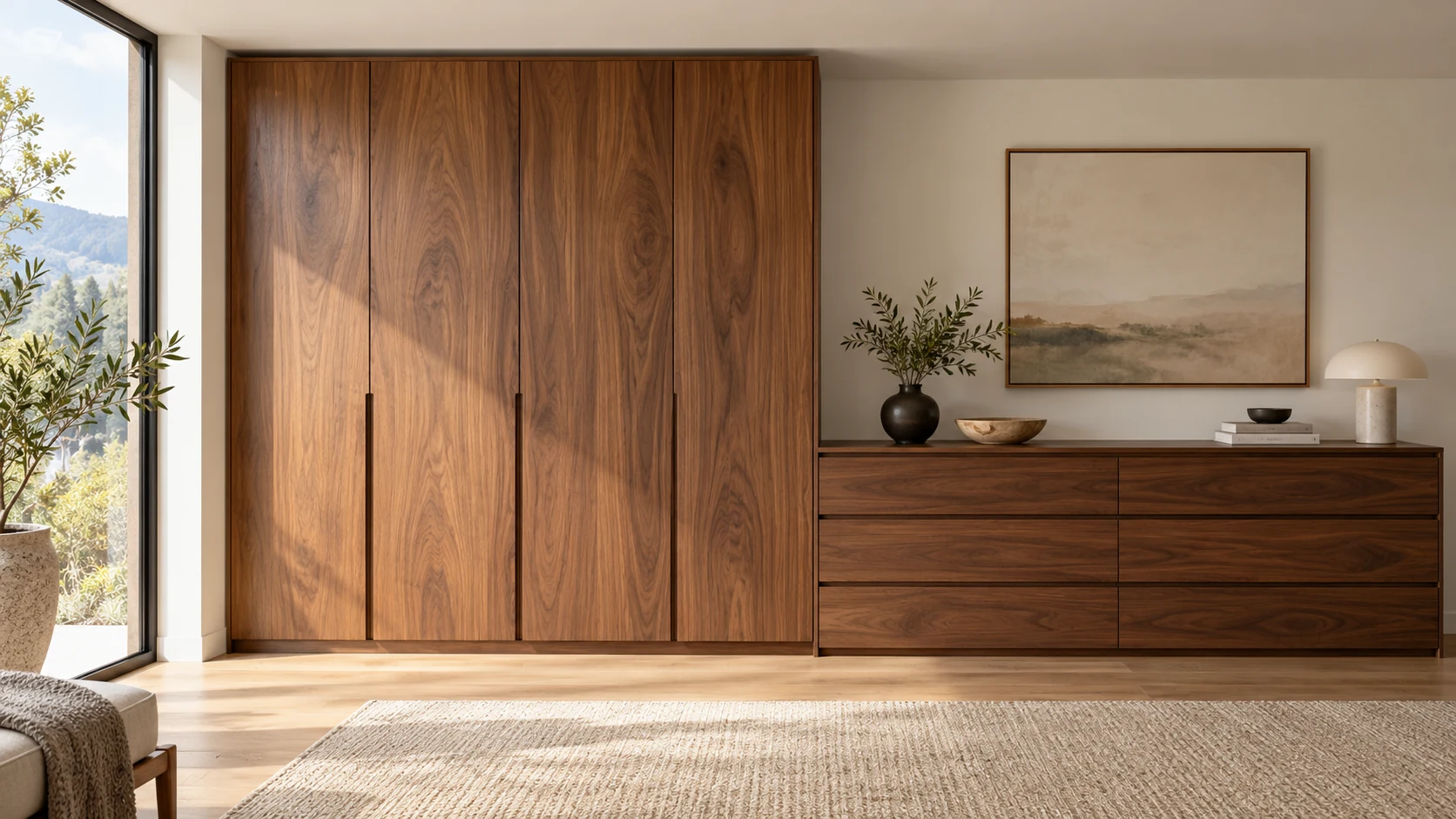
Grain matching cabinets means arranging doors, drawer fronts and panels so their woodgrain relates across neighboring parts. Getting the intended result requires two separate instructions: which way the grain runs, and which parts must look continuous. A row of doors can share one color and a vertical direction while the grain pattern starts again on every door.
What does grain matching mean on cabinets?
Grain matching means selecting and arranging visible parts so their grain pattern works together across the finished cabinet. The intended relationship can be a consistent direction, a close visual match, or a pattern that continues across gaps between fronts.
Those levels need different planning. A supplier may offer the same woodgrain decor on every front without offering a continuous pattern across the entire kitchen. Before comparing samples, decide which result the design needs.
| Requested appearance | What you should see | What still needs to be decided |
|---|---|---|
| Same decor or wood species | A related color and grain character | Direction and the relationship between individual parts |
| Same grain direction | Grain runs vertically or horizontally across the selected fronts | Whether distinctive lines must continue across the gaps |
| Continuous grain | Identifiable lines or figures carry across adjacent parts | The exact group of parts and the material layout that produces it |
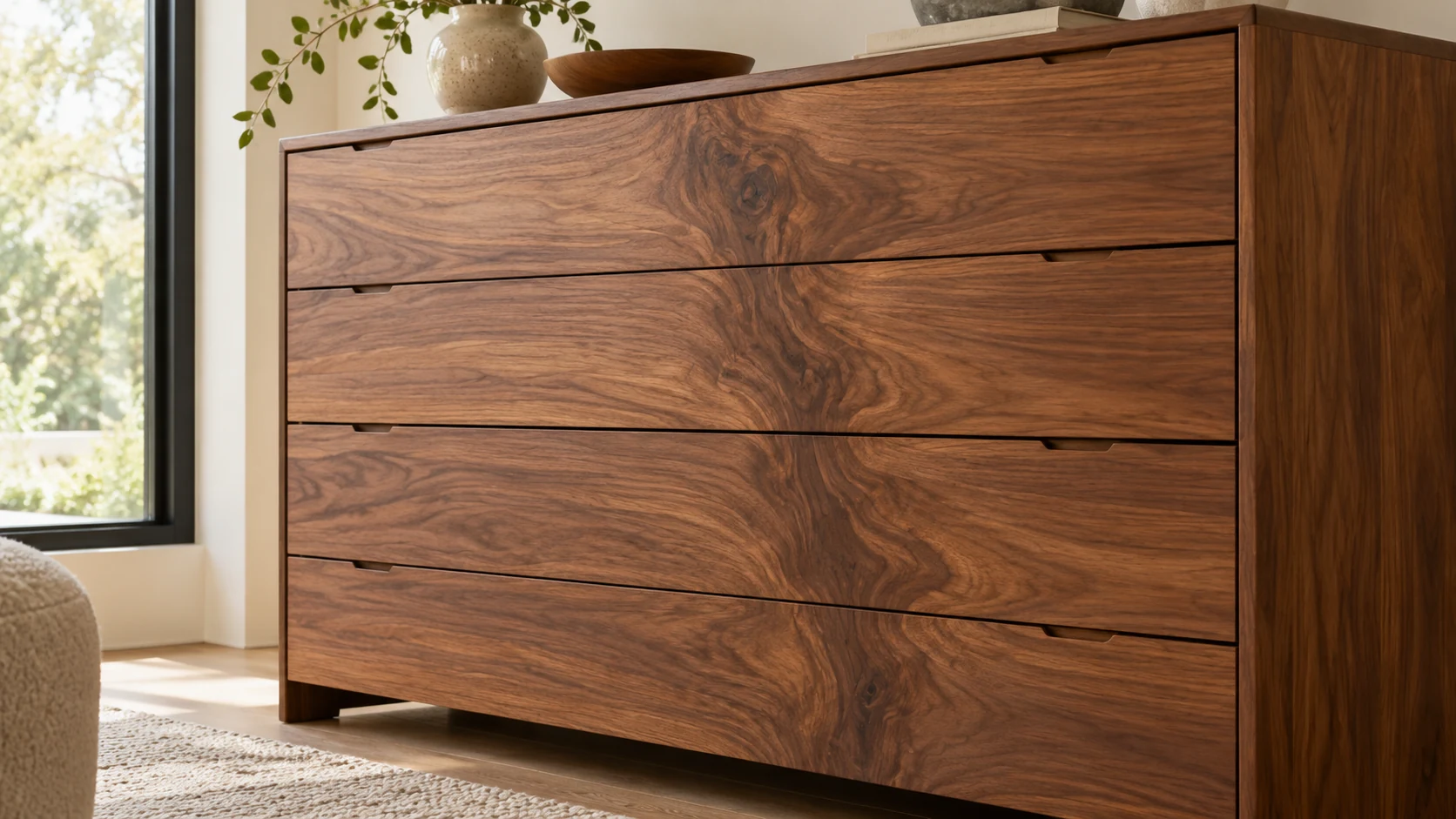
For a stack of drawers, continuity might mean following a distinctive curve from the top drawer to the bottom. For tall doors, the design may only need consistent vertical grain. Both can be deliberate choices; the order should describe the intended appearance.
Should cabinet grain run vertically or horizontally?
Vertical grain usually suits tall doors and upright cabinet elevations; horizontal grain suits wide drawer runs and long, low cabinetry. Keep the direction intentional across the area you see together, especially where tall cabinets meet a horizontal base run.
Horizontal lines can emphasize the width of a low bank, while vertical lines can reinforce its height. These are design effects, not measured changes to a room. The proportions of the actual doors, the grain figure and the surrounding architecture determine whether the effect is useful.
A wide drawer with horizontal grain can show a long section of the pattern. A narrow door may interrupt that same figure repeatedly. Lay out the visible fronts together before selecting a direction from a small sample. The choice of kitchen cabinet materials also changes the available grain appearance and construction.
You can combine directions deliberately, such as vertical tall storage beside horizontal drawers. Mark the transition on the elevation so it reads as a design decision. Also compare matte and gloss cabinet finishes: reflected light can make the same grain figure more or less prominent.
How is continuous grain achieved across drawers and doors?
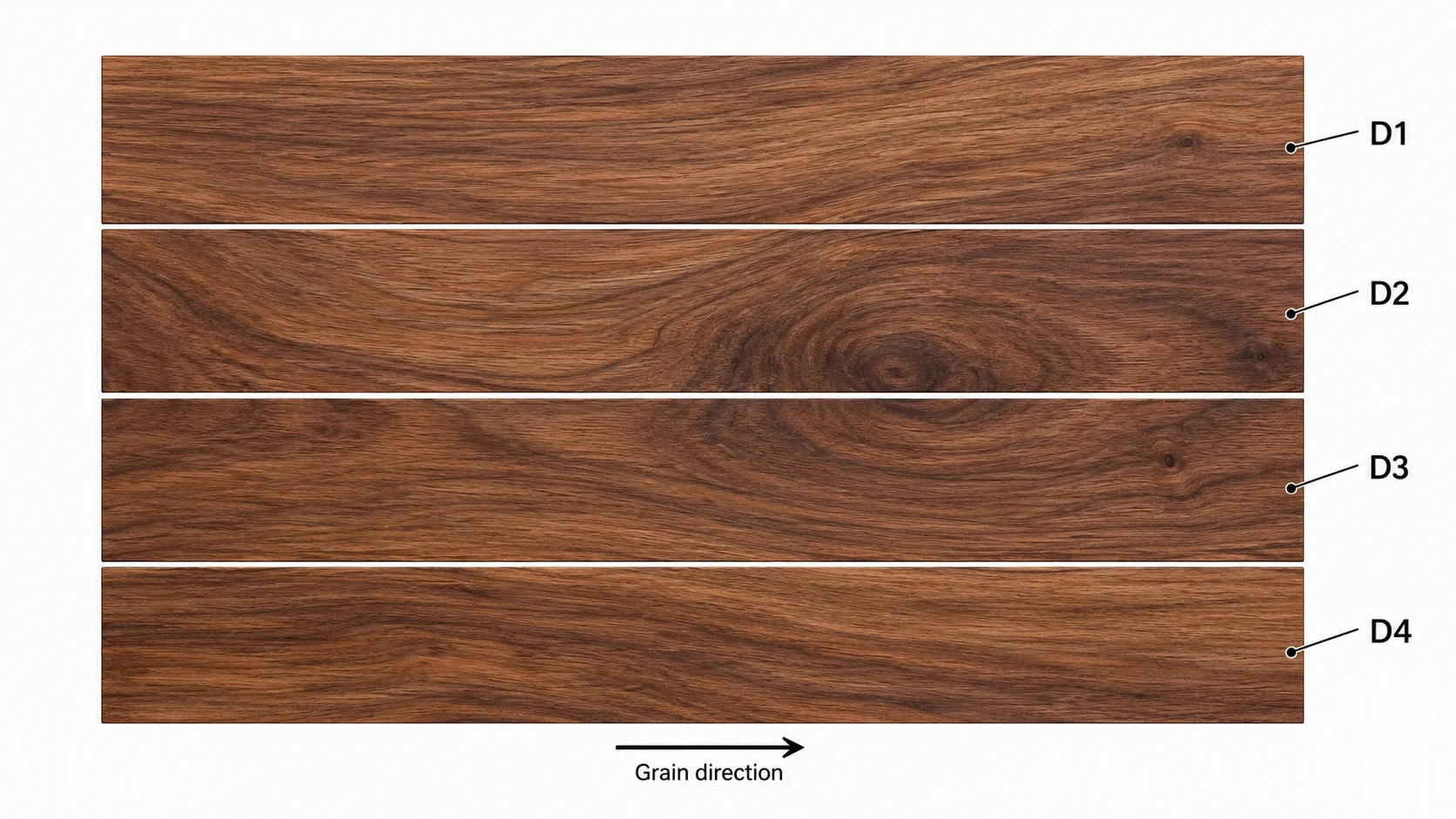
Continuous grain is usually planned by laying out adjacent parts in sequence on the same board or decorative sheet, then keeping that sequence through fabrication and assembly. Numbering the parts preserves the relationship that was visible in the original material.
The Wood Magazine grain-matching article, published in 2017, describes making an oversized solid-wood panel and dividing it into matching drawer fronts. Its cutting allowances belong to that woodworking example. The useful principle for a cabinet elevation is to plan the whole group before separating its parts.
Keeping the parts in order matters as much as the layout, as a 2009 continuous-grain example shows. Once similar fronts have been rotated or mixed, identifying their original neighbors can be difficult. A simple part mark on a non-visible surface lets the assembly team retain the intended sequence.
On a printed woodgrain panel, the corresponding planning task is to locate the fronts within the chosen face pattern and preserve their orientation. Saw cuts, door gaps and edge details interrupt the picture, so a photograph or layout of the complete group is more useful than inspecting each front separately.
Does grain matching work the same on veneer, solid wood and laminate?
The visual goal can be similar, but solid wood, veneer and printed laminate obtain their patterns differently. Solid wood requires selected boards or an assembled panel; veneer uses thin wood leaves; printed finishes use a reproduced decorative pattern.
In natural wood, color and figure vary with the material selected. Choosing related boards can help the finished parts look coherent even where exact continuity is unavailable. Veneer terms such as book matching and slip matching describe arrangements of wood leaves. They name a material-specific method, not a general promise for every wood-look surface.
The 2024 wood-paneling standard separates natural-veneer and decorative-laminate matching. That separation gives you a useful question for a sample review: is the proposed effect created by selecting natural material, arranging veneer leaves, or laying out a printed pattern?
For the material choice itself, compare wood veneer with laminate and veneer with solid wood. Then describe the required finished effect using a layout or sample of the selected material. A veneer photograph alone leaves the printed-face supplier without an agreed pattern arrangement.
Which parts actually need to match?
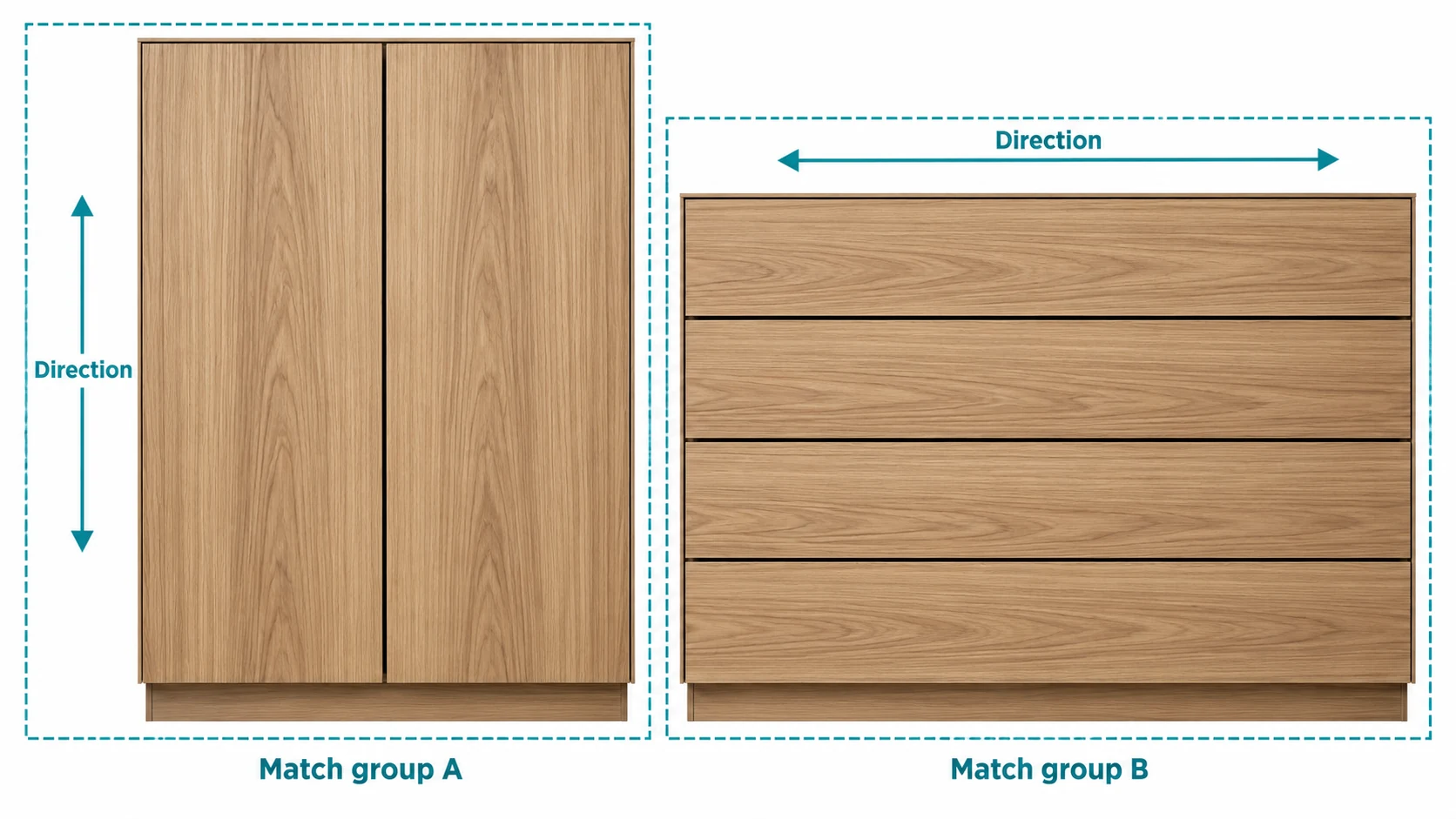
Only the parts you group together need to look continuous, so define that group first and then give it a grain direction. One cabinet, a whole cabinet run, and an adjoining wall are different matching boundaries.
In ANSI/AWI 0641-2019, the flush-overlay door and drawer-front provisions distinguish matching requirements by grade. Even the Premium provisions make cross-cabinet blueprint or sequence matching conditional on it being specified. The cabinet aesthetic requirements therefore support a practical distinction between matching within a unit and demanding continuity across several units.
The 2024 paneling design provisions separately address grain or pattern direction and special surface patterns on elevations. These are voluntary project standards used through the applicable specification and contract, with material and construction conditions attached.
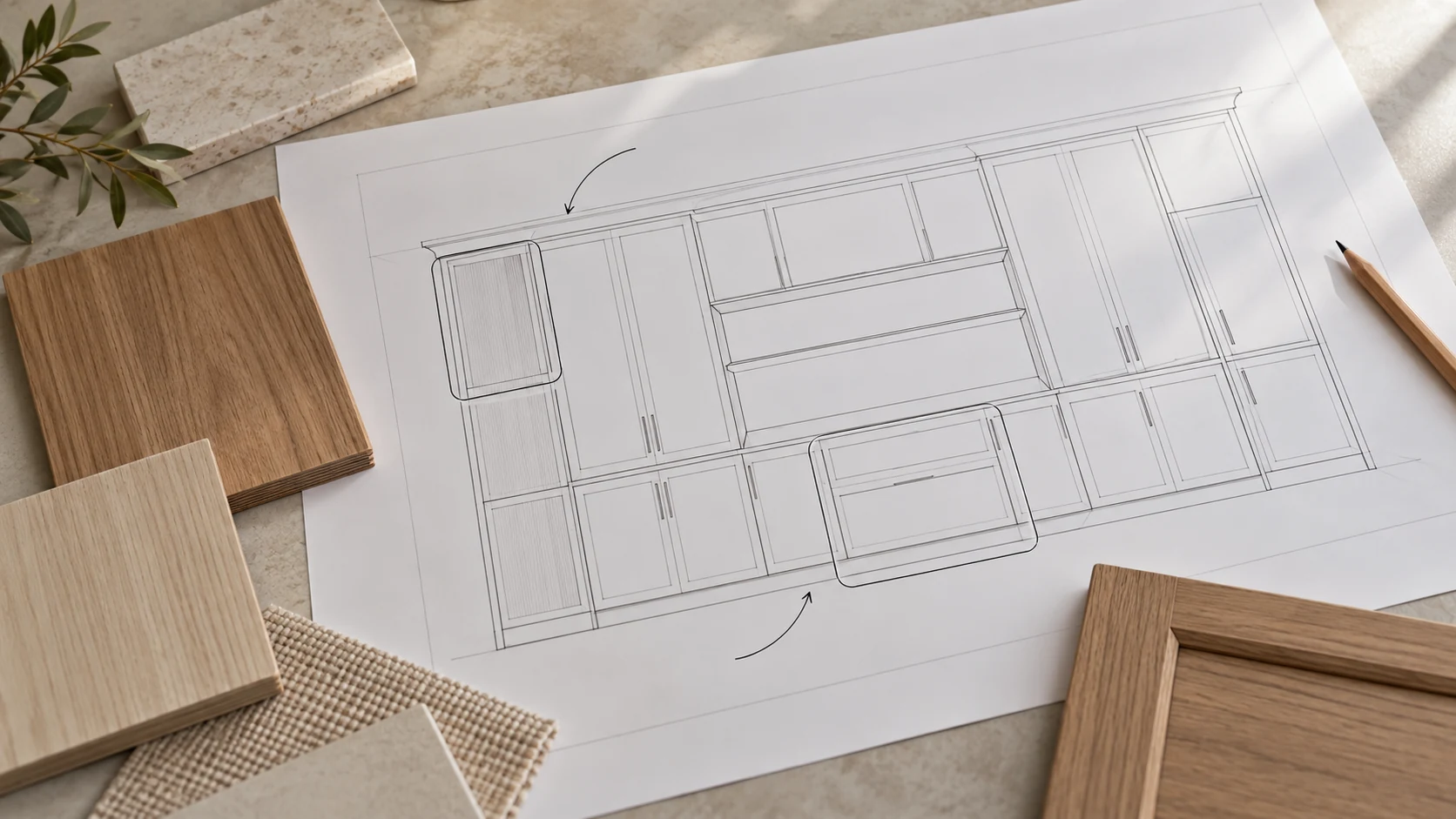
As a planning method, label adjacent fronts and draw a boundary around each continuous group. For example, a drawer bank may form one group while the refrigerator surround forms another. State whether the end panel belongs to the same visual sequence. Where cabinetry meets wall paneling, use the elevation to show whether the pattern stops at the joint; the layout choices in wall paneling ideas can help you identify those transitions.
How should grain direction be shown on drawings and cut lists?
Give each directional panel an arrow or a note stating which dimension follows the grain, and use the same convention on the elevation and parts list. Dimensions exchanged between design and purchasing can otherwise carry a different meaning.
The AWI 300 materials convention gives a concrete example: a 1219 × 2438 mm panel has grain along the 2438 mm dimension, whereas a 2438 × 1219 mm panel has grain along the 1219 mm dimension. The panel area is unchanged, but the intended orientation changes. That is AWI’s convention, not a universal rule, so confirm which convention your supplier uses.
An explicit note such as “grain along the longer dimension” removes that particular ambiguity. For a cut part, include an arrow showing its installed orientation as well. The direction on a source sheet and the direction on an installed door must describe the same layout.
Default direction also varies by cabinet standard. The 2019 architectural-casework provisions generally call for vertical directional grain on vertical surfaces, subject to their exceptions. The 2022 manufactured-casework provisions generally leave direction to the supplier unless specified otherwise. Writing the desired direction resolves the difference before the fronts are made.
How do sheet and roll sizes limit a continuous match?
Compare the required continuous group with the material actually available, then plan seams and separate matching groups where the proposed layout needs them. A large rendered woodgrain surface must be translated into real panels and a feasible decorative-material layout.
The 2024 decorative-laminate paneling provisions condition matching on the total length or width staying within the maximum available sheet dimensions. They explain that matching may be unobtainable beyond those dimensions. The rule is written for decorative-laminate sheets, but the planning point carries over: the continuous group has to fit the material you actually receive.
For decorative film, establish the usable width, pattern direction and proposed placement of neighboring parts. Film length describes the quantity supplied; it leaves the pattern repeat and relationship between separated sections to be demonstrated with the chosen decor. A long length of material is therefore insufficient evidence for a wall-wide continuous picture.
At a tall cabinet beside a low drawer bank, the easiest design to manufacture may use separate matching groups with an intentional break. A wall joint or change of plane can also provide a deliberate stopping point. Decide those boundaries before accepting the appearance of one isolated door sample. The supplier’s layout demonstration should correspond to the fronts and wall divisions in the drawing.
Where does a silicone-faced woodgrain film fit?
Puremorfilm makes decorative film with a silicone functional surface, including woodgrain choices for flat cabinet and wall-panel parts. We have more than 100 patterns and can customize texture and gloss for a project.
The silicone surface is inherently flame-retardant, with higher grades up to UL 94 V-0 available on request. Our formulation is No DOP and formaldehyde-free. In the manufacturer’s laboratory tests, coffee, red wine and soy sauce held on the surface at 25°C for 24 hours wiped off with no obvious change.
Our effective film widths are 1240, 1260 and 1400 mm; available lengths are 50, 100, 250 and 500 m, with combinations confirmed by model. We supply primarily rolls for PUR flat lamination, with faced panels available on request. Our paint-free decorative material uses an organosilicon functional face, distinct from PVC, melamine, PP and PETG decorative faces.
Explore the wood grain decorative film and patterns and finishes with your marked elevation to discuss the selected decor and layout.
How do you specify grain matching before ordering?
Specify direction, matching boundaries and a demonstrated material layout before ordering fronts. Use the approved appearance together with the drawing, so everyone is checking the same group of parts.
| Item | What to specify | Why it changes the result |
|---|---|---|
| Direction | An arrow on each directional part | Rotation changes the visible pattern |
| Continuous group | The fronts, panels and returns included | Matching inside one cabinet leaves other boundaries unresolved |
| Dimension convention | Which dimension follows the grain | The same dimensions can be interpreted in a different orientation |
| Material layout | Usable format, selected pattern and intended seams | The rendered surface has to fit the supplied material |
| Appearance reference | A view of the complete group and agreed lighting | A single front leaves its neighbors unseen |
Review the pattern and color together. The metamerism color explanation shows why a match viewed under one light can change under another. Keep this review focused on the selected material and the adjacent surfaces people will see.
A marked elevation, part dimensions, selected decor and the boundaries of each continuous group give us a useful starting point; contact us with those details to discuss decorative-film samples.
Frequently Asked Questions
What is the wood grain direction?
Wood grain direction is the direction the visible grain lines follow across a surface. On a finished cabinet front, it can run vertically or horizontally; the drawing should make the intended installed direction clear.
Which grain direction is better for kitchen cabinets?
Vertical grain usually works with tall fronts, while horizontal grain works with long drawer runs. View the complete elevation to see how the chosen direction relates to adjoining units.
What are grain-matched cabinets?
Grain-matched cabinets are cabinets whose visible parts have been selected and arranged for a related grain appearance. For a custom order, the agreed effect should show whether that means consistent direction or an identifiable pattern continuing between fronts.
Which way should wood grain run on cabinet doors?
Vertical grain is a common choice for tall doors, with horizontal grain used where the design calls for a wider visual line. The direction written on the elevation should control the order, including any deliberate transitions between cabinet groups.
How do you match wood grain?
Related material selection and a planned sequence produce the match. For continuous drawer fronts, the woodworking examples use one larger board or panel and retain the order of its parts. A printed decorative face needs a layout demonstrated in its own selected pattern.