
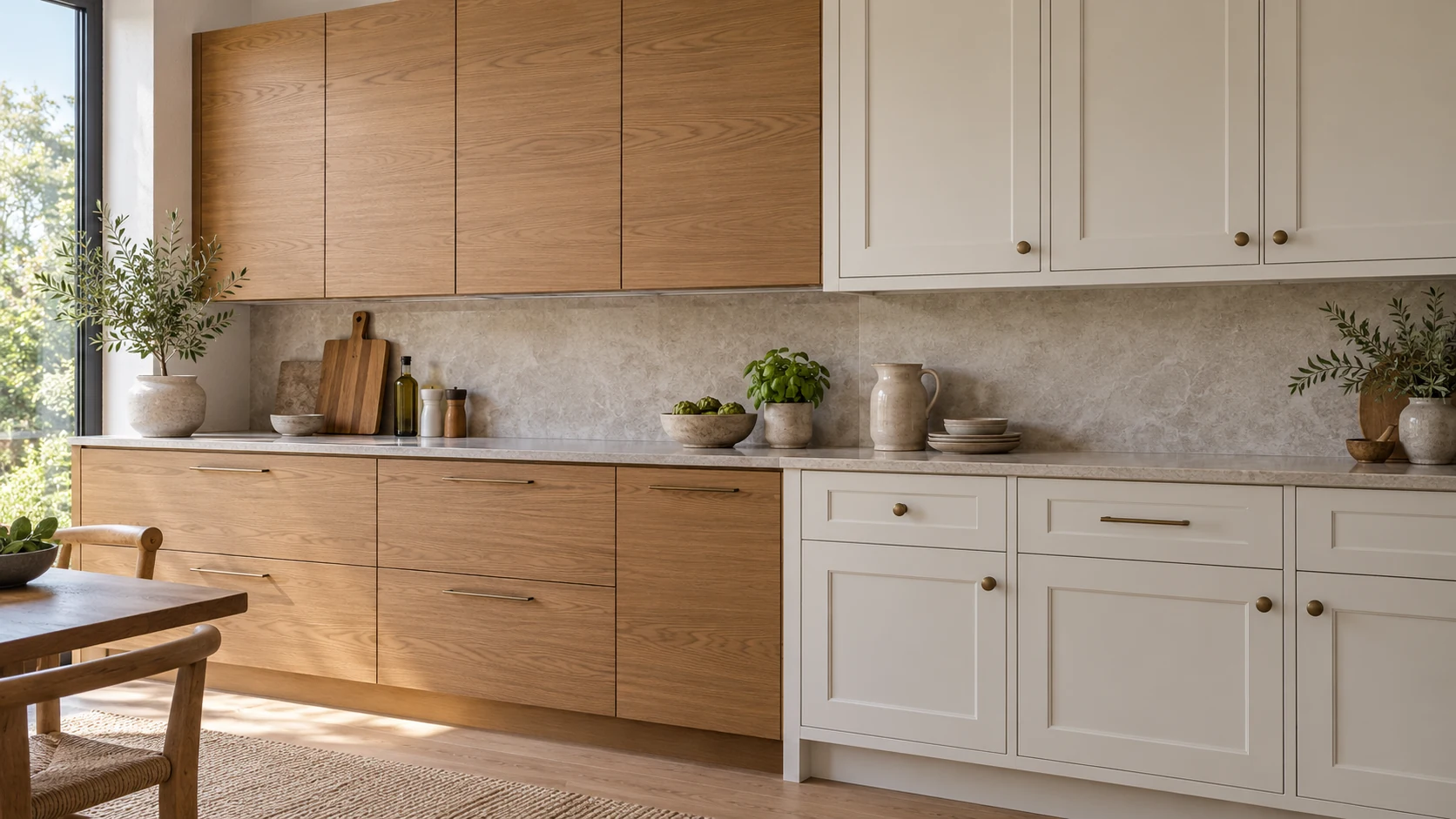
For laminate vs lacquer kitchen cabinets, choose a suitable HPL-faced flat door for a manufactured wear surface; choose a specified lacquer system for continuous color around shaped profiles and a future recoating route. Kitchen durability also depends on the finished edges, adhesive and core, so compare complete doors under matching test conditions.
Compare the actual facing or coating and the finished door edge. A face swatch omits the joints and corners that receive wet hands and knocks beside a sink or dishwasher.
Laminate vs lacquer kitchen cabinets: what is the difference?
Laminate gives the door a manufactured facing, while lacquer forms a coating over the prepared door. The difference shows up in the edge detail, available shapes and route to repair.
In a cabinet quotation, “laminate” may mean HPL, TFL or a decorative film. The first table uses separately made HPL bonded to a board; identify other constructions before comparing them. Lacquer also needs an identified coating system rather than a sheen name.
| Decision dimension | HPL-faced door | Lacquered door |
|---|---|---|
| Door geometry | A practical choice for flat slab fronts; special postforming grades permit specified curves | A useful choice for routed or shaped profiles when color should continue around the edge |
| Wear on the broad face | Choose the HPL grade for the expected rubbing; a high-wear grade has a different scope from a basic vertical grade | Choose the actual coating system and its abrasion evidence; the word lacquer supplies no single wear result |
| Edge and sink-side water | A separate edge band or joint needs its own bond and moisture assessment | Continuous coating can cover the edge, but chips or thin coverage expose the supporting door |
| Fingerprints and appearance | Texture and sheen affect mark visibility; low sheen alone is not a scratch rating | Sheen and color also affect visibility; a matte lacquer still needs its own performance evidence |
| Damage through the visible face | Deep loss of printed decor often favors a new facing or replacement front | A compatible touch-up or recoat can renew the coating; color and sheen blending may require the whole front |
| Fair cost comparison | Include core, backing, adhesive, edging and machining in the delivered-door quote | Include preparation, identified coating system, curing and profile work in the same delivered-door scope |
The broader cabinet finish comparison explains the other finish families. If one quotation describes melamine and another HPL, our melamine vs laminate article helps identify what is actually being compared.
The Composite Panel Association’s HPL definition distinguishes general-purpose, postforming and special grades. Those grade choices support the table’s conditional recommendations; they do not establish a lifetime ranking against every lacquer. Request a sample with the finished face, edge and back.
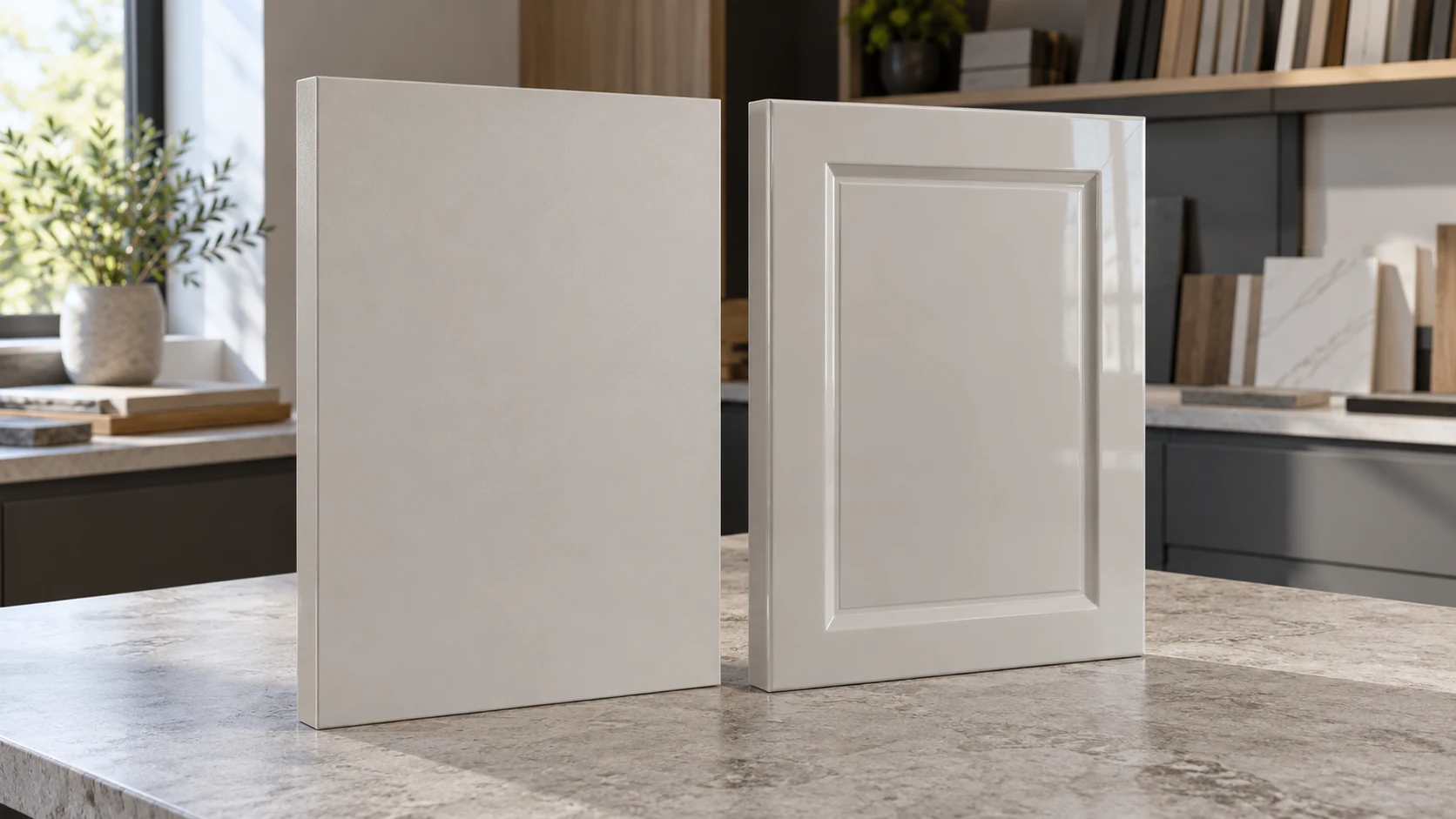
What are lacquer cabinets, and what does “lacquer” mean on a quote?
Lacquer cabinets have a coated door surface, but the word lacquer leaves important details of the coating system unspecified. The coating technology and its performance evidence are more useful than a glossy sample or the finish name.
Professional factory-finishing specifications make this distinction explicit. ANSI/AWI 0400-2022, section 3.2, calls for a finishing-system number or a finishing technology and performance characteristics to be specified. When the system or technology is unspecified, its selection falls to the manufacturer or supplier.
Have the proposed factory coating identified in the written offer, with the performance information for that system. Two white doors can have the same sheen without having the same coating construction.
The named system should cover substrate preparation, sealer, topcoat and curing. A result for one specified build cannot be transferred to an unspecified product sold under the same broad lacquer label.
How do they look and feel?
Lacquer can give a shaped door a continuous coated appearance; laminate gives flat fronts a wide choice of manufactured colors, patterns and textures. Either category can include different sheens, so do not equate laminate with matte or lacquer with high gloss.
Examine the front edge in the room’s lighting. A separate edge band may be subtle on a plain slab door and more noticeable beside a contrasting back or core. A lacquered edge can continue the face color around a profile, but its appearance depends on the preparation and application.
Then compare how reflections behave. Strong side lighting reveals surface irregularities and marks that a front-lit showroom sample can conceal. A highly reflective door can make fingerprints and fine scratches more visible without proving that the surface has lower resistance to scratching. Our matte vs gloss comparison explains how reflections change the appearance of handling marks.
Touch also belongs in the sample check. Look at the face and edge together, open the door normally and compare it beside the worktop and adjacent finishes. A small loose swatch can show a color yet omit the edge that dominates the finished door.
Is super-matte laminate better than painted MDF?
For flat MDF doors with the same core and profile, choose super-matte laminate when a repeatable factory-made face is the priority; choose painted MDF when you need the specified color and a compatible recoating route. “Super matte” describes low sheen, while painted MDF identifies a coated substrate. Neither phrase establishes a scratch-resistance grade.
Keep the MDF grade, thickness, door dimensions, backing and edge geometry the same. Then compare the actual matte facing against the actual paint system in the same color family and viewing light. A shaped painted door and a flat laminated slab answer different design questions, even if both use MDF.
For surface performance, compare the same abrasion or scratch method, load, endpoint and conditioning. For sink-side use, compare completed edges. A film hardness result, a laminate abrasion grade and a paint cure schedule cannot be combined into a first-to-third durability ranking.
| Same flat MDF door | Super-matte laminate face | Painted MDF |
|---|---|---|
| Color and texture repeatability | Specify the decor and texture code; check a replacement batch against installed doors | Specify the paint system, color and sheen; matching a local repair may require recoating the whole front |
| Edge on the same slab profile | Specify the band or facing termination and adhesive; inspect the joint rather than assuming the matte face protects it | Specify coating preparation and coverage around the same edge; damage that exposes MDF still needs attention |
| Deep damage | Loss of a uniform face or printed decor may favor refacing or a new door | Sound MDF may permit compatible repair and recoating; swollen MDF requires component assessment |
| Cleaning and mark visibility | Use the supplied care method; anti-fingerprint behavior needs evidence for that product | Use the paint maker’s care method after the stated cure; matte appearance alone is not anti-fingerprint evidence |
For low-sheen choices across different surface families, the soft-touch and matte surface guide separates appearance, feel and handling marks.
Which lasts longer in a busy kitchen?
A well-chosen laminated flat front is a practical option for frequent handling, while a specified lacquer system can also provide a durable kitchen finish. The useful comparison is the type of damage you expect and how the finished door responds to it.
On a household route between the sink, dishwasher and storage, edges receive knocks as well as wet hands. A tough face with a weak or poorly finished edge can still be disappointing. On a dark reflective front, minor surface marks may become visually intrusive long before a door stops functioning.
Lacquer gives you a coating that can be repaired or refinished with a compatible system. A chipped corner may need more than a dab of matching color if the aim is an even sheen across the front. Laminate can keep a repeatable manufactured appearance, but damage through a patterned face can be difficult to disguise locally.
For claims about wear, compare the identified product and test conditions. “Scratch-resistant” and “hard-wearing” should lead to evidence for the proposed finish, not a general ranking of every laminate against every lacquer. The scratch-resistant cabinet guide explains why visibility, resistance and repair are separate parts of that decision.
For a heavily used family kitchen, favor a finish whose likely damage you can manage. A replaceable slab front may be a sensible choice where repeat knocks are expected; a shaped lacquered front may be worth the additional finishing attention when its profile is central to the design.
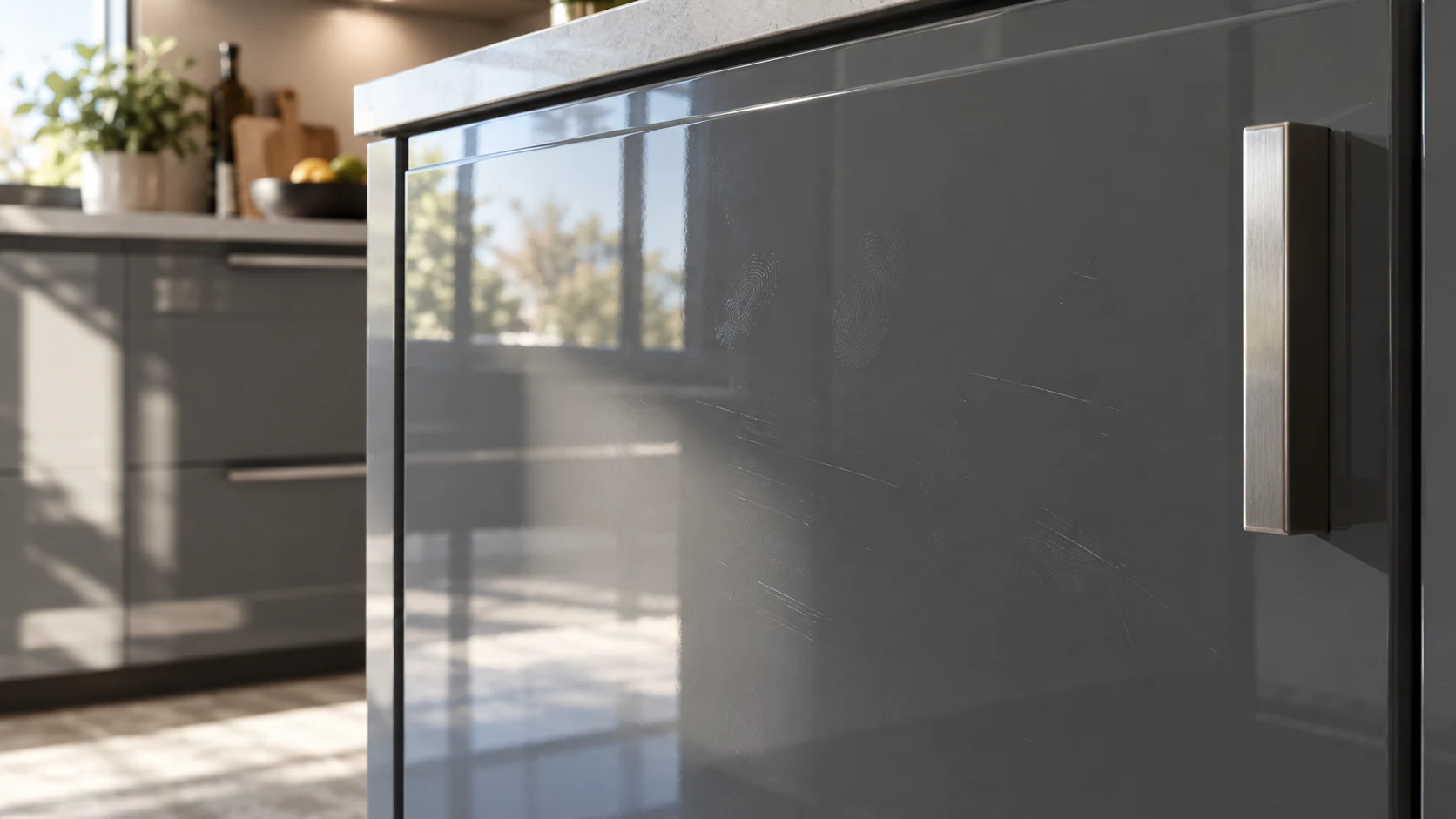
Which handles water near the sink better?
The finished door edge is the most useful place to compare sink-side moisture performance. Laminate can have joints in its edge construction, while a lacquered edge relies on continuous coating coverage and an intact surface over the underlying door.
Wiping a flat sample tells you little about water reaching the bottom edge of a door. A drip can collect there after the face has been wiped. Inspect the edge band, corners, backing junction and any damage that exposes the supporting material. The edge-banding detail explains why the edge needs its own consideration.
The cabinet industry’s test method makes that distinction concrete. KCMA A161.1-2022, section 9.5, evaluates the door-edge finish or treatment against a sponge containing a 0.5% by-weight solution of non-concentrated hand-dishwashing detergent. Exposure is 4 hours where the contact area has a material splice or seam, and 24 hours where it has none.
Those durations follow the door’s seams, not its material: they are test conditions, not laminate and lacquer scores. The method checks for effects including delamination, swelling and changes in the finish, with its full assessment procedure retained in the standard.
For your kitchen, the lesson is to compare a completed door and its edge evidence, especially beside the sink and dishwasher. A continuous-looking edge is worth examining, but appearance by itself cannot show how the completed door performs. Remove routine spills promptly so they do not become prolonged edge wetting whichever finish you choose.
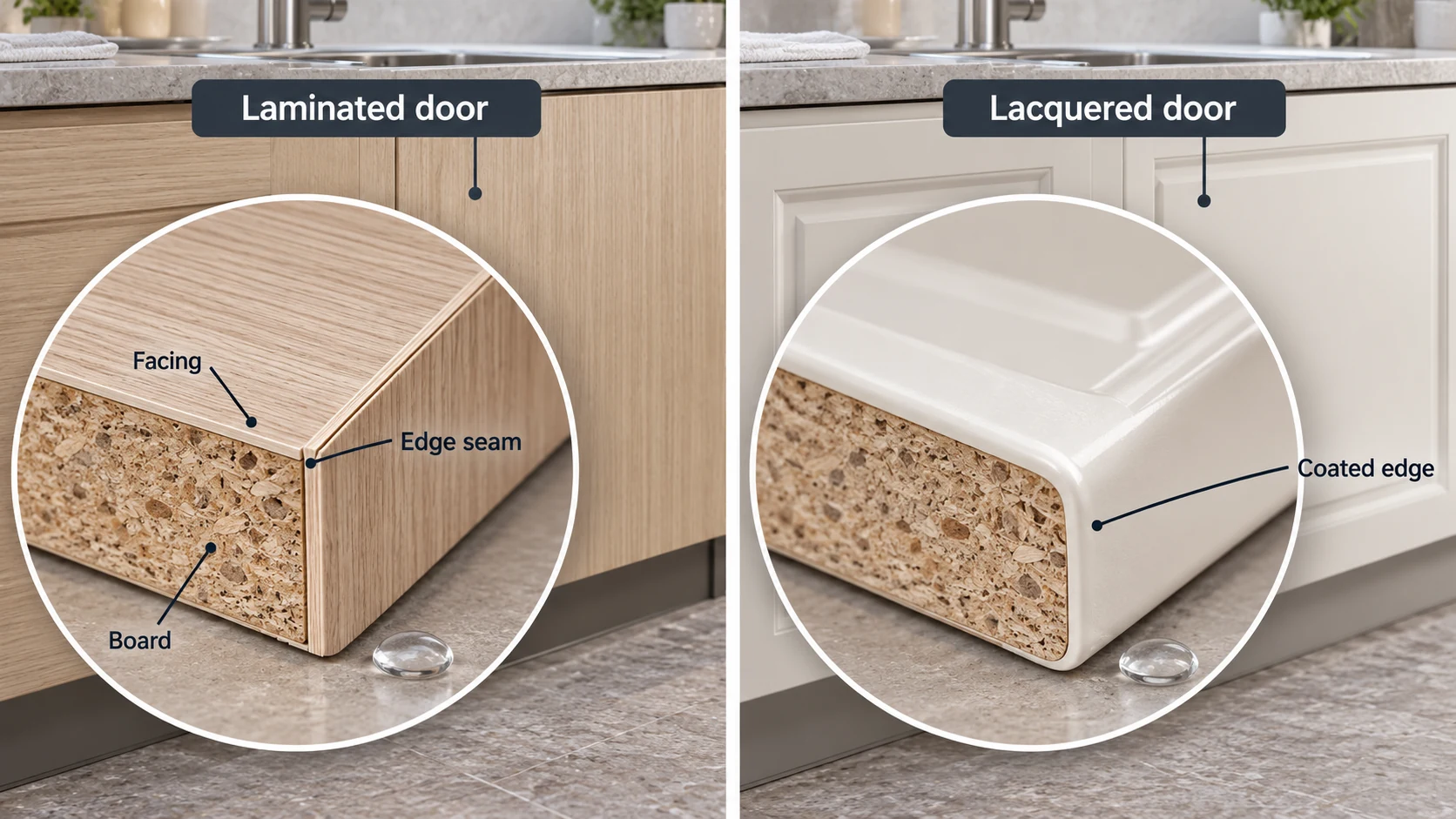
How do cleaning and repairs differ?
Both finishes need cleaning that suits the particular surface; their repair routes differ once the face or edge has been damaged. Lacquer repair involves a compatible coating system, while restoring a manufactured laminate appearance may favor replacing the affected front.
For daily care, use the maker’s compatible soft-cloth cleaning method and remove spills from edges as well as the broad face. Avoid assuming that a cleaner suited to one gloss coating is appropriate for every coated or laminated door. Our laminate cabinet cleaning article covers the everyday cleaning decision in more detail.
If you want to preserve the original appearance, ask how a local repair will blend in color, texture and sheen. A repair that fills a chip may remain visible on a plain glossy face or through a printed woodgrain. A removable door makes professional refinishing or replacement easier to plan than repairing the same surface in place.
An intact laminated face can sometimes be converted to a coating using an approved preparation and laminate-compatible coating system. That creates a different finish; it does not restore the original manufactured decor.
For an existing kitchen, the wrapping vs painting comparison explains why preparation and the condition of the current doors affect the result.
Which costs more?
Compare the price of the same completed door and delivery scope; the labels laminate and lacquer alone cannot establish a fixed surcharge. Profile machining, substrate preparation, facing grade, edging and finishing work can each change the quotation.
Do not compare a bare facing sheet with a lacquered, drilled and packed door. Record what the supplier delivers and what your shop still needs to do before installation.
| Cost detail | Keep comparable |
|---|---|
| Doors and drawer fronts | Same dimensions, count and profile |
| Finish | Identified face or coating, with the specified color and sheen |
| Cabinet construction | Same boxes, backing and edge detail |
| Fittings and work | Same hardware, delivery and installation scope |
| Later repair | Replacement-front availability or the expected refinishing route |
Lining up these items shows when a cheaper face ends up as a more expensive kitchen, or when a higher quote simply covers more work.
Where does a silicone-faced cabinet film fit?
Puremorfilm manufactures silicone decorative film in China with a silicone functional face on PET support film. The route offers a paint-free face for flat cabinet fronts; it is not a lacquer coating or a vacuum-formed finish for routed profiles.
For wear evidence, an SGS-submitted film sample was tested to ASTM D4060-25 with CS-10 wheels, 1000 g per wheel and 60 rpm. After 2000 revolutions, the sample showed slight matting without substrate exposure or coating peel. The result concerns the film under those conditions, not a finished door or a comparison with every lacquer.
We supply rolls without self-adhesive backing for PUR flat lamination, starting at 500 m per pattern. Silicone laminated panels are quoted per project in 1220 × 2440 mm format, starting at 200 sheets per pattern. The film suits furniture fronts, cabinet doors and wall panels with vertical or low-wear exposure; it is not for floors, countertops, cooktops, shower floors or other walked-on areas.
Our furniture decorative film page explains the flat-front route and its supply options.
Laminate or lacquer: which should you choose?
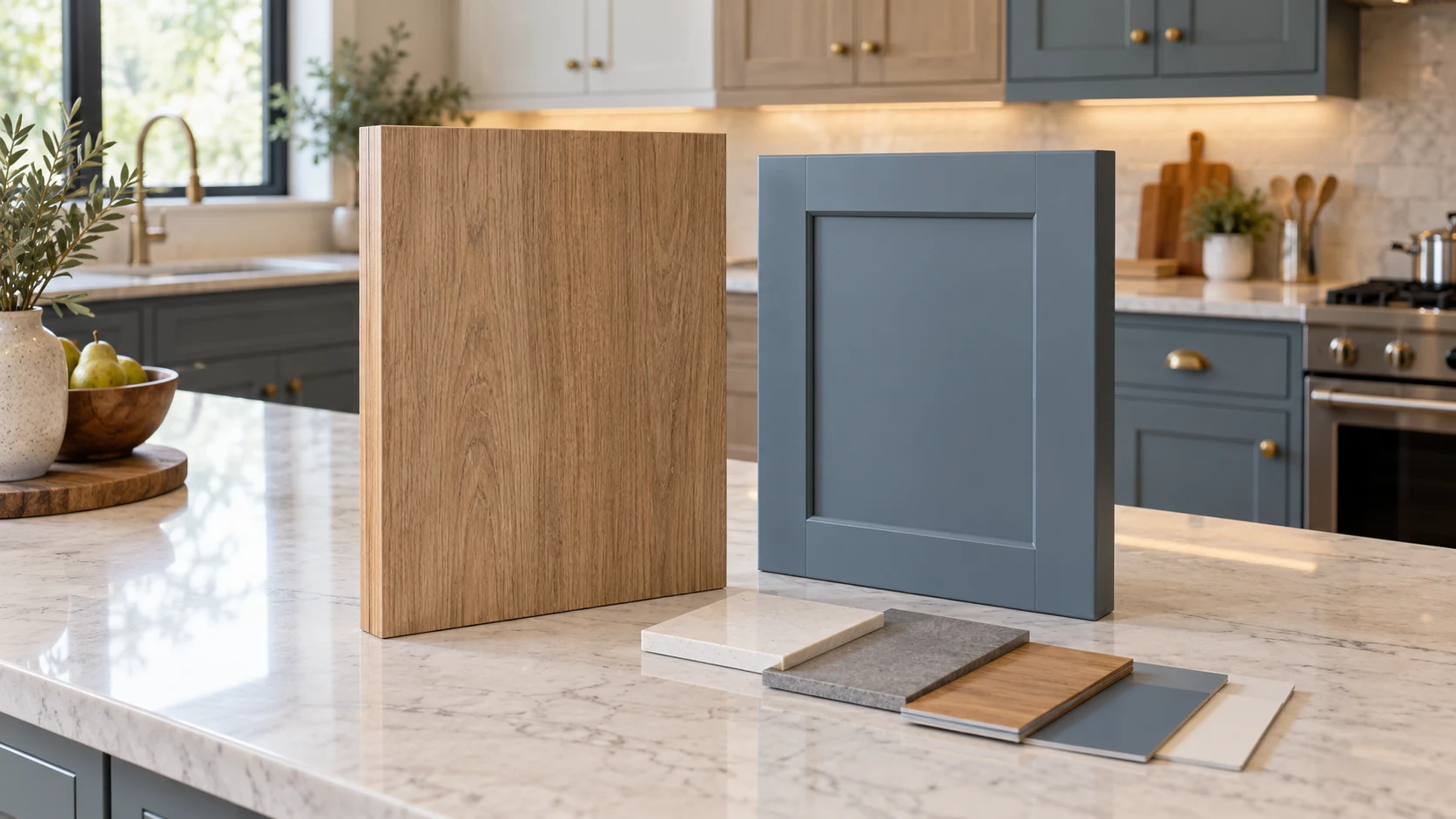
Choose laminate for a practical manufactured flat-front finish, and lacquer when a continuous coated color and shaped profile are central to the design. For either route, inspect a completed door edge and compare evidence for the identified surface.
| Your priority | Direction to consider |
|---|---|
| Practical flat fronts and a controlled budget | A suitable laminated construction with well-finished edges |
| A shaped profile with continuous painted color | A specified factory lacquer system |
| Sink-side moisture | Completed door-edge construction and relevant evidence |
| Keeping the original appearance after damage | A realistic touch-up, refinishing or replacement-front plan |
Ask every supplier for two things: the name of the actual factory coating and the finished edge construction. Compare the sample in your own lighting before committing to the color and sheen.
For a flat cabinet-front project, contact us with the door shape, desired color and sheen, and the cabinet’s location so we can discuss a silicone-faced option.
Frequently Asked Questions
What should a batch of kitchen-door samples compare?
Use the same door drawing, core, backing, edge construction and hardware preparation. Compare the identified HPL grade or lacquer build, then record wear evidence, wet-edge behavior and the agreed repair or replacement route.
Is laminate always more durable than lacquer?
No. A suitable HPL face is a practical flat-front choice, but completed-door durability also depends on the grade, coating system, edges, bond and exposure. Use comparable results for the proposed products instead of a universal material ranking.
Is super-matte laminate the same as painted MDF?
No. Super-matte laminate supplies a low-sheen factory-made facing, while painted MDF has a coating applied to a fiberboard substrate. Compare both on the same core and door shape; sheen alone does not measure scratch resistance.
Can lacquered cabinet doors be repaired?
Yes. A sound door may accept a compatible touch-up or recoat using the identified coating system. Local color or sheen differences may remain, and swollen or structurally damaged doors need more than a surface repair.
Does a smooth laminate face make a cabinet door waterproof?
No. Water can still reach the core through damaged edges, joints, cutouts or a failed bond. Compare the completed edge construction and remove repeated leaks or steam exposure as well as routine spills.