
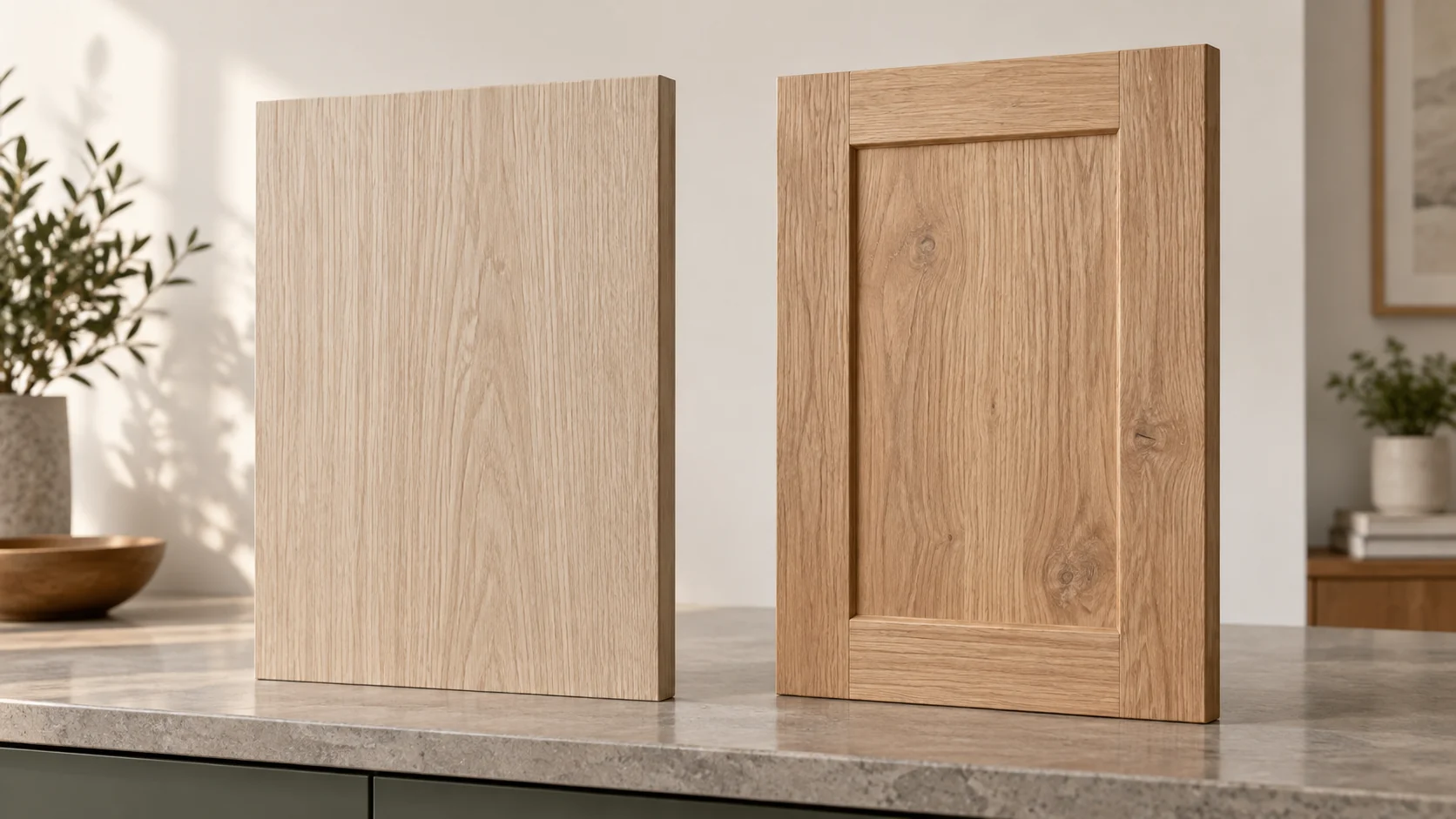
For laminate cabinets vs wood cabinets, laminate usually costs less up front, while solid wood can be sanded and refinished for years. For example, HomeAdvisor’s June 2026 guide lists stock laminate cabinets at $4,000–$15,000 and wood at $5,000–$25,000+. However, the ranges overlap, so use them for planning, not as quotes. Choose laminate for an easy-care decorative face, and wood when natural grain and future renewal matter more.
What the door is actually made of matters as much as the label. A laminate door can sit on a plywood box, and a door that looks like oak can be solid timber, real veneer or a printed surface. Find out what each cabinet is made from before you compare prices. Check how it would cope with water or a knocked corner.
What Is the Difference Between Laminate and Wood Cabinets?
Laminate is a decorative face bonded to a board; solid wood is timber all the way through; wood veneer is a thin layer of real wood on another board. All three can look like oak in a photo.
The core under a laminate face is usually MDF, particleboard or plywood, topped with decorative paper-and-resin or film, as Oppein’s laminate guide describes. Kitchen Solvers’ November 2021 comparison adds easy cleaning and uniform color to laminate’s appeal. Both name the same drawback: it’s hard to repair.
| What you compare | Laminate face | Solid wood | Wood veneer |
|---|---|---|---|
| Visible surface | Printed resin paper or a decorative film | Real timber | Thin real timber |
| Door core | Commonly MDF, particleboard or plywood | Timber; construction varies by door style | Composite board or plywood |
| Upfront cost | Often economical, with premium options | Often higher | Varies with veneer and construction |
| Appearance | Coordinated color or repeating printed grain | Natural grain and color variation | Natural grain on a panel |
| Moisture concern | Water entering edges and openings can damage the core | Humidity causes movement; standing water harms finishes | Both wood face and core need protection |
| Damage and renewal | Deep chips or peeling may require a new door | More scope for filling, sanding and refinishing | Renewal depth is limited by veneer thickness |
| Later color change | Bonding primer and paint on sound surfaces | Paint or stain, after suitable preparation | Paint or stain if the veneer permits preparation |
| U.S. emissions information | Check composite-board labeling | Check any composite parts in the cabinet | Check the composite core and finished-good labeling |
However, solid-wood doors don’t make a solid-wood cabinet. Our kitchen cabinet materials guide separates doors from boxes, shelves and other parts. Compare them one by one, so a well-built box isn’t dismissed because of its door finish.
What Are Laminate Cabinets Made Of?
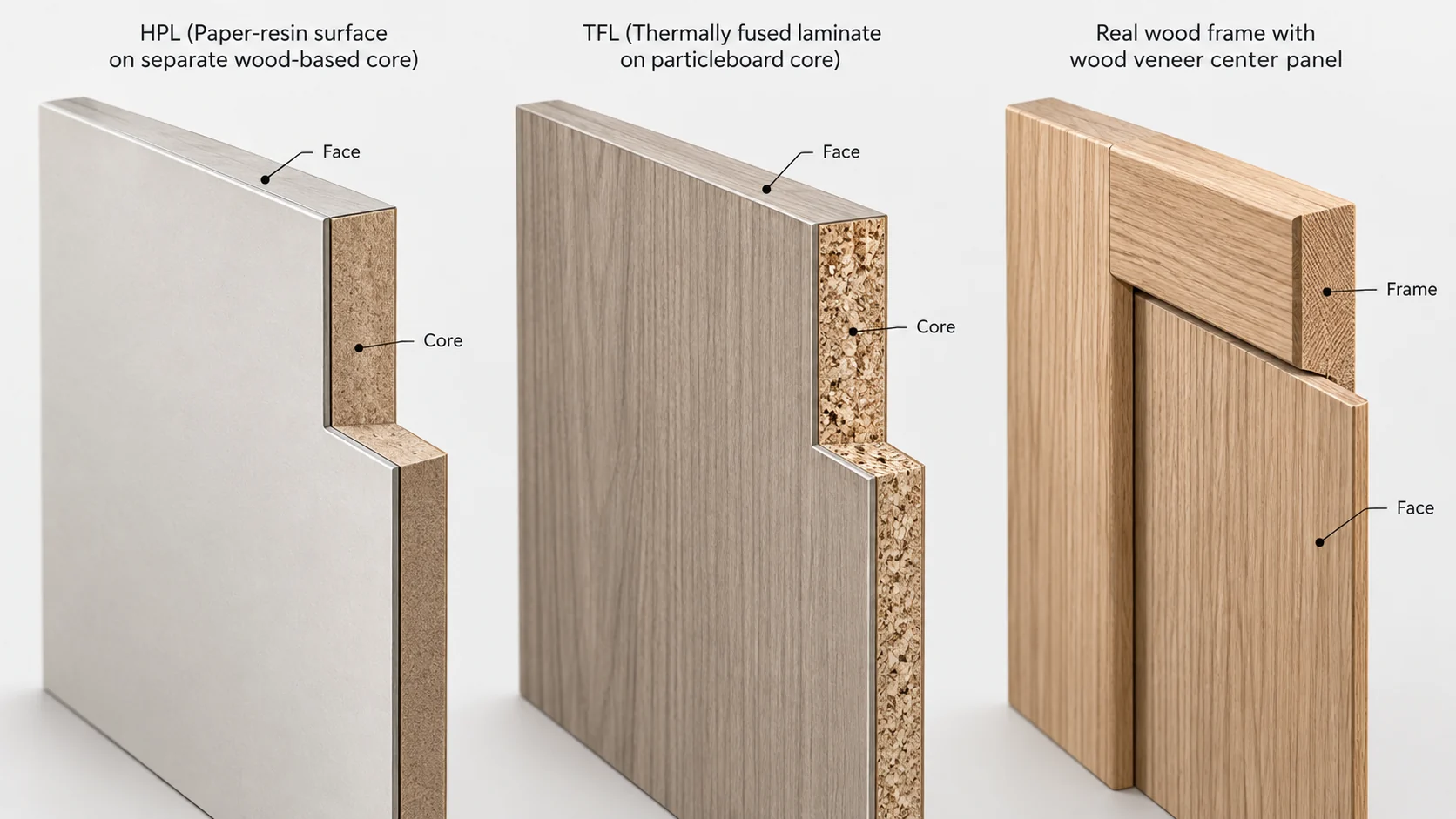
Usually TFL, HPL or a thermoplastic film over a board core. TFL is resin-treated decor paper fused straight onto the panel; HPL is made as a separate sheet and glued on; thermofoil is film formed around a shaped door.
TFL is thermally fused laminate, formerly known as melamine, according to the Composite Panel Association’s TFL definition. Its decor paper commonly weighs 60–130 g/m², and exposed edges need their own edge treatment.
In contrast, HPL is tougher. The association’s HPL overview describes resin-treated kraft and decorative layers pressed at more than 1,000 psi into sheets typically 0.028–0.048 inches thick, which are then bonded to a board. Nevertheless, the board and edges still decide how the cabinet holds up.
Shaped doors usually get thermofoil: PVC or PETG film, commonly 10–16 mils thick, formed in a vacuum or membrane press, per the CPA’s 3DL definition. It wraps contours and edges in one piece. Our thermofoil and laminate comparison explains why a wrapped door and a flat laminated panel are repaired differently.
Which Costs Less: Laminate or Wood Cabinets?
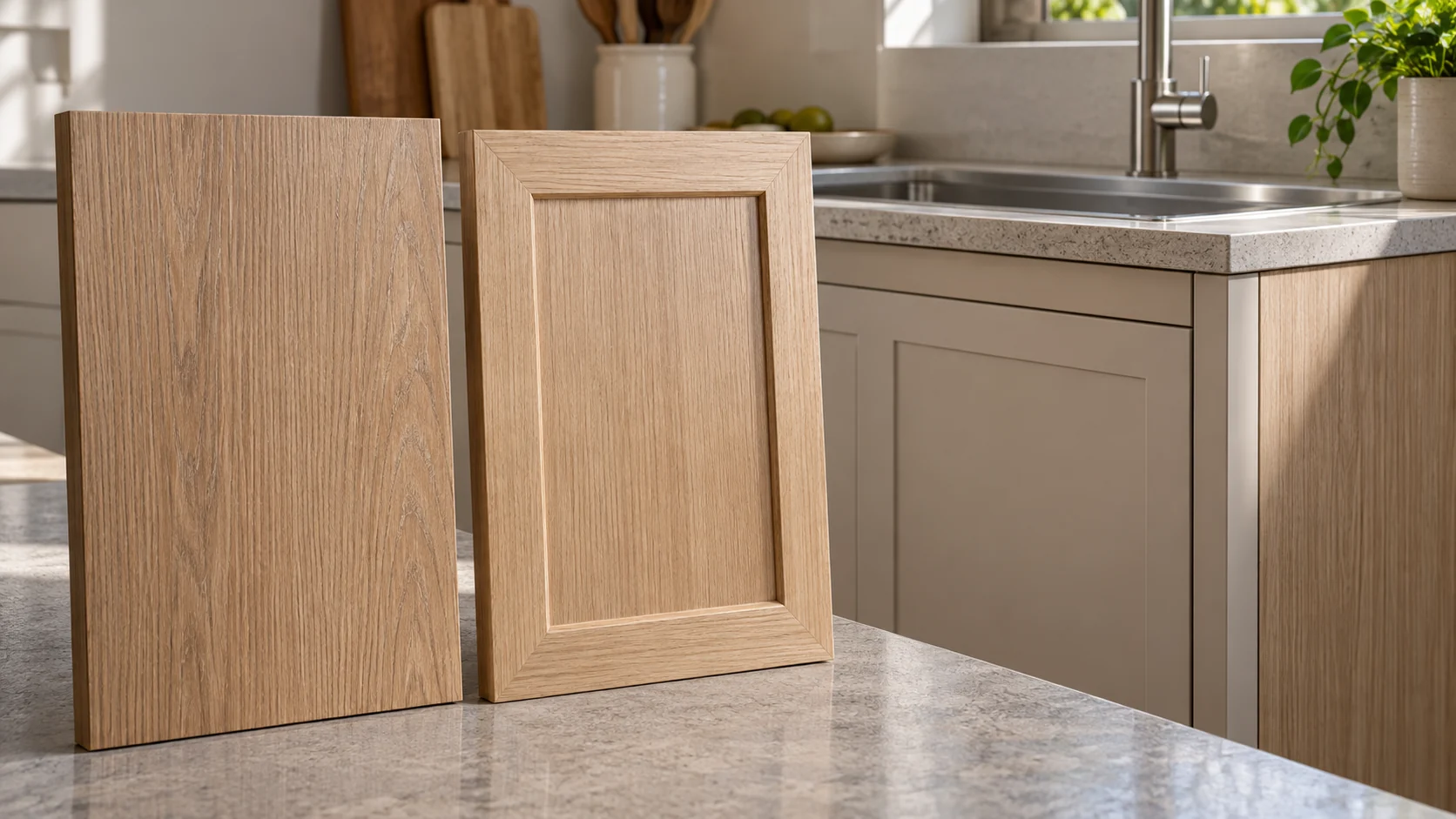
Laminate, generally, but cabinet grade and construction can matter more than the face. HomeAdvisor’s ranges overlap so much that a premium laminate cabinet can cost more than an entry-level wood or veneer one.
| Stock cabinet material | HomeAdvisor’s average-cost range | How to use it |
|---|---|---|
| Laminate | $4,000–$15,000 | Broad planning range; compare the actual cabinet scope |
| Wood | $5,000–$25,000+ | Species, door construction and cabinet grade affect cost |
| Wood veneer | $2,000–$15,000+ | Veneer and supporting construction vary widely |
Those figures come from the HomeAdvisor installation guide, updated June 20, 2026, and don’t assume a kitchen size or split out labor. However, the same guide’s national installation average of $6,189 (common range $1,935–$10,765) covers all projects, so don’t mix it with the material table.
Cabinet grade moves the price more. HomeAdvisor gives installed stock cabinets at $100–$300 per linear foot, semi-custom at $150–$650 and custom at $500–$1,200. And since materials typically make up 25%–50% of a project, according to HomeLight’s January 2026 guide, a cheaper face doesn’t cut the whole renovation by the same share.
Therefore, the only fair comparison is quotes for the same layout, boxes, doors, hardware and installation. Pull out any removal, countertop or appliance work so both quotes cover the same job.
Which Handles Kitchen Moisture Better?
Neither is immune. A sound laminate face shrugs off splashes, but water that gets past a damaged edge or a hinge hole can swell the board underneath. Solid wood swells and shrinks with humidity; its finish slows that down but doesn’t stop it.
The trouble spots are predictable: standing water, steam, and the area around sinks and dishwashers, as Oppein notes. For example, one homeowner’s September 2024 EcoCult account describes exactly that: MDF swelling and the laminate cracking on the doors under her sink. It’s one kitchen, not a failure rate, but it shows how the damage happens.
By contrast, wood behaves differently. The USDA Forest Products Laboratory’s 2021 Wood Handbook, Chapter 16 explains how wood takes in and gives off moisture as humidity changes, and how finishing every face and the end grain slows that exchange. On a timber door, seasonal movement shows at joints and gaps; on a water-damaged composite door, a swollen edge pushes the face out of shape.
Under the sink, check the underside of the door, the hinge holes and the edge seams. Fix leaks before replacing a front, wipe up standing water, and keep steam vented. Our laminate cabinet cleaning guide covers routine care. Our MDF and plywood comparison helps you judge the board underneath.
Which Is Easier to Repair When Doors Chip, Dent or Peel?
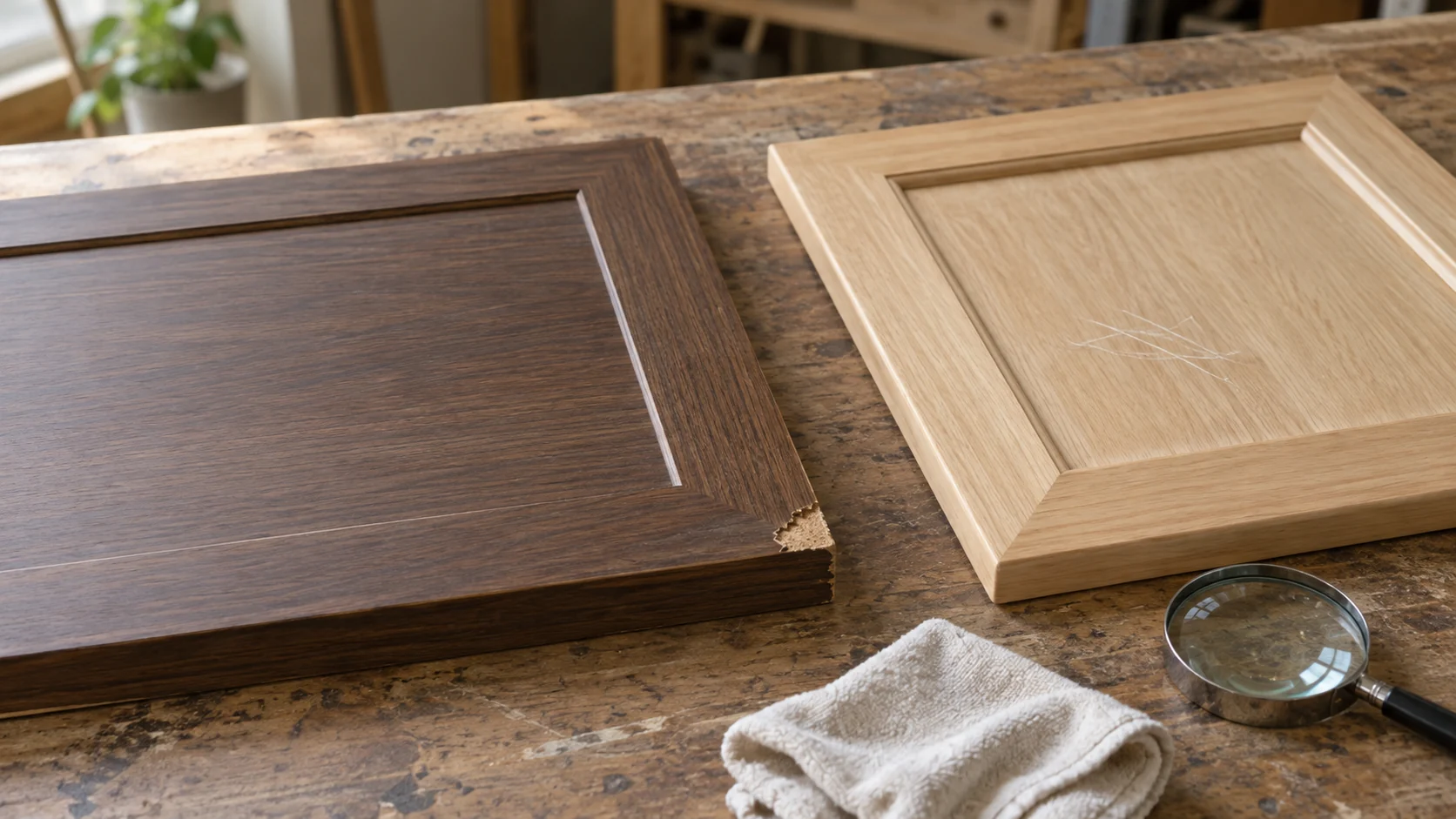
Wood. A dent or worn finish on solid timber can usually be filled, sanded and refinished. A deep chip in laminate takes part of the decorative face with it, and there’s no invisible way to put it back.
Both Oppein and Kitchen Solvers say serious laminate damage is hard to repair and often means a new door. A small lifted edge on a sound board is a different story: the Fast Cabinet Doors painting tutorial shows regluing it before painting. Swelling, widespread peeling or a missing corner is beyond that.
Before you replace fronts, check that the color is still made; an older printed decor may not match a new door, and the doors around it will have faded or worn. Wood repairs need matching too, to the species, stain and sheen, and a good result takes skill.
However, veneer sits in between. Because its real-wood face is thin, heavy sanding can break through to the core. Our wood veneer and laminate comparison covers that option if you want real grain on a composite door.
Can You Paint Laminate Cabinets Later Like Wood?
Yes, if the laminate is intact: clean it, scuff it lightly and use a bonding primer. Wood can be painted or stained, but ordinary wood stain can’t soak into a resin or plastic face.
Benjamin Moore’s laminate tutorial specifies 220-grit scuff sanding and bonding primer, enough to dull the surface without cutting through the thin face. Martha Stewart’s August 2026 cabinet tutorial explains why: paint needs something to grip on a nonporous face.
Degrease first, reglue any loose spots, and use a coating system made for the surface. Our laminate cabinet painting guide covers the preparation sequence. Painting over film that’s already peeling just glues new paint to a failing layer, and a door with a swollen core needs replacing before any color change will help.
In contrast, prepare or remove real wood’s existing finish before staining; stain won’t take over a sealed face. On MDF, paint is the right route rather than trying to stain it. Our MDF finishing guide covers its faces and thirsty cut edges.
Do Laminate Cabinets Release More Formaldehyde Than Wood?
Not necessarily. Formaldehyde in a cabinet comes mainly from the resins that bind its composite boards, so the board and the finished-goods label tell you more than whether the face is laminate or wood. MDF, particleboard and hardwood plywood fall under the U.S. TSCA Title VI composite-wood rule, including finished goods that contain them.
The EPA’s composite-wood guidance, updated February 12, 2026, lists the covered materials and the third-party certification system. Covered products have needed certification and labeling since June 1, 2018, and after March 22, 2019 the label has to say TSCA Title VI compliant. The limits match California’s Phase II composite-wood emission limits.
So look for the finished-good label on the cabinet, its packaging or the bundle: manufacturer, month and year of manufacture, and the compliance statement. Solid timber is outside this rule, but a cabinet with solid-wood doors can still have plywood boxes or other covered parts.
However, one date trips people up. EPA’s March 22, 2024 deadline for certain laminated-product producers refers to wood or woody-grass veneer on composite cores, not every plastic-faced cabinet a showroom calls “laminate.” Check the cabinet’s paperwork rather than guessing from its surface.
How Do Laminate and Wood Compare on Looks and Resale?
Laminate gives you consistent color and any printed pattern; real wood and veneer give you natural grain that varies board to board. Which looks better is your call, and neither material guarantees a resale premium.
Oppein and Kitchen Solvers both point to laminate’s uniform look and wide color range. A printed woodgrain can repeat, while real timber never quite does. Some people find printed grain unconvincing; others like the consistency. Look at several doors side by side under raking light, where texture and sheen show up.
However, on resale, Oppein says laminate may be viewed less favorably than solid wood in some markets but gives no figure. Houzz’s 2026 U.S. Kitchen Trends Study found wood-colored cabinets chosen by 29% and white by 28% of people updating cabinets. That’s a color preference among Houzz users, not a measure of solid timber or property value.
In addition, real wood changes color with light over time, as USDA’s handbook explains, so compare a replacement door against your existing kitchen, not just a fresh showroom sample. If reflections or fingerprints bother you, compare matte and gloss cabinet options too.
Where Does a Silicone-Faced Film Panel Fit Between the Two?
It’s another factory-applied face for flat doors. At Puremorfilm, we make decorative film with a silicone functional surface for flat cabinet and furniture panels; as with any laminate, the core and sealed edges still matter.
The silicone surface is inherently flame-retardant, with higher grades up to UL 94 V-0 available on request. Our film has a No DOP, formaldehyde-free formulation. In our laboratory tests, coffee, red wine, ice cream and soy sauce left for 24 hours at 25°C wiped away with no obvious change.
On moisture, worked examples described in the patent application showed no delamination or blistering after 12 hours in boiling water, or after 500 hours at 85°C/85% RH. That’s the film itself; the board and edges still decide how a door copes with water.
We supply mainly rolls and can provide film-faced panels on request, laminated flat with PUR adhesive. It’s a paint-free finish with a silicone functional face, distinct from PVC, melamine, PP and PETG decorative faces. Our furniture decorative film describes it in more detail.

Should You Choose Laminate or Wood Cabinets?
Choose laminate when price, consistent looks and easy cleaning come first; choose wood when natural grain and the option to refinish matter more. Either way, check the edges and construction wherever water and heat reach.
| Your situation | Choice to consider | Practical check |
|---|---|---|
| A restrained budget or rental refresh | A well-made laminated cabinet | Compare the whole cabinet and installation scope |
| Natural grain and later color changes | Solid wood, or suitable real veneer | Confirm the face construction and renewal limits |
| Sink or dishwasher exposure | Protected edges and a suitable core in either route | Inspect seams and fix leaks or repeated steam exposure |
| Frequent handling and occasional impacts | Durable laminate, or repairable timber | Weigh surface wear against the repair route for a chip or dent |
| A shaped, continuously faced door | A documented thermofoil construction | Assess nearby heat and the film bond |
Work through the decision in three steps:
- Price the same layout, boxes, doors and installation in both materials, using the ranges above only for planning.
- Check the door and box construction where water and heat reach them: the sink base, the dishwasher side and the oven run.
- Bring a full door sample into your kitchen and compare it against the worktop, floor and light. For a flat silicone-faced panel option, contact us with the door dimensions and quantity, profile, intended location and preferred texture or sheen.
Frequently Asked Questions
How long do laminate cabinets last?
Oppein estimates 10–15 years for laminate with regular care and 20–30 years or more for solid wood. InterNACHI gives a general 50-year estimate for kitchen cabinets without splitting them by material. Water damage, edge condition and care change the real figure for your doors.
Can you make cabinets out of MDF?
Yes. MDF is common for cabinet doors and as the board under painted, laminated and thermofoil faces. Its smooth surface suits those finishes, but keep its edges dry, because a swollen MDF core is hard to repair.
What is better, veneer or laminate?
Veneer if you want real grain and some ability to refinish; laminate if you want coordinated decor and easy care, often for less. Either way, check the veneer thickness and finish, or the laminate’s construction and edges.
Can I stain laminate cabinets?
No. Ordinary wood stain can’t soak into a resin or plastic face the way it soaks into timber. A compatible primer and paint can change the color of sound laminate after preparation.
Are high-end laminate cabinets worth it?
Yes, if the face, board and edges suit your kitchen and the price holds up against complete alternatives. HPL is a durable face, but a deep chip can still mean a new door; paying more doesn’t make laminate sandable like solid wood.